
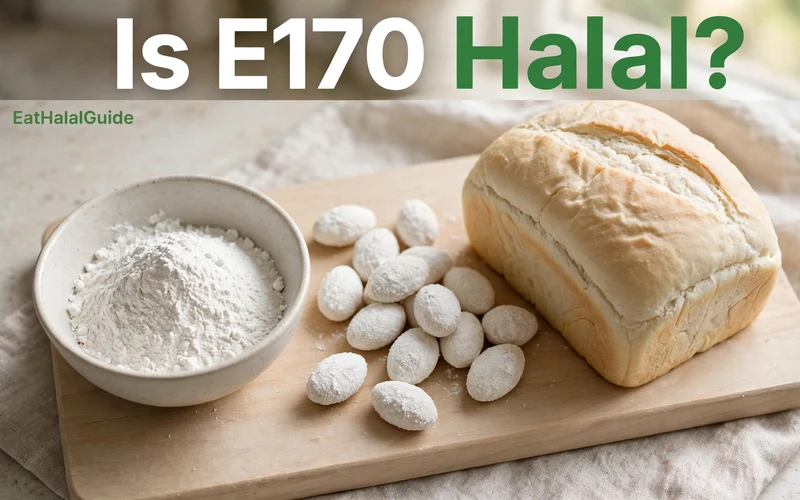

Is E170 halal? Mushbooh — doubtful — is the honest answer for the code on a label. Calcium carbonate is a mineral, mined as limestone, chalk or marble, and the standard food-grade supply is ground rock or the same compound precipitated in a factory. But MUIS marks E170 doubtful: it “may be extracted from naturally occurring white mineral or animal bones”. The label never says which.
So is calcium carbonate halal? From mineral limestone or precipitated production, yes. Without a halal mark, you cannot tell from the packet whether the white powder came from a quarry or from bones.
Quick Answer
| Form | Verdict |
|---|---|
| E170 on a label, source unstated | Mushbooh — the source is unconfirmed |
| E170 from limestone, chalk, marble or precipitated | Halal |
| Product with a recognised halal mark | Halal |
| Liquid colour preparation, solvent unstated | Mushbooh — the solvent has to be halal |
MUIS marks E170 doubtful; no route involves pork — the doubt is source ambiguity.
What is E170?
The e170 food code is the European code for calcium carbonate, Codex number INS 170(i) — a white colour, acidity regulator, anti-caking agent, firming agent and calcium fortifier with formula CaCO3. It is also called chalk, and appears as CI 77220 or Pigment White 18.
Since the EU banned titanium dioxide (E171) in food in 2022, makers have switched white coatings to E170. Unlike our E160b guide and E162 guide, which cover plant colours, E170 is a mineral colour: rock, not a plant extract.
Where does E170 come from?
This is the whole question behind “is calcium carbonate halal”.
| Part | Source | Verdict | Why |
|---|---|---|---|
| Ground limestone, chalk or marble | Mined mineral | Halal | Rock — no animal involved |
| Precipitated calcium carbonate (PCC) | Factory precipitation | Halal | Chemical process, no biological origin |
| Oyster shells, eggshells, coral | Shells and eggs | Halal by most scholars | Sea creatures are permitted by the majority; Hanafi scholars differ on eating shellfish, but most treat mineral calcium from a shell differently |
| Animal bones | Extraction (MUIS remark) | Mushbooh | The label names the code, not the extraction source |
| Liquid colour preparations | Solvents of unstated origin | Mushbooh | The solvent has to be halal, and the label never says what it is |
The EU specification defines E170 as ground limestone or a precipitate of calcium and carbonate ions — mineral only. The US regulation names three manufacturing methods, all chemical. EFSA’s 2023 re-evaluation recommended the definition name the source material outright: limestone. The standard supply is mineral; the bone route is only a possibility MUIS names, not a confirmed current practice.
What the scholars say
No fatwa rules on E170 itself. IslamQA’s AskImam 19202 (Darul Iftaa) opens with “Most ‘E-number’ ingredients are halaal for consummation”, names four haram codes — E120, E441, E542, E904 — and a mashbooh list from E1405 to E921. E170 is in neither list, and not in the questioner’s list either.
Its general principle governs: ingredients “will be permissible if derived from plant, vegetable, or synthetic sources. They will not be permissible if derived from animal sources.” E170 is a mineral, so the principle applies by analogy — limestone is not an animal source; the bone extraction MUIS names would fall on the impermissible side. MUIS’s asterisk is the operative ruling: syubhah, doubtful.
SANHA’s own E170 entry lists it as Halaal, from mineral sources — the mineral route, in other words. The liquid-solvent caution (mushbooh as a liquid, because the solvent has to be halal) comes from a secondary reproduction of the SANHA-derived list, not from SANHA’s own entry — see “What we could not verify”.
Which foods contain E170?
In the UK, the biggest source is one most shoppers never notice: the law. The Bread and Flour Regulations 1998 require calcium carbonate in non-wholemeal common wheat flour — 235 to 390 mg per 100 g, rising to 300–455 mg in England from 13 December 2026. So E170 is in almost every loaf of UK bread. Wholemeal flour is exempt.
Beyond flour: white-coated confectionery, chewing gum, baking powder, breakfast cereals, calcium supplements, antacid tablets, toothpaste, canned vegetables and fortified plant milks. A halal mark settles the whole product; a vegan label settles this code. E170 in bread does not make the bread halal — check the rest of the label too; see our E471 guide.
The safety note
JECFA set an acceptable daily intake of “not limited” in 1965. EFSA’s 2011 re-evaluation agreed with a group ADI of “not specified” for carbonates, and its 2023 follow-up found no safety concern at current use levels for all population groups, including infants below 16 weeks. The one caveat was aluminium: EFSA said the unavoidable aluminium in E170 needs tighter purity limits. The US FDA lists it as GRAS under 21 CFR 184.1191. None of this is a halal ruling.
How to check your label in 30 seconds
- Find it — “E170”, “calcium carbonate”, “chalk” or “CI 77220”.
- Check for a halal mark — it audits every additive’s source.
- Check for a vegan label — it rules out the bone and shell routes.
- Check the rest of the label — if gelatin appears, see our Gelatin guide.
- If in doubt, ask the maker which source it uses — mineral, shell or bone.
See Also: E-Code Database
Frequently asked questions
Is E170 halal?
Mushbooh — doubtful — when the source is unstated. MUIS marks it doubtful because it may come from white mineral or animal bones, and the label never says which. Mineral limestone or precipitated E170 is halal; a halal mark or a vegan label settles it.
Is calcium carbonate halal in bread?
The calcium carbonate is the same question as anywhere else — Mushbooh without a stated source, halal from mineral limestone. But UK law requires it in non-wholemeal wheat flour, so avoiding E170 means avoiding ordinary UK bread. A halal mark on the loaf settles the whole product.
Is E170 halal in the USA, UK and Canada?
Authorised in all three — the US FDA lists it as GRAS, the EU and Great Britain authorise E170, and Canada permits it. The halal question is the source, and it is the same in all three.
Does E170 make a product halal?
No. E170 being halal says nothing about the rest of the packet. Judge the whole list, or look for a halal mark.
Final Thoughts
E170 is the same problem as our E270 guide: one code, several sources, a label that hides which. With lactic acid the dairy route is common; with calcium carbonate the mineral route is the standard supply and the bone route is only a possibility MUIS names. MUIS still marks it doubtful — the honest verdict for an unlabelled packet. A halal mark or a vegan label turns it into a yes.
Sources & Verification
| # | Source | What it says | Status |
|---|---|---|---|
| 1 | MUIS — Food Additive Listing, Halal Certification Strategic Unit, last updated 13 Sep 2016, muis.gov.sg | “170 Calcium Carbonate/Chalk (C.I. 77220) — Inorganic colouring — May be extracted from naturally occurring white mineral or animal bones” — the asterisk means “Syubhah / Doubtful (either by way of its source or manufacturing process)”. | Verified — opened directly 2026-11-21 |
| 2 | Commission Regulation (EU) No 231/2012, legislation.gov.uk | “E 170 CALCIUM CARBONATE… Definition: Calcium carbonate is the product obtained from ground limestone or by the precipitation of calcium ions with carbonate ions.” Synonyms: CI Pigment White 18; Chalk. Colour Index No 77220. Assay: content not less than 98% on the anhydrous basis. | Verified — opened directly 2026-11-21 |
| 3 | 21 CFR 184.1191 — Calcium carbonate, law.cornell.edu (e-CFR) | “Calcium carbonate (CaCO3, CAS Reg. No. 471-34-1) is prepared by three common methods of manufacture: (1) As a byproduct in the ‘Lime soda process’; (2) By precipitation of calcium carbonate from calcium hydroxide in the ‘Carbonation process’; or (3) By precipitation of calcium carbonate from calcium chloride in the ‘Calcium chloride process’.” GRAS as a direct human food ingredient. | Verified — opened directly 2026-11-21 |
| 4 | WHO JECFA database — Calcium Carbonate, apps.who.int; FAO JECFA monograph, fao.org | “Evaluation year: 1965. ADI: NOT LIMITED.” Monograph: “An ADI ‘not limited’ was established at the 9th JECFA (1965).” Synonyms: Chalk; INS No. 170(i). CAS 471-34-1. Assay not less than 98.0% after drying. | Verified — opened directly 2026-11-21 |
| 5 | EFSA — Re-evaluation of calcium carbonate (E 170) as a food additive, EFSA Journal 2023;21(7):8106, efsa.onlinelibrary.wiley.com | “Calcium carbonate is an inorganic salt with CAS Registry Number 471-34-1, Colour Index No. 77220.” No safety concern at current use levels for all population groups including infants below 16 weeks; no need for a numerical ADI. The definition “should include the source material of the calcium ions i.e.: limestone”. Aluminium in E170 needs tighter purity limits. | Verified — opened directly 2026-11-21 |
| 6 | IslamQA (Hanafi) — E-numbers answer, AskImam 19202 (Darul Iftaa; Ml. Asif Umar; checked and approved by Mufti Ebrahim Desai) | “Most ‘E-number’ ingredients are halaal for consummation.” The outright haram list is only E-120, E-441, E-542 and E-904; the mashbooh list runs E1405–E921. E170 appears in neither list — and not in the questioner’s list either. “Other ingredients such as glycerol will be permissible if derived from plant, vegetable, or synthetic sources. They will not be permissible if derived from animal sources.” | Verified — opened directly 2026-11-21 |
Last verified: 2026-11-21
What we could not verify
- SANHA: an E170-specific entry was found on re-check 2026-11-21 — SANHA lists E170 (Calcium Carbonate) as Halaal, source “minerals argonite, calcite & vaterite” (sanha.org.za/2009/12/16/e170-calcium-carbonate/, dated 16 December 2009). The old direct E-number URL (sanha.org.za/view.php?enumber&ing_id=170) still returned HTTP 404 on 2026-11-21. The liquid-solvent mushbooh line comes from a secondary reproduction of the SANHA-derived E-number list (WorldOfIslam PDF), not from SANHA’s own entry.
- IFANCA, JAKIM and HFA: no E170-specific statement from any of the three. A secondary guide claims IFANCA and JAKIM list E170 as halal, but cites no document — NOT repeated as verified.
- halalharams.com: no E170 page surfaced in search.
- The competitor’s certifier claim: halalcodecheck.com states its E170 classification is “checked against recognised halal certification bodies” and that the additive is “typically derived from plant or synthetic sources” — no evidence cited for either, and the plant claim contradicts the EU definition. Neither is repeated as fact.
- Any specific batch or product: no maker states its calcium carbonate source; no product-level check was done.
- PAA: no People Also Ask block appeared for “is e170 halal” in search on 2026-11-21.


