E471 is the emulsifier in your sliced bread, margarine, ice cream and chocolate — and is e471 halal has no answer you can read off the packet. The code is the same whether the fat came from palm oil or pork lard, and no food law in the US, UK or Canada makes the maker say which. That is the whole problem with E471: Mushbooh until the source is known.
This guide is the first of our three E-code deep guides — E471, then E621 and E120.
Quick Answer
Mushbooh by default — the source decides, and the label never names it. E471 made from plant oils (palm, soybean, rapeseed, sunflower) or made synthetically from a stated plant source is Halal. E471 made from pork fat is Haram. E471 made from non-zabiha animal fat, such as ordinary beef tallow, is Haram on the precautionary position most certifiers take. A product carrying a recognised halal mark is Halal — the mark settles the whole product, including its E471. One scholarly position disagrees: the European Council for Fatwa and Research, cited by Islamweb, holds that foods with E471 are permissible unless proven forbidden. Both positions are reported below — neither as the consensus.
E471 at a glance
| Item | Detail |
|---|---|
| Code | E471 (INS 471) — mono- and diglycerides of fatty acids |
| What it is | An emulsifier: a mixture of glycerol mono-, di- and triesters of fatty acids |
| Also called | Mono- and diglycerides; glycerol monostearate (the common mono form); in the US, “mono- and diglycerides” (no E-number on the label) |
| What it does | Keeps oil and water mixed; keeps bread soft, margarine spreadable, ice cream smooth |
| Plant source | Palm, soybean, rapeseed or sunflower oil — Halal |
| Synthetic source | Made from glycerin and fatty acids — Halal if the source is stated plant, Mushbooh if unstated |
| Pork source | Lard — Haram |
| Non-zabiha animal source | Ordinary beef tallow — Haram on the precautionary position |
| Unknown source | Mushbooh — MUIS marks it Syubhah (doubtful); SANHA lists it Mushbooh; IFANCA lists it questionable |
| Certified product | Halal — a recognised halal mark settles it |
| Where it hides | Bread, buns, margarine, shortening, ice cream, chocolate, peanut butter, cakes, custard, baby rusks and follow-on formula |
| Safety | EFSA (2017): no numerical ADI needed, no safety concern at reported uses; JECFA (1973): ADI “not limited” — safety is not a halal ruling |
What is E471?
E471 is short for mono- and diglycerides of fatty acids. A fat is a triglyceride: three fatty-acid chains on one glycerol molecule. E471 is what you get when that fat is rearranged with extra glycerol, so some molecules carry one chain and some carry two. The result has one end that likes water and one that likes oil — an emulsifier, holding together mixtures that would otherwise split.
The law defines it by what it is, not where it came from. The EU specification (Commission Regulation (EU) No 231/2012) calls it “mixtures of glycerol mono-, di- and triesters of fatty acids occurring in food oils and fats” — no species named. The FDA’s rule, 21 CFR 184.1505, says mono- and diglycerides are “prepared from fats or oils or fat-forming acids that are derived from edible sources”. Neither requires the maker to say whether the fat was palm oil or pork lard. That silence is the halal question.
The fats are ordinary ones: palm, soybean, rapeseed and sunflower oil on the plant side; beef tallow and pork lard on the animal side. It can also be made synthetically, from glycerin and fatty acids — but “synthetic” settles nothing, because the glycerin and fatty acids can come from either side. Our Is E422 Halal or Haram? guide covers glycerol itself. E471 inherits that problem twice over.
Is E471 halal?
Ask is e471 halal and the answer starts with the source, because the code itself carries no information about it. The same four characters sit on a loaf made with palm oil and a loaf made with tallow, and the two are indistinguishable from the label. That is why no single verdict is given here either. The mono and diglycerides halal question is really a question about the fat they were made from.
Plant-derived E471 is halal: IFANCA says plainly that “when derived from vegetable sources, they are halal”. Pork-derived E471 is haram — no authority disputes that, and HalalCodeCheck’s baby-food guide says it outright: porcine E471 is haram “without any qualification”. Non-zabiha animal fat is where the precautionary position bites: IFANCA calls animal-derived mono- and diglycerides “questionable”, and Darul Iftaa Birmingham holds that E471 should be avoided if its origin is in doubt and not stated on the packaging. Factory beef tallow is not zabiha-slaughtered.
Unknown source is the case that matters, because it is the case on nearly every packet — and the next section shows all three authorities agree.
A recognised halal mark settles it without asking the maker, because certification audits the source. So does a label stating “100% vegetable mono- and diglycerides”. What does not settle it is the bare code, the word “emulsifier”, or a kosher mark: kosher rules do not ask whether the animal fat was zabiha. Our What Is Halal Food? guide explains Mushbooh.
What the certifiers and scholars say
The authorities agree on the shape of the answer and differ on the default — the question at the heart of is e471 halal in islam — so it is stated here in full rather than smoothed over.
MUIS is the clearest on the listing itself. Its Food Additive Listing (last updated 13 September 2016) carries the entry “471 Mono-and Diglycerides of Fatty Acids*” with the asterisk meaning Syubhah/Doubtful. MUIS calls it doubtful — not halal, not haram — and says the E-number alone cannot decide it.
SANHA names the check. Its E471 page (published 2009, updated July 2023) gives the status as Mushbooh and the source as “synthetically from glycerin and fatty acids. Check source of these.” It also notes that “Citrol EGMS is halaal” — one named product, not a general clearance.
The scholars say the same in fatwa form. IslamQA (Hanafi), in an answer by Mufti Abdullah Patel, asks “What are diglycerides and fatty acids and are they halal?” and answers: “If they are from animal ingredients then they would be impermissible otherwise not.” Sheikh Ahmad Kutty (AboutIslam, September 2025) says E-codes like E471 “are not automatically haram. Their ruling depends on the source”.
Then there is the other side, and it is a real side. Islamweb’s fatwa 387325 answers a question naming “e471, e472” in “chocolates, bread, cookies etc” where “we don’t know either they are vegetable basis or pork basis”. Its answer: “the foods to which this ingredient is added are permissible unless it is proven that they are forbidden. Doubting its permissibility does not necessitate its prohibition.” The fatwa cited is from the European Council for Fatwa and Research (ECFR). That is the permissive default, against the precautionary default.
Two things were not found: no E471-specific statement from the Halal Food Authority (HFA), the Halal Monitoring Committee (HMC) or JAKIM, and no named halal certificate for a specific E471 product from any manufacturer.
The vegetarian label question
Does a “suitable for vegetarians” label settle E471? The guides contradict each other on it.
HalalCodeCheck says both things. Its baby-food page says a vegetarian label does NOT rule out animal-derived E471, because the Vegetarian Society classifies mono- and diglycerides as processing derivatives rather than animal derivatives. Its own Haram E-Numbers page says the opposite: that a “suitable for vegetarians/vegans” disclosure “confirms a plant source”. HalalSpy agrees with the second side. One competitor, two answers.
The scholars’ answer, verified directly, is on the second side. IslamQA’s Foodguide answer, on the same page as Mufti Patel’s diglycerides ruling, says a ‘suitable for vegetarians’ emblem “would ensure that these ingredients are suitable for Muslims since they can not be from any animal source.” It adds one caveat: a vegetarian product could still contain alcohol, so “only the alcohol content need be checked”.
What was not verified is the claim at the centre of that argument: the Vegetarian Society’s own classification. Its wording was not found on the Society’s site. The practical rule: a vegetarian or vegan mark is good evidence the E471 is plant-based, because the mark is audited against the ingredients. It is not a halal mark.
Is E471 in bread halal?

Bread is the food this question is asked about most. Is e471 in bread halal? The same rule, applied to a loaf: halal if the E471 is plant-derived or the loaf carries a halal mark, haram if the fat is pork or non-zabiha animal, Mushbooh if the label says nothing more than “emulsifier: E471”. See our E170 guide.
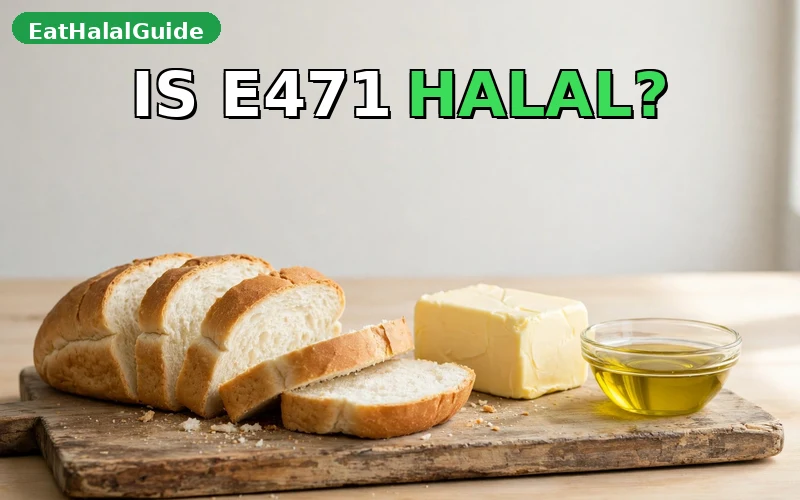
Sliced bread is where most people meet E471: it keeps the crumb soft and slows staling. A typical list reads “emulsifier: mono- and diglycerides of fatty acids (E471)” with no source given — the standard case, and the standard verdict: Mushbooh until the maker is asked. Some loaves state the source: “from vegetable origin” settles it, and a vegetarian or halal mark settles it more firmly still. Buns, rolls, pitta and naan use the same emulsifier. That is the whole answer to is e471 in bread halal: the mark, the stated source, or the maker.
One competitor’s UK bread guide names brands as Mushbooh or Halal, but cites no manufacturer confirmation. They are that competitor’s claims, not verified facts.
Margarine, ice cream, cakes and custard mixes use it too. Chocolate uses it alongside lecithin — our Is Chocolate Halal or Haram? guide explains the codes to check in a bar, and our Is KitKat Halal or Haram? guide records E471 on no KitKat label retrieved. Our Is Roshen Halal or Haram? guide shows the same pattern in sweets: most Roshen lines are clean, but the Yummi Gummi Twists list E471 with shellac and are not halal.
E471 in the USA, UK and Canada
The code is the same in all three countries. The label is not.
In the USA, you will rarely see “E471” at all: American labels use the name, not the number — “mono- and diglycerides”. The FDA’s rule, 21 CFR 184.1505, affirms mono- and diglycerides as GRAS and defines them only as “prepared from fats or oils or fat-forming acids that are derived from edible sources”. No species, no source, no requirement to state one. So is e471 halal in usa comes down to the same check, with one extra step: first recognise the ingredient under its American name.
In the UK, the label says “E471”, and the law requires the code to be listed but not its source. That is the whole of the UK problem. The UK’s advantage is the density of vegetarian and vegan marks on supermarket shelves — a “suitable for vegetarians” mark, per the scholars’ answer above, is good evidence the E471 is plant-based. Ask is e471 halal in uk about a specific loaf, and the answer is the mark on that loaf, not a general rule about British bread.
Canada is the gap in this article: no Canada-specific halal ruling or label rule for E471 was found. The Canadian position is recorded as unverified rather than guessed.
The E472 family and related codes
The E472 codes — E472a to E472f — are esters of mono- and diglycerides: E471 with an extra acid attached. Because they are made from E471, they inherit its source question exactly. If a label lists E472e (DATEM, standard in bread), apply the E471 check to it.
E422, glycerol, is the other half of the E471 molecule, and our Is E422 Halal or Haram? guide shows it carries the same three-source problem. The 2023 EU amendment ties the two together: the glycerol used to make E471 must now comply with the E422 specifications. E476, PGPR, is the other emulsifier most often confused with E471 — our Is E476 Halal or Haram? guide rates it Mushbooh for the same reason. Gelatin, E441, is the parallel case, covered in our Is Gelatin Halal or Haram? guide. Our E-Code Database hub lists E471 as a deep guide “coming next”.
See Also: Is E320 (Butylated Hydroxyanisole) Halal or Haram? — the antioxidant that turns up in the same cereals, cookies and baked goods, where the same unnamed-carrier question decides the verdict.
Is E471 safe?
Short answer: yes, on the safety evidence — and that is a different question from halal. EFSA’s 2017 re-evaluation concluded there was “no need for a numerical acceptable daily intake (ADI)” and that E471 “was of no safety concern at the reported uses and use levels”. JECFA set its ADI as “not limited” in 1973. Regulation (EU) 2023/1428 (July 2023) has since tightened the specification: lower metal limits, plus limits for 3-MCPD, glycidyl esters and erucic acid.
None of that is a halal ruling. EFSA and JECFA assess toxicity, not source. E471 is not a health scare. It is a sourcing question.
How to check any product in 30 seconds
Five checks. First, the halal mark — a recognised logo settles the whole product, including its E471. Second, the source wording — “100% vegetable mono- and diglycerides” or “from vegetable origin” settles the code itself. Third, the vegetarian or vegan mark — good evidence the E471 is plant-based, but still check for alcohol in cakes and puddings. Fourth, the American name — in the US it is listed as “mono- and diglycerides” with no E-number, so look for the words, not the code. Fifth, the maker — if none of the above is on the pack, ask the manufacturer, and treat an unstated source as Mushbooh until they answer. The mono and diglycerides halal question has no shortcut past the source.
Frequently Asked Questions
Is E471 halal? Mushbooh by default: halal from plant oils or a stated plant source, haram from pork or non-zabiha animal fat, doubtful when the label is silent. A halal mark settles it.
Is E471 halal in the UK? The same as everywhere: Mushbooh unless the source is stated or the product is certified. UK labels must list the code but not its source. A vegetarian mark is good evidence; a halal mark settles it. Ask is e471 halal in uk about a specific loaf — the mark on that loaf is the answer.
Is E471 halal in the USA? The same rule, under a different name: US labels say “mono- and diglycerides”, not E471. The FDA affirms it as GRAS under 21 CFR 184.1505 without requiring the source to be named. Ask is e471 halal in usa about a US product the same way — look for “100% vegetable” wording or a halal mark, and ask the maker if neither is there.
Is E471 always from pork? No. It can be made from palm, soybean, rapeseed or sunflower oil, from beef tallow, from pork lard, or synthetically. No primary source states the share — “most of it is plant-based” is repeated by every guide and cited by none.
Does a vegetarian label make E471 halal? On the scholars’ answer verified for this article, yes in substance: IslamQA’s Foodguide answer says a ‘suitable for vegetarians’ emblem “would ensure that these ingredients are suitable for Muslims since they can not be from any animal source” — with the caveat that the alcohol content still needs checking. One competitor claims otherwise; the Society’s own wording was not verified.
What is the difference between E471 and E472? E472a to E472f are esters of E471. They inherit its source question exactly. E472e (DATEM) is the one you will see most, in bread.
Final Thoughts
E471 is the hardest E-code to write a short verdict for, and that is the point. It is not haram in itself — palm oil is halal — but the code hides exactly the fact a Muslim shopper needs, and no food law in the US, UK or Canada requires it to be shown. MUIS calls it Syubhah, SANHA calls it Mushbooh, IFANCA calls it questionable, and the scholars say the source decides. The one real disagreement is the default — avoid until proven, or permit until proven forbidden — and this article has given you both positions with their names on them, because that choice — the heart of is e471 halal in islam — belongs to you and your scholar, not to a food blog.
What would fix E471 is a label that says “vegetable mono- and diglycerides” or a halal mark on the pack.
What we could not verify
- HFA, HMC and JAKIM: no E471-specific statement was found from any of the three — do not cite them for E471.
- The Vegetarian Society’s classification: claimed by HalalCodeCheck’s baby-food page, not verified from the Society’s site.
- The plant-vs-animal split: no primary source states the plant-vs-animal share. No percentage or “most” claim is made here.
- Any named halal certificate for a specific E471 product: none was found. Palsgaard’s “Halal-certified” claim is range-level only, with no certificate number named.
- Canada: no Canada-specific halal ruling or label rule for E471 was found.
- Brand-level E471 verdicts: no manufacturer confirmation was obtained for any specific brand.
- The “~291 traffic/month” figure: the task brief’s figure for a HalalCodeCheck E471 page could not be verified — a standalone HalalCodeCheck E471 guide was found live on 2026-11-20, but no traffic figure is shown on it. It is not used here.
Sources & Verification
| # | Source | What it says | Status |
|---|---|---|---|
| 1 | MUIS — Food Additive Listing, Halal Certification Strategic Unit, last updated 13 Sep 2016, muis.gov.sg (PDF) | “471 Mono-and Diglycerides of Fatty Acids* Emulsifier/Stabiliser — Commercially prepared from glycerin (E422) and fatty acids”. Legend: “* Syubhah / Doubtful (either by way of its source or manufacturing process)”. “The above list serves as a general guideline and not limited to and/or conclusive.” | Verified — opened directly 2026-11-20 |
| 2 | MUIS — “Is there a definite halal or non-halal emulsifier?”, ask.gov.sg/muis | “There is no definite halal or non-halal emulsifier based on the E-number alone. For example, E471 can be halal or non-halal depending on its source and manufacturing process.” Foods: “margarine, ice cream, chocolate and baked goods”. | Verified — opened directly 2026-11-20 |
| 3 | SANHA — E471 (Glyceryl Monostearate), sanha.org.za (published 2009-12-17, updated 2023-07-24) | “Status: Mushbooh — Source: synthetically from glycerin and fatty acids. Check source of these. Citrol EGMS is halaal.” Health Code Green — safe in food use. Uses: “Cakes, hot chocolate mix, sponge puddings, margarine, ice cream, quick custard mix”. | Verified — opened directly 2026-11-20 |
| 4 | IFANCA — “Are mono- and diglycerides halal?”, ifanca.org/faqs | “Mono and diglycerides can be derived from animal or vegetable sources. When derived from vegetable sources, they are halal. When derived from animal sources, they are questionable… Halal consumers should avoid products containing mono- and diglycerides unless they are labeled as 100% vegetable mono- and diglycerides.” Uses: “baked goods, peanut butter, margarine, shortening, and other products”. | Verified — opened directly 2026-11-20 |
| 5 | IFANCA — “E-numbers: what should Muslim consumers know?”, ifanca.org/resources | “Some E-numbers that are questionable for Muslims are E471 (mono-and diglycerides), E491 (sorbitan monostearate), and E570 (fatty acids). The E470’s consist mostly of fatty acid derivatives and fatty acids which are questionable as they may be derived from vegetable or animal sources.” | Verified — opened directly 2026-11-20 |
| 6 | IslamQA (Hanafi) — “What are diglycerides and fatty acids and are they halal?”, Mufti Abdullah Patel, islamqa.org (published 2012-07-28, updated 2023-03-02) | “If they are from animal ingredients then they would be impermissible otherwise not.” Foodguide answer on the same page: “Preservatives like E471, E472, E476 and other such constituents can be from a vegetarian, synthetic or animal source. So a ‘suitable for vegetarians’ emblem would ensure that these ingredients are suitable for Muslims since they can not be from any animal source.” Caveat: “only the alcohol content need be checked”. | Verified — opened directly 2026-11-20 |
| 7 | AboutIslam — “Are E-codes like E471 and E481 halal or haram?”, Sheikh Ahmad Kutty, aboutislam.net (17 Sep 2025) | “Many food additives, such as E-codes (E470, E471, E481) and mono- and diglycerides, are not automatically haram. Their ruling depends on the source. If they come from plants or are made synthetically, they are halal; but if they are derived from pork or animals not slaughtered according to Islamic law, they are haram.” “E471 is especially important to verify, since it can come from either plant or animal sources.” | Verified — opened directly 2026-11-20 |
| 8 | Islamweb — Fatwa 387325, “Eating Foods Containing Emulsifier Agents”, islamweb.net | Question names “e471, e472” in “chocolates, bread, cookies etc” where “we don’t know either they are vegetable basis or pork basis”. Answer: “the foods to which this ingredient is added are permissible unless it is proven that they are forbidden. Doubting its permissibility does not necessitate its prohibition. A Fatwa has been issued by the European Council for Fatwa and Research (ECFR) to this effect.” | Verified — opened directly 2026-11-20 |
| 9 | Commission Regulation (EU) No 231/2012, legislation.gov.uk (2020-01-31 version) | “Mono- and diglycerides of fatty acids consist of mixtures of glycerol mono-, di- and triesters of fatty acids occurring in food oils and fats. They may contain small amounts of free fatty acids and glycerol.” Assay: mono- and diesters not less than 70%. No species named. | Verified — opened directly 2026-11-20 (stale copy: predates the 2023 amendment, see row 10) |
| 10 | Commission Regulation (EU) 2023/1428 of 7 July 2023 (OJ L 175, 10.7.2023; applies from 30 July 2023) | Amends the E471 specification: “Glycerol used for the manufacture of mono- and diglycerides of fatty acids should comply with the specifications for E 422” and “E 471 shall be produced from fats and oils complying with Union food safety requirements for edible fats and oils”; erucic-acid assay limit; lower metal limits (0.1 mg/kg each); new 3-MCPD and glycidyl-ester limits. | Verified — opened directly 2026-11-20 (EUR-Lex OJ text, CELEX:32023R1428) |
| 11 | EFSA — Scientific Opinion on the re-evaluation of mono- and diglycerides of fatty acids (E 471), EFSA Journal 2017;15(11):5045, doi:10.2903/j.efsa.2017.5045 | “The Panel concluded that there was no need for a numerical acceptable daily intake (ADI) and that the food additive mono- and di-glycerides of fatty acids (E 471) was of no safety concern at the reported uses and use levels.” Authorised in 84 food categories; E471 was “only 0.8–3.5% of the recommended daily fat intake” at the mean. | Verified — full text opened directly 2026-11-20 (PMC mirror of the EFSA Journal article) |
| 12 | EFSA — Safety of E471 in foods for infants below 16 weeks, EFSA Journal 2021;19(11):e06885 | “There is no reason for a safety concern when E 471 used as food additive in FC 13.1.1 and 13.1.5.1”; recommends lowering metal limits and adding limits for glycidyl esters, 3-MCPD and erucic acid. | Partially verified — search text only, 2026-11-20 (PubMed abstract, not opened) |
| 13 | WHO JECFA database — Mono- and Diglycerides of Fatty Acids, apps.who.int | “Mixture of mono- and di-glyceryl esters of long chain, saturated and unsaturated fatty acids that occur in food fats” — CAS 68953-43-5, INS 471, Emulsifier — “Evaluation year: 1973” — “ADI: NOT LIMITED”, Meeting 17. | Verified — opened directly 2026-11-20 |
| 14 | 21 CFR 184.1505 — Mono- and diglycerides, law.cornell.edu (e-CFR) | “Mono- and diglycerides consist of a mixture of glyceryl mono- and diesters, and minor amounts of triesters, that are prepared from fats or oils or fat-forming acids that are derived from edible sources. The most prevalent fatty acids include lauric, linoleic, myristic, oleic, palmitic, and stearic.” GRAS affirmed, “used in food with no limitation other than current good manufacturing practice”. | Verified — opened directly 2026-11-20 |
| 15 | Palsgaard — E471 in puff-pastry margarine, palsgaard.com | “Mono- and diglycerides (E471) lower the interfacial tension in the water-in-oil emulsion…” Key features: “Non-GMO — Kosher / Halal-certified — Available as RSPO SG certified” and “Non-palm alternatives available”. No certificate number or certifying body named for any specific E471 product. | Verified — opened directly 2026-11-20 (range-level claim only; no named certificate) |
| 16 | American Halal Foundation — “Are Mono Diglycerides Halal?”, halalfoundation.org (written 25 May 2025, updated 6 June 2025) | Plant/synthetic = halal; pork/non-zabiha beef/shared equipment = not halal; advises avoiding E471 unless labelled “vegetable” or the product carries a halal logo. Ranks #1 for the exact query in 8 of 12 searches. Self-interested source (AHF is a certifier); no independent citations in the fetched text. | Verified — opened directly 2026-11-20 (competitor/certifier) |
| 17 | HalalCodeCheck — “Is E471 in Baby Food Safe?”, halalcodecheck.com/blog/is-e471-safe-babies/ | E471 of unknown source = Mushbooh; plant = Halal; halal-slaughtered bovine = Halal; non-halal bovine = Haram; porcine = Haram “without any qualification”. Claims a vegetarian label does NOT rule out animal-derived E471 (Vegetarian Society “processing derivatives” claim — not verified from the Society’s site). Brand table dated May 2026 with a “formulations change” disclaimer. No certificate named for any product. | Verified — opened directly 2026-11-20 (competitor) |
| 18 | HalalCodeCheck — “Haram E-Numbers to Avoid: The Complete Reference List (2026)”, halalcodecheck.com/blog/haram-e-codes-to-avoid/ | E471: “Always verify (Mushbooh — avoid unless confirmed)”: halal if plant oil, haram if non-halal animal fat. Says a “suitable for vegetarians/vegans” disclosure “confirms a plant source” — directly contradicting its own baby-food page. No dates shown; no links to the underlying fatwa pages. | Verified — opened directly 2026-11-20 (competitor) |
| 19 | HalalCodeCheck — “Is E471 Halal or Haram? Complete Guide (2026)”, halalcodecheck.com/blog/is-e471-halal-complete-guide/ | Verdict: Mushbooh; halal if plant-sourced, haram if animal-derived. A vegetarian label “usually indicates plant-based emulsifiers, but not a guarantee”. UK brands listed as Mushbooh without manufacturer confirmation. | Verified — opened directly 2026-11-20 (competitor; standalone E471 guide found live today — supersedes the prep finding of no standalone page) |
| 20 | HalalSpy — “Is E471 Halal? Mono and Diglycerides of Fatty Acids Explained”, halalspy.com (published 16 Mar 2026, updated 19 Mar 2026) | Mashbooh by default; production methods (glycerolysis 200–250°C, enzymatic lipase route); global production “exceeds 500,000 metric tons/year” (uncited); manufacturers named (BASF, Corbion, IFF/DuPont, Kerry, Palsgaard); vegetarian label “a reliable indicator that E471 is halal”. No citations/footnotes for the production, tonnage or four-schools claims. | Verified — opened directly 2026-11-20 (competitor) |
| 21 | Halal Scanner — “Is E471 Halal? Mono- and Diglycerides Explained”, halalscanner.org (last updated 15 Nov 2026) | Mushbooh unless plant source named or certified. Only page to acknowledge a genuine scholarly disagreement. Notes US labels say “mono- and diglycerides” (no E-numbers). No sources cited. | Verified — opened directly 2026-11-20 (competitor) |
| 22 | HalalInfoHub — “Is E471 Halal or Haram?”, halalinfohub.com/is-e471-halal-or-haram/ (published/updated 21 May 2026) | Verdict: source decides; unknown = mashbooh. No sources section, no certifier or certificate named, no author. Visible defects on the live page: internal prep notes printed in the article, “Scholarly Figure out” heading typo, unsourced USA-vs-UK qualitative ratings, uncited “alcohol-based processing aids” claim. | Verified — opened directly 2026-11-20 (public competitor only) |
| 23 | HalalHarams.com — no E471 page | A search for “halalharams.com e471” returned zero results from halalharams.com. No page exists in the search results. | Verified — search, 2026-11-20 |
| 24 | isithalal.food — “Is E471 (Emulsifier 471) Halal?”, isithalal.food/food/e471/ | Halal when certified/vegetable/vegan-labelled; unknown = check; pork/non-zabiha = haram. Cites Darul Ifta Birmingham and SANHA with numbered references. The Darul Iftaa Birmingham wording (“normally made from soya bean oil but also from animal sources; if it is not from an animal source it is Halal, and if its origin is in doubt and not stated on the packaging it should be avoided”) was verified directly from the original fatwa page (daruliftabirmingham.co.uk/e471/, 1 September 2011) on 2026-11-20. | Verified — opened directly 2026-11-20 (original fatwa page; isithalal.food secondary) |
| 25 | HalalMate — “E-numbers and halal”, halalmate.sufiyanyasa.com | E471 “doubtful” unless certified or the manufacturer confirms a plant source; notes certifiers differ (some accept manufacturer attestation, others require full audit). | Partially verified — search text, 2026-11-20 (competitor) |
| 26 | EatHalalGuide — Is E422 Halal or Haram? | Glycerol: one molecule, three sources, label never states the source. E471 is made from glycerin (E422). | Verified — our own published article |
| 27 | EatHalalGuide — Is E476 Halal or Haram? | PGPR Mushbooh — the related emulsifier, most often confused with E471; castor-oil half plant, glycerol half can be animal. | Verified — our own published article |
| 28 | EatHalalGuide — Is Gelatin Halal or Haram? | E441: the parallel code whose source the label also hides. | Verified — our own published article |
| 29 | EatHalalGuide — Is Chocolate Halal or Haram? | The chocolate hub: E471 among the codes to check in a bar, brand by brand. | Verified — our own published article |
| 30 | EatHalalGuide — Is KitKat Halal or Haram? | E471 does not appear on any KitKat label retrieved; HalalCodeCheck contradicts itself on whether it does. | Verified — our own published article |
| 31 | EatHalalGuide — Is Roshen Halal or Haram? | Yummi Gummi Twists list E471 with shellac and are not halal; Konafetto and Lovita Classic Cookies are clean, no E471. | Verified — our own published article |
| 32 | EatHalalGuide — What Is Halal Food? | Mushbooh explainer. | Verified — our own published article |
| 33 | EatHalalGuide — E-Code Database (e-codes/) | Hub lists E471 as a deep guide “coming next” and still names it in “Codes we have not checked yet” (hub text last verified 2026-11-19, live curl 2026-11-20). The hub itself was NOT edited. | Verified — our own published hub page (live, 2026-11-20) |
Last verified: 2026-11-20