
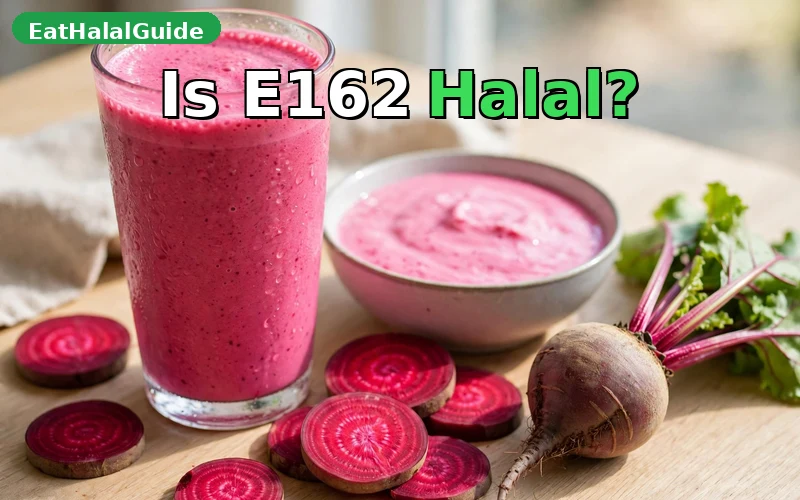

Is E162 halal? Yes — beetroot red is halal. It is the pink-red pigment of beetroot, and its legal definition names only beetroot and water: pressed juice or aqueous extraction. MUIS lists it with no doubtful mark — the only plant red in its listing without one.
So is beetroot red halal? For the code itself, yes. The one thing to check is the carrier, if you buy it as a liquid food colour.
Quick Answer
| Form | Verdict |
|---|---|
| E162 as defined (press juice or water extraction) | ✅ Halal |
| Dry powder or granules | ✅ Halal |
| Liquid colour, carrier unstated | ⚠️ Check the carrier — the solvent must be halal |
| Product with a recognised halal mark | ✅ Halal |
MUIS lists E162 with no syubhah (doubtful) mark. The code itself has no animal route.
What is E162?
The e162 food code is the European code for beetroot red, a colour, Codex number INS 162. Its main pigment is betanin, 75–95% of the red betacyanin pigments. Like annatto — see our E160b guide — it is a plant colour, not a synthetic dye and not an insect colour.
It is the pink in strawberry yogurt and the red in fruit drinks — the colour makers reach for to replace carmine, which comes from insects.
Where does E162 come from?
The answer is written into the law.
| Part | Source | Verdict | Why |
|---|---|---|---|
| The colour itself | Red beetroot (Beta vulgaris var. rubra) | ✅ Halal | A plant, nothing else |
| Extraction | Pressing crushed beet, or water extraction | ✅ Halal | Water only, by definition |
| Solvent-extracted preparations | Methanol or ethanol extraction | ⚠️ Check | Outside the E162 definition EFSA re-evaluated |
| Liquid colour as sold | Colour plus a carrier | ⚠️ Check | The label names the colour, not the carrier |
The EU specification defines beet red as obtained “by pressing crushed beet as press juice or by aqueous extraction of shredded beet roots”. No animal ingredient appears in it. EFSA’s 2015 re-evaluation covers only that press-juice and water-extracted form — not “preparations manufactured by solvent extraction with methanol or ethanol”. So the code is halal; a liquid preparation made another way is a question the label will not answer.
What the scholars say
No fatwa rules on E162 itself: it is a plant extract. The Darul Iftaa answer quoted by IslamQA (AskImam 19202, approved by Mufti Ebrahim Desai) opens with “Most ‘E-number’ ingredients are halaal for consummation”, then names only four outright haram codes — E120, E441, E542 and E904. Its mashbooh list runs from E1405 to E921. E162 appears in neither list.
SANHA gives a direct ruling: its E162 entry lists the status as “Halaal”, source “Beetroot extract”. MUIS supports the same conclusion: its Food Additive Listing (last updated 13 September 2016) marks doubtful additives with an asterisk — “* Syubhah / Doubtful (either by way of its source or manufacturing process)”. E162 carries no asterisk. Annatto, paprika, lycopene and anthocyanins carry one; beetroot red does not. Not halal certification — the listing is a general guideline — but a named authority declined to flag the code.
Which foods contain E162?
Health Canada permits beet red in jam, bread, butter, fruit juice, ice cream, icing sugar, jelly, flavoured milk, pickles, sherbet and tomato catsup. In practice: flavoured yogurts and milk drinks, ice cream, jams and jellies, breakfast cereals, soups, sauces, confectionery, frostings and pink smoothies. Heat and light fade it, so baked goods lose much of the red.
A halal mark settles the whole product. Without one, the code itself is still halal — the rest of the label is what needs checking.
The safety note
EFSA’s 2015 re-evaluation could not set an acceptable daily intake, but concluded that “at the reported use levels, beetroot red (E 162) is not of safety concern” — the pigment is a normal part of the diet. JECFA’s 1987 evaluation records an ADI of “not specified”, with a caution to keep nitrate within specifications, especially in foods for infants. None of this is a halal ruling — it is food safety.
How to check your label in 30 seconds
- Find it. “E162”, “beetroot red” or “betanin” — the same thing.
- Check for a halal mark — a recognised logo settles the whole product.
- Check the form — a dry powder is the defined form; a liquid colour deserves a look at its carrier.
- Check the rest of the label — if gelatin appears on it, see our Gelatin guide; one halal code does not make the whole product halal.
- If in doubt, ask the maker what solvent its liquid colour uses.
See Also: E-Code Database
Frequently asked questions
Is E162 halal?
Yes. It is a plant pigment from beetroot, defined by law as pressed juice or water extraction, and MUIS lists it with no doubtful mark. Only a liquid colour’s carrier needs checking.
Is E162 the same as carmine?
No. Carmine is E120, from cochineal insects, and most scholars consider it haram. E162 is the plant alternative makers switch to — beetroot, not insects.
Is E162 halal in the USA, UK and Canada?
Yes, in all three. The US permits dehydrated beets (21 CFR 73.40) for colouring foods generally; the EU and Great Britain authorise E162; Health Canada lists beet red as a permitted colour. The halal question is the source, and the source is beetroot everywhere.
Does E162 make a product halal?
No. E162 being halal says nothing about the rest of the packet — gelatin, alcohol and other additives are separate questions. Judge the whole list, or look for a halal mark.
Final Thoughts
E162 is the easy case in the E-code database — the opposite of glycerol, see our E422 guide, where one code hides several sources. Here the source is in the legal definition: beetroot, pressed or extracted with water. SANHA lists it as Halaal, MUIS declined to flag it, the scholars’ lists do not name it, and the only caveat is a liquid carrier. If the packet says E162, the colour is not your problem.
Sources & Verification
| # | Source | What it says | Status |
|---|---|---|---|
| 1 | MUIS — Food Additive Listing, Halal Certification Strategic Unit, last updated 13 Sep 2016, muis.gov.sg | “162 Beet Red/Betanin/Betanidin — Colouring — Deep purplish-red colouring extracted from beetroot” — no asterisk. Legend: “* Syubhah / Doubtful (either by way of its source or manufacturing process)”. | Verified — opened directly 2026-11-19 |
| 2 | Commission Regulation (EU) No 231/2012, legislation.gov.uk | “E 162 BEETROOT RED, BETANIN… Beet red is obtained from the roots of strains of red beets (Beta vulgaris L. var. rubra) by pressing crushed beet as press juice or by aqueous extraction of shredded beet roots… betanin accounts for 75-95 % [of betacyanins]… Content of red colour (expressed as betanine) is not less than 0,4 %.” | Verified — opened directly 2026-11-19 |
| 3 | EFSA — Scientific Opinion on the re-evaluation of beetroot red (E 162), EFSA Journal 2015;13(12):4318, doi:10.2903/j.efsa.2015.4318 | “The Panel concluded that… at the reported use levels, beetroot red (E 162) is not of safety concern.” The re-evaluation covers only press-juice and aqueous extraction, “not to preparations manufactured by solvent extraction with methanol or ethanol”. No ADI currently specified; nitrate limit 2 g nitrate anion/g red colour. | Verified — opened directly 2026-11-19 |
| 4 | WHO JECFA database — Beetroot Red, apps.who.int | “BEETROOT RED… INS, 162… Evaluation year: 1987. ADI: NOT SPECIFIED.” Nitrate must stay within specifications; “keeping in mind the need to limit the nitrate content of foods produced for infants and young children.” | Verified — opened directly 2026-11-19 |
| 5 | 21 CFR 73.40 — Dehydrated beets (beet powder), law.cornell.edu (e-CFR) | “The color additive dehydrated beets is a dark red powder prepared by dehydrating sound, mature, good quality, edible beets.” “Dehydrated beets may be safely used for the coloring of foods generally in amounts consistent with good manufacturing practice.” | Verified — opened directly 2026-11-19 |
| 6 | Health Canada — List of Permitted Food Colours, canada.ca (published 2025-10-20) | Item B.1 Beet Red, permitted as a food colour at Good Manufacturing Practice in jam, bread, butter, fruit juice, ice cream mix, icing sugar, jelly, flavoured milk, pickles, sherbet, smoked fish and tomato catsup. | Verified — opened directly 2026-11-19 |
| 7 | IslamQA (Hanafi) — E-numbers answer, AskImam 19202 (Darul Iftaa; Ml. Asif Umar; checked and approved by Mufti Ebrahim Desai) | “Most ‘E-number’ ingredients are halaal for consummation.” The outright haram list is only E-120, E-441, E-542 and E-904; the mashbooh list runs E1405–E921. E162 appears in neither list. | Verified — opened directly 2026-11-19 |
| 8 | SANHA — E162 (Beetroot Red), sanha.org.za | “E-number: 162… Status: Halaal. Source: Beetroot extract.” Health Code: Green — “safe in food use, contains nitrates so NRC”. | Verified — opened directly 2026-11-19 |
Last verified: 2026-11-19
What we could not verify
- IFANCA, JAKIM and HFA: no E162-specific statement from any of the three was found.
- halalharams.com: no E162 page surfaced in search.
- Any specific batch or product: no maker states its colour’s carrier, and no product-level check was done.
- PAA: a People Also Ask block appeared for “is e162 halal” in search on 2026-11-19, with four questions — “Is the color E162 halal?”, “Which E-colouring is haram?”, “What is E162 in food?” and “What E-numbers are not halal?”. None contradicts this article, so none was added.


