
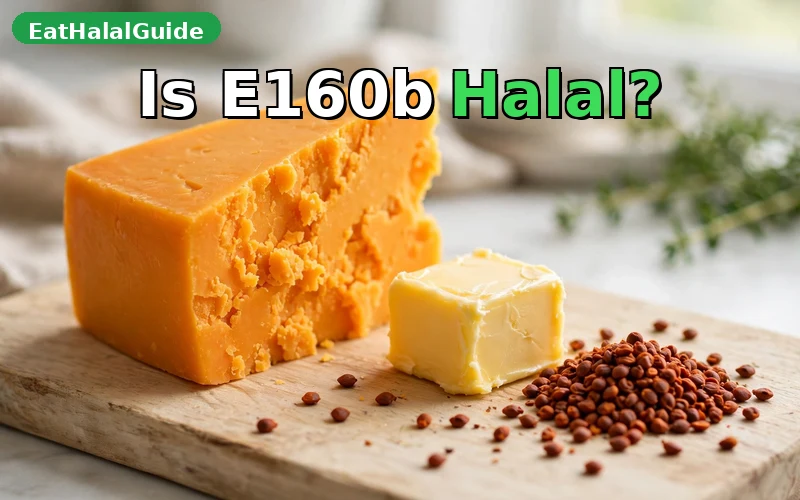

Is E160b halal? Yes — annatto is a plant colour from achiote seeds, with no animal source. SANHA lists it Halaal, source vegetable dye, and the UK’s Halal Monitoring Board lists it among its halal E-numbers. The rest is about the preparation, which can carry other ingredients.
If you came here asking “is annatto halal”, the answer is the same: the colour is halal; the check is what travels with it.
Quick Answer
| Form | Verdict |
|---|---|
| Annatto pigment itself (bixin / norbixin, dry colour) | ✅ Halal |
| Liquid colour preparation, carrier or solvent unknown | ⚠️ Mushbooh — ask the maker |
| Finished product, certified halal | ✅ Halal |
| Finished product, uncertified, other doubtful ingredients | ⚠️ Check the whole label |
SANHA lists it Halaal, source vegetable dye; Halal Authority India lists it plainly as Halal; the UK’s Halal Monitoring Board lists it among its halal E-numbers. The doubt is never about the pigment.
What is E160b?
The e160b food code is the European code for annatto, a yellow-to-red natural colour from achiote seeds (Bixa orellana). Its two colouring principles are bixin (oil-soluble) and norbixin (water-soluble). Its Codex number is INS 160b and its Colour Index number is CI 75120. It is authorised in the EU and Great Britain and permitted in the US and Canada. A plant colour, not a synthetic dye and not an animal product — and that single fact decides the verdict.
Where does annatto come from?
Annatto has one route: the seed. The pigment sits in the reddish waxy coating of the achiote seed, removed by abrasion in water, vegetable oil, or food-grade solvents. No animal is involved. The doubt starts only when the concentrated extract is turned into a factory colour.
| Part | Source | Verdict | Why |
|---|---|---|---|
| Annatto pigment (bixin / norbixin) | Plant — achiote seeds | ✅ Halal | SANHA: Status Halaal, Source vegetable dye; Halal Authority India: Halal |
| Liquid colour preparation | Pigment + carriers / solvents | ⚠️ Depends | Carriers and solvents are not on your label (JECFA); ask the maker |
| Finished food | Pigment + other ingredients | ⚠️ Check | Other ingredients (e.g. rennet in cheese, gelatin in sweets) are separate questions |
The carrier question — the one thing to check
Annatto extracts are too concentrated to add directly to food. JECFA says they “require dilution with carriers such as vegetable oil (with emulsifiers), propylene glycol or alkali”. The EU specification adds that solvent extraction may use food-grade solvents including ethanol, capped at 50 mg/kg remaining. One manufacturer’s norbixin is annatto extract, water and potassium hydroxide, halal-certified. A halal mark settles it. Unlike Sunset Yellow — see our E110 guide — a synthetic dye with the same caveat, annatto’s pigment is plant, so the check is only about the carrier.
Which foods contain E160b?
SANHA lists its uses as margarine, baked goods, reduced fat spreads, dairy products and breakfast cereals. JECFA notes annatto has coloured food “for over two centuries”, “especially in cheese” — cheddar, Red Leicester, Double Gloucester, Mimolette, butter, custards and rice dishes. An annatto-coloured cheese still depends on its rennet, a separate check: the Darul Iftaa ruling says rennet from an unlawful animal is unlawful, and from a lawful, Islamically slaughtered one it is lawful. A sweet coloured with annatto may still be set with gelatin — see our Gelatin guide — so check the whole label, not just the colour.
The EU split and the safety note
Since 2020 the EU splits E160b into E160b(i) Annatto bixin and E160b(ii) Annatto norbixin, with separate limits — norbixin 50 mg/kg only in Red Leicester, 35 mg/kg only in Mimolette. EFSA’s 2016 opinion set daily intakes of 6 mg bixin and 0.3 mg norbixin per kg of body weight, with reported exposure below both. SANHA gives annatto its Red health code and notes rare allergies. None of this changes the halal verdict. Tartrazine (E102) is a fellow colour in the same family — see our E102 guide — synthetic where annatto is plant.
How to check your label in 30 seconds
- Find the colour. “E160b”, “annatto”, “bixin”, “norbixin” or “annatto extract” are the same colour.
- The pigment itself is halal — plant, no animal source.
- Check for a halal mark — a recognised logo means the whole product is audited.
- Check the rest of the label — rennet, gelatin and other E-numbers are separate questions.
- If it is a liquid colour with no mark, ask the maker what carrier it uses.
See Also: Is E904 (Shellac) Halal or Haram?
See Also: Is E635 (Disodium 5′-Ribonucleotides) Halal or Haram?
See Also: Is E162 (Beetroot Red) Halal or Haram? — the other plant red: beetroot, not insects, with a SANHA Halaal listing.
Frequently asked questions
Is E160b halal?
Yes. Annatto is a plant colour — SANHA lists it Halaal and Halal Authority India lists E160b as Halal.
Is annatto the same as bixin and norbixin?
Yes — bixin and norbixin are the two colouring principles in annatto: bixin dissolves in oil, norbixin in water, and since 2020 the EU lists them as E160b(i) and E160b(ii).
Does E160b contain pork or animal ingredients?
No. The pigment comes from achiote seeds. A finished product can still contain rennet or gelatin, so check the whole label.
Is E160b halal in the USA, UK and Canada?
The colour is halal in all three — permitted as a food colour in each. Labelling differs: the EU and UK split it into E160b(i) and E160b(ii); the US lists it as Annatto Extract, exempt from batch certification.
Final Thoughts
E160b is the easy one in the E-code list, like its fellow colour E102: a plant colour, certifiers in agreement, and the Hanafi answer’s lists omit it. The annatto halal question only gets complicated in a liquid preparation or a finished product — then check the mark or ask the maker.
Sources & Verification
| # | Source | What it says | Status |
|---|---|---|---|
| 1 | SANHA — E160(b) (Annatto), sanha.org.za | “E-number: 160(b) Name: Annatto Alternative Names: Bixin; Norbixin; C.I. 75120; Orlean; Rocou. Function: Colouring Status: Halaal Source: vegetable dye.” Health Code Red. Uses: margarine, baked goods, reduced fat spreads, dairy products, breakfast cereals. | Verified — opened directly 2026-11-16 |
| 2 | Halal Authority India — Food Ingredient Numbers (E-numbers), halalauthorityindia.com | “E160b Annatto, Bixin, Norbixin Color – Carotene Halal” — plain Halal, with no dry/liquid caveat attached to this code (unlike its E110 row). | Verified — opened directly 2026-11-16 |
| 3 | FDA — Regulatory Status of Color Additives: Annatto Extract / Annatto, fda.gov | “Permanently listed, exempt from certification”. CAS Reg. No. 1393-63-1. Use: Foods, Drugs, Cosmetics. “Foods generally GMP (as Annatto extract); exempt from certification.” 21 CFR 73.1030. E Number: E160b. | Verified — opened directly 2026-11-16 |
| 4 | EFSA — The safety of annatto extracts (E 160b) as a food additive, EFSA Journal 2016;14(8):4544 | ADI “of 6 mg bixin/kg bw per day and an ADI of 0.3 mg norbixin/kg bw per day”. “Exposure estimates were below the ADI … for all population groups and for all refined exposure scenarios” at reported use levels. | Verified — opened directly 2026-11-16 |
| 5 | JECFA — Annatto Extracts (WHO Food Additives Series 52, 2004), inchem.org | “Annatto extracts are obtained from the outer layer of the seeds of the tropical tree Bixa orellana.” Concentrated preparations “require dilution with carriers such as vegetable oil (with emulsifiers), propylene glycol or alkali”. Used “for over two centuries as a food colour, especially in cheese”. | Verified — opened directly 2026-11-16 |
| 6 | Health Canada — Food colours permitted in Canada, inspection.canada.ca | “Annatto, E 160b, Annatto Extract”. Date modified 2025-01-15. | Verified — opened directly 2026-11-16 |
| 7 | IslamQA (Hanafi) — E-numbers answer, islamqa.org (AskImam 19202) | “Most ‘E-number’ ingredients are halaal for consummation.” E160b is in neither the haram list (E120, E441, E542, E904) nor the mashbuh list. The same answer carries the Darul Iftaa rennet ruling. Answer by Ml. Asif Umar; checked and approved by Mufti Ebrahim Desai, Darul Iftaa. | Verified — opened directly 2026-11-16 |
| 8 | Commission Regulation (EU) 2020/771 (legislation.gov.uk, retained EU law) | E160b split into E160b(i) Annatto bixin and E160b(ii) Annatto norbixin, each with category maximum levels (norbixin 50 mg/kg only in Red Leicester, 35 mg/kg only in Mimolette). Solvent-extracted bixin/norbixin may use food-grade solvents including ethanol; residual limits ethanol / isopropyl alcohol / ethyl acetate ≤50 mg/kg. | Verified — opened directly 2026-11-16 |
Last verified: 2026-11-16
What we could not verify
- HMC (UK), HFA (UK), JAKIM and MUIS: no E160b-specific statement found on 2026-11-16.
- IFANCA: no annatto-specific FAQ on ifanca.org. The IFANCA Halal Standard list naming Annatto 160B as Halal was seen only via a doczz.net mirror.
- No fatwa specifically on annatto surfaced; the IslamQA (Hanafi) answer’s haram and mashbuh lists do not include E160b.
- halalharams.com and halalinfohub.com: no annatto / E160b page surfaced in search on 2026-11-16.
- Conflicting secondary listings: an older undated list (haboard.com) marks E160b “Mushbooh, may be mixed with gelatin”; ecodehalalcheck.com marks it “Doubtful” — neither gives a reason. The certifiers above say otherwise; the draft states the gelatin/carrier check as the reason such listings exist.
- The carrier or solvent in any specific product’s liquid colour, and the rennet in any specific annatto-coloured cheese: no label states them, and no brand-level check was done.


