
Is E120 halal? The answer is disputed — and the dispute is real, not a rumour. E120 is carmine, a red colour made from crushed cochineal insects, and most scholars say it is haram in food. But a real minority of fatwa bodies permits it under conditions, and in Indonesia a halal-certified product can contain it.
This guide is about the food additive E120 — carmine, cochineal, carminic acid — not the imageboard website that shares the name “e120”.
Quick Answer
No single verdict — genuinely disputed. E120 is carmine, a red colour made from the dried bodies of female cochineal insects. The majority view is Haram in food — Hanafi, Shafi’i and Hanbali scholars hold that eating insects other than locusts is not permitted, and carmine is made by deliberately adding crushed insects to food. A real minority permits it conditionally — MUI Indonesia (Fatwa 33/2011), Malaysia (2012), Egypt (2013/2015), Saudi Arabia and Jordan all permit it if beneficial and not harmful. Follow your own certifier — a UK/US reader following the majority view treats E120 as Haram; an Indonesian reader following MUI does not.
E120 at a glance
| Code / area | Verdict | Why |
|---|---|---|
| E120 as a colour, majority view | Haram in food | Made from crushed cochineal insects; insects other than locusts are not permitted to eat |
| E120, permitting minority | Halal if beneficial and not harmful | MUI Fatwa 33/2011, Malaysia 2012, Egypt 2013/2015, Saudi Permanent Committee, Jordan 3240 |
| Maliki school | Not a blanket permission | Insects are in principle more permissible, but the detailed analysis finds carmine production does not meet the Maliki condition |
| A halal mark on the pack | Does not always clear carmine | In Indonesia, BPJPH-certified products may contain carmine under MUI Fatwa 33/2011 |
| Lipstick and oral products | Not permissible where intake is likely | The majority fatwas treat likely ingestion the same as eating it |
| Other external cosmetics | Permissible | Shampoo, blush and eyeshadow do not involve eating it; the pigment itself is treated as pure |
| Medicines | Necessity (darurah) | A medicine with no halal alternative is a different case from a sweet or a yogurt |
| E120 in the USA | Haram on the majority view | Labels must say “carmine” or “cochineal extract” by name; US M&M’s and Skittles do not use it, but US Yoplait strawberry does |
| E120 in the UK | Haram on the majority view | Approved additive, labelled “E120” or “carmine”; UK M&M’s list it, and some UK Skittles packs do |
| E120 in Canada | Haram on the majority view | “Cochineal” is on the permitted list; look for the words carmine or cochineal, not “E120” |
| E120 in Malaysia and Indonesia | Disputed — follow your certifier | Malaysia’s National Fatwa Committee permits it; MUI permits it and BPJPH certifies products that may contain it |
What is E120?
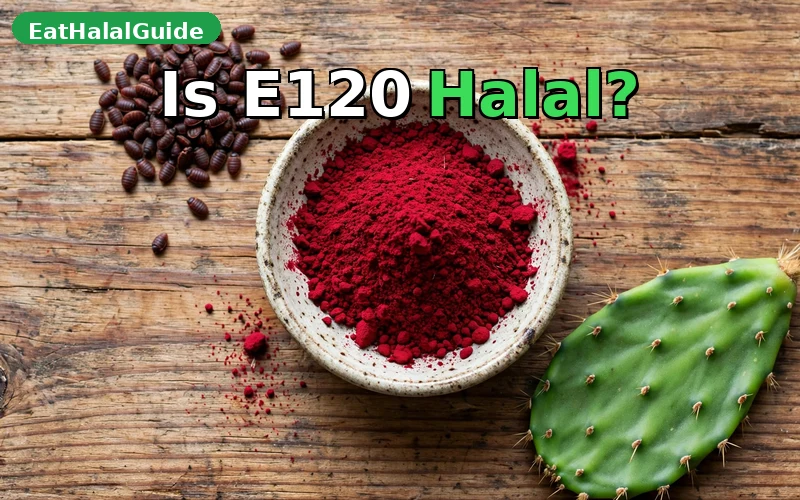
E120 is the European code for cochineal, carminic acid and carmines — the red colouring better known as carmine, also called cochineal extract, carminic acid, Natural Red 4 and C.I. 75470. Two forms exist: cochineal extract (E120(ii)), from the raw dried and pulverised insect bodies with around 20% carminic acid, and carmine (E120(i)), the more purified colouring, usually bound with aluminium or calcium salts. Ask is cochineal halal and you are asking about the same substance under its older name.
It survives because it is stable: heat, light and acidity do not fade it the way many plant reds fade. Three name traps: E132, “indigo carmine”, is a synthetic blue dye, not insect carmine; E124, “Ponceau 4R” or “Cochineal Red A”, is a synthetic azo dye, also not insect-derived; and “natural colour” does not mean plant-based — carmine is natural and insect-derived at the same time.
How is E120 made?
Carmine comes from the female cochineal insect, Dactylopius coccus, a scale insect that lives on prickly pear cacti (Opuntia). The insects are killed in hot water, then dried and ground to a powder. The powder is boiled in water to extract the carminic acid — typically 17–24% of the dried insects’ weight — and the clear solution is treated to make the dye, bound with aluminium or calcium salts.
Two figures circulate for how many insects that takes, and they are the same figure: about 155,000 insects to make one kilogram of cochineal, and about 70,000 to make one pound. Neither is independently verified as a count, but the arithmetic agrees. What matters for the ruling is the method: whole dried insects, deliberately killed, dried, ground and boiled, go into the dye.
Why do most guides say E120 is Haram?
Because of what it is made from, and because the addition is deliberate. The majority hold that eating insects is not permitted (Qur’an 7:157: “He permits pure substances for them and forbids filthy substances unto them”). The one exception the hadith gives is the locust — “Two dead animals are lawful for us: fish and locust” — and the cochineal is not a locust. See our What Is Halal Food? guide.
The fullest ruling found is Darul Ifta Birmingham’s Fatwa ID 05613 (21 Dec 2021), by Maulana Mohammed Haroon Hussain, checked by Mufti Mohammed Tosir Miah: Hanafi, Shafi’i and Hanbali — eating insects is not permissible. The Maliki school is in principle more permissive, but only if insects “are killed in such a way that makes them fit to eat (e.g. locusts)” — and in carmine they are “being used purely as a colouring, with all their body parts put into it”, so “the Maliki scholars have also said it is not permissible.” So this guide never writes “Malikis permit carmine” flatly.
The same fatwa closes the two loopholes readers ask about: the “negligible amount” exception covers a fly that fell into a pot and disintegrated — an accident — while “in the carmine example, the addition is deliberate and it could have been left out altogether”; and extreme need means famine or extreme hunger, not a red sweet.
The other majority fatwas agree, and each was opened directly. Darul Iftaa Trinidad (Mufti Arshad Ali, 11 Dec 2017): “it is impermissible to consume any products containing carmine.” Binnori Town Darul-Ifta, via SeekersGuidance (12 Mar 2023): the colour is pure and external use is permissible, but food use is not. SANHA, in its own publication (Musjid Times #37, April 2015): “The consumption of insects is Haraam and forbidden by the Shari’ah.” Brunei (2015) and LBM NU East Java (2023) also ruled it haram — both reported in academic sources, neither text opened directly.
Who permits it, and why?
The permitting side is smaller, but it is real fatwa — and it is why this guide has no single verdict.
MUI (Indonesia), Fatwa No. 33 of 2011 (10 August 2011). The Indonesian Ulema Council ruled that food and drink colourings derived from cochineal are halal “as long as they are beneficial and not harmful”. LPPOM MUI’s reasoning: the cochineal resembles the grasshopper — no larval or pupal stages, blood does not flow — and lives on cactus, not filth. On that basis “the MUI Fatwa Commission issued a halal fatwa, and BPJPH issued a halal certificate”. LPPOM MUI: a halal-certified product “can be guaranteed to be halal”.
Malaysia’s National Fatwa Committee, 100th meeting, 4–6 July 2012, ruled the same way — reported in a 2020 ASEAN fatwa analysis and an IIUM book chapter; the fatwa text was not opened directly.
Egypt’s Dar Al-Ifta, Fatwa 6888 (30 December 2013), opened directly, permits carminic acid on two grounds: the Maliki view, and istihalah — transformation, where the insects undergo changes that “completely change their chemical structure”, becoming pure and permissible if they do not cause harm. Egypt frames this as the majority scholars’ own view — an exception within the majority position. Fatwa 9393 (2015) agrees.
Saudi Arabia’s Permanent Committee, read in English translation, permits the colour because “the color is a trace and not the insect itself which is repugnant to eat”, as long as it is not harmful; the Arabic original was not opened directly. Jordan’s General Iftaa’ Department, Fatwa 3240 (27 Oct 2016), opened directly in English on aliftaa.jo (Arabic original not opened), permits E120 when the colourant has transformed, is needed, is used only as needed, and does not harm health. IFANCA (USA) records on its own site that its late religious advisor concluded cochineal extract was halal — “now almost everybody accepts that opinion” — a retrospective summary, not a dated fatwa document. The academic argument: Alzeer et al., in Halalsphere (IIUM, 31 July 2025), argue carmine can be halal when derived from herbivorous insects and processed hygienically — a journal article, not a fatwa.
What the certifiers actually say
The certifiers split, and three popular claims about the split are wrong. Each body below has its own source and date — or “not found” where nothing was found.
| Body | Position | Evidence |
|---|---|---|
| SANHA (South Africa) | Haram | Own publication, Musjid Times #37, April 2015 — “The consumption of insects is Haraam” — verified, opened directly |
| MUI / BPJPH (Indonesia) | Halal if beneficial and not harmful | Fatwa No. 33 of 2011; LPPOM MUI’s own site, 22 Jan 2025 — verified, opened directly |
| Malaysia National Fatwa Committee | Permissible if not harmful | 100th meeting, 4–6 July 2012 — academic/secondary summaries only; fatwa text not opened |
| Egypt Dar Al-Ifta | Permissible (Maliki view + istihalah) | Fatwa 6888, 30 Dec 2013 — verified, opened directly; Fatwa 9393, 5 May 2015 — secondary only |
| Saudi Permanent Committee | Permissible if not harmful | “Trace, not the insect itself” — English translation opened; Arabic original not opened |
| Jordan Iftaa’ Department | Permits if transformed, needed, limited, harmless | Fatwa 3240 (27 Oct 2016) — English version opened directly; Arabic original not opened |
| IFANCA (USA) | Halal (per late religious advisor) | IFANCA’s own site — verified, opened directly; no standalone fatwa document found |
| MUIS (Singapore) | No verdict issued | Food Additive Listing, last updated 13 Sep 2016 — describes the insect origin; E120 carries no asterisk; the listing has no halal/haram column — verified, opened directly |
| JAKIM (Malaysia) | Unresolved | “Haram” claimed by secondary sites only; no JAKIM haram document found; JAKIM’s i-FIQH portal lists the 2012 National Fatwa Committee decision permitting cochineal (search result, 15 Mar 2012; portal page timed out when opened, 2026-11-21) |
| HFA (UK) | Not found at source | “Haram” claimed by secondary sites only; no HFA document found |
| HMC (UK) | Not found at source | “Haram” claimed by secondary sites only; no HMC document found |
| ESMA (UAE) | Not found | “Haram” claimed by one secondary site only; no ESMA source found |
Three corrections, stated plainly. First, MUI does not classify carmine haram. FoodCheckr, HalalCodeCheck’s UK yogurt audit and AppsMustHave all say it does — MUI Fatwa 33/2011 permits it. Second, IFANCA does not classify carmine haram — IFANCA’s own site says its religious advisor concluded cochineal extract was halal. Third, MUIS does not list E120 as halal. One aggregator claims so from the MUIS Food Additive Listing, but that document has no halal/haram column at all. E120 carries no asterisk — the asterisk means Syubhah/doubtful. Absence of an asterisk is not a halal verdict. JAKIM is the one genuinely unresolved item: secondary sites claim it lists E120 haram, but no JAKIM haram document was found — JAKIM’s i-FIQH portal lists the 2012 permitting decision, though the portal page timed out when opened — and Malaysia’s own National Fatwa Committee permits it.
Where you meet E120
E120 hides in red and pink foods: strawberry yogurts, ice cream, red sweets, gummies, chewing gum, fruit juices, red velvet cake, maraschino cherries, some sausages, surimi, and red liqueurs. No specific ice-cream, sauce or juice brand label with E120 was verified, so no brand is named for those categories. The table below names only products where a source actually shows E120 on the label.
| Product | What the label shows | Note |
|---|---|---|
| M&M’s Milk Chocolate (UK) | “colours (e100, carmine, e133, e160a, e160e, e170)” | Open Food Facts UK, barcode 5000159564700; flagged non-vegetarian, non-vegan |
| M&M’s Crispy 213g pouch (UK) | “Colours (E100, E120, E133, E160a, E160e, E170)” | One Stop retailer listing |
| M&M’s Peanut 112g pouch (UK) | “Colours (Carmine, E133, E170, E100, E160a, E160e)” | One Stop retailer listing |
| M&M’s Milk Chocolate (USA) | No carmine — synthetic colours (Red 40, Yellow 6, Blue 1, Blue 2) | Mars Wrigley US declaration, 28 Feb 2023; EWG captures Sep 2025 and May 2025 |
| Skittles (UK) | “colours (E100, E120, E133, E141, E160a, E171)” | Open Food Facts, barcode 4009900492829 |
| Skittles Fruits 55g (France/EU) | “Sucre, sirop de glucose, E120, E100, E171, E132, E160e, E133…” | Open Food Facts |
| Original Skittles 61g (USA) | No E120 — Red 40 Lake, Yellow 5 Lake, Blue 2 Lake and others | Open Food Facts; note “Indigo carmine” here is E132, the synthetic blue |
| Yoplait Original Strawberry 6 oz (USA) | “Colored with Carmine” | Open Food Facts, Publix and Harris Teeter agree; also contains kosher gelatin — a second halal question |
| Müller Corner Strawberry Shortcake (UK) | Older pack: “Colour: Carmines”; current Asda listing: beetroot concentrate, no carmine | Reformulation example, not a current claim; current pack is marked “Suitable for Vegetarians” |
| Mentos (USA / EU variants) | US: “colors (turmeric oleoresin, carmine, beta-carotene, vegetable juice, beetroot red)”; EU sour chews: “karmin” | Flavour and market decide — mint Mentos in many markets do not list carmine |
Three warnings from the label work. First, the same brand differs by country: UK M&M’s list carmine and US M&M’s do not, and our M&M’s guide covers that split in full. Second, packs change: UK Skittles are genuinely mixed — one UK Open Food Facts entry lists E120, while another UK entry for a 45g Wrigley pack lists E162 and E163 with no E120. Our Skittles guide says the pack decides. Third, two products are history: Campari was coloured with carmine for about 150 years and discontinued it in 2006, and Starbucks used cochineal extract in its Strawberry Frappuccino and other pink items until 2012, when it switched to lycopene (tomato-based). Neither is a product you can buy with E120 today. Red sweets are the live case: our Chupa Chups guide shows how the colour decides the verdict flavour by flavour.
E120 in the USA, UK, Canada and Malaysia–Indonesia
USA. The FDA requires “cochineal extract” and “carmine” to be declared by name (21 CFR 73.100(d)(2); rule effective 5 January 2011) — they may not be hidden under “artificial color” or “color added”. The E-number is not used on US labels. Ask is e120 halal in usa: Haram on the majority view — but no US product is automatically free of it, or automatically guilty. US M&M’s and Skittles do not use it; US Yoplait strawberry and some Mentos do.
UK. E120 is on the GOV.UK “Approved additives and E numbers” list, authorised under retained Regulation (EC) No 1333/2008. UK labels declare it as “E120”, “carmine”, “carmines”, “cochineal” or “carminic acid”, typically inside “Colours (…)” — for example “Colours (E100, E120, E133…)”. Ask is e120 halal in uk: Haram on the majority view — and the UK is the highest-risk market for E120, because UK sweets are where it shows up most.
Canada. Health Canada’s List of Permitted Food Colours lists “Cochineal” among permitted colouring agents for a long list of foods, and in sausage casings at 0.75%. Canada requires ingredients by common name (Food and Drug Regulations B.01.008). “E120” is not a Canadian label term — look for the words carmine or cochineal. No carmine-specific by-name statute was verified, and no current Canadian product label with carmine was found.
Malaysia and Indonesia. Here the fatwa split is the story, not the label. In Indonesia, MUI Fatwa 33/2011 permits it, and BPJPH has certified products using it — so an Indonesian halal-certified product may list carmine. In Malaysia, the National Fatwa Committee’s 2012 ruling permits it, while secondary sites claim JAKIM lists it haram — and JAKIM’s own i-FIQH portal lists the 2012 National Fatwa Committee decision permitting cochineal (search result, 15 Mar 2012; the portal page timed out when opened, so the position stays unresolved).
Food, lipstick and medicine: where the line falls
| Use | Majority ruling | Why |
|---|---|---|
| Food and drink | Not permissible | Deliberate addition of crushed insects; Qur’an 7:157; the locust exception does not cover the cochineal |
| Lipstick and oral products | Not permissible where intake is likely | You swallow lipstick and toothpaste residue; treated the same as eating it |
| Other cosmetics (shampoo, blush, eyeshadow) | Permissible | No ingestion; the pigment itself is treated as pure after extraction, and it does not affect wudu |
| Medicines | Necessity (darurah) | A medicine with no halal alternative is a different case from a sweet; ask a scholar, do not stop a needed medicine on a label alone |
| The pigment itself | Pure after extraction | Binnori Town: “It will not affect one’s wudu, as the color is now considered to be pure after extraction and full process” |
The halal reds to look for instead
Manufacturers do not need insects to make food red. E162, beetroot red (betanin), is Halal — a plant pigment from beetroot — and our E162 page rates it Halal. It is the red that replaced carmine in the reformulated UK Skittles variant and in the current Müller Corner Strawberry Shortcake. Other halal reds: E163 anthocyanins, E160c paprika extract, and lycopene (E160d, from tomatoes — the red Starbucks switched to in 2012). One caveat: a liquid E162 preparation can carry a solvent — our E162 page covers that.
How to check any E120 product in 30 seconds
Four checks. First, the words — “E120”, “carmine”, “cochineal” or “carminic acid” in the UK and EU; “carmine” or “cochineal extract” by name in the USA; the words carmine or cochineal in Canada. Second, the halal mark — but remember the Indonesia exception: a BPJPH-certified product may contain carmine, so a halal mark settles the question only if you follow the certifier that issued it. Third, the country — the same brand can contain carmine in the UK and not in the USA, so check the pack from your market. Fourth, the rest of the label — one halal code does not make the whole product halal; Gelatin is a separate question, and the US Yoplait strawberry that lists carmine also lists kosher gelatin. Our E-Code Database hub still lists E120 in “Codes we have not checked yet”, even though E471 and E621 are already live. Our What Is Halal Food? guide explains the terms; our E621 guide is the parallel case where the certifiers split, and our E471 guide completes the set of three.
Frequently Asked Questions
Is E120 halal?
No single verdict — genuinely disputed. The majority view (Hanafi, Shafi’i, Hanbali) is Haram in food, because E120 is made from crushed cochineal insects. A real minority — MUI, Malaysia, Egypt, Saudi Arabia and Jordan — permits it if beneficial and not harmful.
Is carmine halal?
Ask is carmine halal about a product in the UK or USA and the majority answer is no — carmine is the dye itself, and the same ruling covers it under any of its names.
Is cochineal halal?
Ask is cochineal halal and the answer is the same as for carmine.
Is E120 halal in the UK?
Ask is e120 halal in uk: Haram on the majority view. E120 is an approved additive in the UK, and UK M&M’s and some UK Skittles packs list it — but approval is a food-safety decision, not a halal ruling. Check the Colours list for “E120”, “carmine” or “cochineal”.
Is E120 halal in the USA?
Ask is e120 halal in usa: Haram on the majority view. US labels must say “carmine” or “cochineal extract” by name — the E-number is not used. US M&M’s and Skittles do not use it; US Yoplait strawberry and some Mentos do.
Is carmine vegan?
No. Carmine is made from killed insects, so it is not vegetarian and not vegan. A “Suitable for Vegetarians” logo is a useful negative screen, but the ingredient list is the authority.
Can Muslims use lipstick containing carmine?
Not where intake is likely, on the majority view — lipstick is swallowed in small amounts, so it is treated like food. Shampoo, blush and eyeshadow are treated as permissible, and the pigment itself is considered pure after extraction.
Final Thoughts
The “Haram” pages are right about the insect — whole dried cochineal insects, deliberately killed and ground, go into the dye, and the majority of scholars say that is not food. The “Halal” pages are right that the question is not unanimous — MUI, Malaysia, Egypt, Saudi Arabia and Jordan have all ruled on it, with fatwa numbers and dates: a locust-like insect, a transformed extract, a trace rather than the insect itself. Both sides are real. So read the pack: words first, country second, certifier third, maker fourth.
What we could not verify
- HFA, HMC, ESMA, AMJA, Mufti Menk and the OIC Fiqh Academy: “haram” claimed by secondary sites only for HFA, HMC and ESMA; no primary source was found for any of them, and no ruling at all for the last three. JAKIM’s i-FIQH portal lists the 2012 permitting decision (search result; portal page timed out when opened), which conflicts with the secondary “haram” claim.
- Four permitting-side texts not opened directly: Egypt Fatwa 9393 (secondary summary); the Malaysia 2012 fatwa text; the Saudi Arabic original (translation opened); the Brunei 2015 fatwa text.
- IslamWeb’s alcohol-in-processing claim: a single-source assertion, not verified elsewhere. LPPOM MUI does mention an “acid alcohol solution” in processing, but whether alcohol survives into the finished dye was not established.
- Insect counts: “70,000 insects per pound” and “155,000 per kilogram” are the same figure arithmetically; neither is independently verified as a count. “Peru ~85% of world supply” and “70 tons per year” are repeated without primary sources.
- Product labels: no current Canadian product label with carmine was found; no current ice-cream, sauce or juice brand label with E120 was verified. No current UK Yoplait label with carmine was found.
- UK Skittles: genuinely mixed — one UK Open Food Facts entry lists E120, another lists E162 with no E120. Treat Skittles as “check the pack by variant and date”.
- Campari outside the US/UK: secondary claims that Malaysia, Australia, Canada or Sweden may still use carmine are unconfirmed, and no current label was found. Campari is presented as historical.
- PAA: no People Also Ask block appeared in any search — capture the live PAA block at publish.
- halalinfohub.com and halalharams.com have no E120 page; halalcodecheck.com has no dedicated E120 page. The competition is IslamQA, Halal Scanner, HalalSpy, WhatIsHalal, HelalScan, FoodCheckr and DeenBack.
Sources & Verification
| # | Source | What it says | Status |
|---|---|---|---|
| 1 | EFSA — “Scientific Opinion on the re-evaluation of cochineal, carminic acid, carmines (E 120)” (EFSA Journal 2015;13(11):4288, adopted 27 Oct 2015, published 18 Nov 2015) | ADI expressed as 2.5 mg carminic acid/kg bw/day. “Since no threshold dose can be established for allergic reactions, it is advisable that exposure to the eliciting allergens, such as proteinaceous compounds, in E 120 is avoided by introducing appropriate purification steps.” | Verified at prep — opened directly 2026-11-21; publish-time re-check blocked by Cloudflare Turnstile on the Wiley page, not re-verified at publish |
| 2 | FDA — Small Entity Compliance Guide, “Declaration by Name on the Label of All Foods and Cosmetic Products that Contain Cochineal Extract and Carmine” (final rule 5 Jan 2009, 74 FR 207; effective 5 Jan 2011) | “Cochineal extract or carmine must be listed on the label by its respective common or usual name, ‘cochineal extract’ or ‘carmine.’ (21 CFR 73.100 (d)(2))” Generic “Artificial Color” or “Color Added” is not allowed for these two. Cosmetics: “Carmine must be declared prominently and conspicuously at least once in the labeling (21 CFR 73.2087 (c)(2))”. Rule driven by reports of severe allergic reactions including anaphylaxis. | Verified — opened directly 2026-11-21 |
| 3 | Regulation (EC) No 1333/2008, Annex II + Commission Regulation (EU) 2018/1472 | E120 authorised colour. 2018/1472 replaced the name “E 120 Cochineal, Carminic acid, Carmines” with “E 120 Carminic acid, Carmine”. UK retained law lists “[F4E 120, Carminic acid, Carmine]”. | Partially verified — search text of primary legislation, 2026-11-21 |
| 4 | GOV.UK — “Approved additives and E numbers” (gov.uk) | “E120, Cochineal; Carminic acid; Carmines” listed as an approved additive. | Verified — opened directly 2026-11-21 (via research) |
| 5 | Health Canada — List of Permitted Food Colours (date published 2025-10-20) | Item C.9 lists “Cochineal” among permitted colouring agents (jam, bread, butter, ice cream mix, flavoured milk, jellies, sherbet and other foods) at Good Manufacturing Practice. Item C.9(c): cochineal in sausage casings at 7,500 ppm (0.75%), residues not to exceed 75 ppm in the sausage prepared from them. Food and Drug Regulations B.01.008 requires ingredients by common name. | Verified — opened directly 2026-11-21 |
| 6 | IslamQA / Darul Iftaa Trinidad — Mufti Arshad Ali, “What is the ruling of carmine (e-120)?” (11 Dec 2017) | “Carmine is a crimson red pigment derived from Cochineal, a ‘scale insect’, by crushing and boiling dried insects in water to extract the carminic acid and then treating the clear solution.” “They are killed by immersion in hot water, then dried by exposure to sunlight, steam or the heat of an oven and ground to a powder… It takes about 155 000 insects to make just one kilogram of cochineal.” Verdict: “it is impermissible to consume any products containing carmine”; lipstick not permissible where intake is likely; external use (e.g. shampoos) permissible. Source cited: SANHA. | Verified — opened directly 2026-11-21 |
| 7 | Darul Ifta Birmingham — Fatwa ID 05613, Maulana Mohammed Haroon Hussain, checked by Mufti Mohammed Tosir Miah (21 Dec 2021) | “Carmine is the name of the dye that is made from the Cochineal beetle. A large number of the beetles are boiled, dried and crushed and this red dye (called carmine) is extracted from that mixture of crushed beetles.” School-by-school: Hanafi, Shafi’i and Hanbali — not permissible; Maliki — permissible only if killed in a way that makes them fit to eat, and carmine production does not meet that condition. Exceptions: locusts, extreme need, and a negligible accidental amount — the deliberate addition of carmine cannot use the fly-in-the-pot analogy. Cites Qur’an 7:157, Fath al-Qadir and al-Mawsu’ah al-Fiqhiyyah al-Kuwaitiyyah. | Verified — opened directly 2026-11-21 |
| 8 | Binnori Town Darul-Ifta via SeekersGuidance — Mawlana Ilyas Patel, checked by Shaykh Faraz Rabbani (12 Mar 2023) | “According to the majority of the jurists, the consumption of insects is not permitted…” “It will not affect one’s wudu, as the color is now considered to be pure after extraction and full process.” Summary: “the bright red color obtained from it is pure; Its usage in external products like cosmetic products, etc., is permissible; Its usage in food items is not permissible.” | Verified — opened directly 2026-11-21 |
| 9 | IslamQA AskImam (Durban) — Moulana Ismail Desai, checked by Mufti Ebrahim Desai (30 Oct 2012, updated 11 Nov 2017) | “Carminic acid, typically 17–24% of dried insects’ weight, can be extracted from the body and eggs then mixed with aluminum or calcium salts to make carmine dye.” “There are two principal forms of cochineal dye: cochineal extract (E120(ii))… and carmine (E120(i)) a more purified colouring made from cochineal.” States SANHA declared cochineal Haraam. Contains an error: it mislabels cochineal as “E-129” — E129 is Allura Red AC, not cochineal; that wording is not quoted in this guide. | Verified — opened directly 2026-11-21 (with the E129 typo flagged) |
| 10 | IslamWeb — Fatwa 90369, “The ingredient carmine” | “If this ingredient is as we found out extracted from cochineal beetle, which is dried before being ground, then it is unlawful to consume it because it is unlawful to eat insects according to the majority of scholars… In addition, it is considered Maytah (dead creature)… it is treated with (intoxicating) alcohol.” The alcohol-in-processing claim is this source’s own assertion and is not verified elsewhere. | Partially verified — search text, 2026-11-21 |
| 11 | LPPOM MUI — “Affirming the Halalness of Carmine” (halalmui.org, 22 Jan 2025) | “MUI Fatwa No. 33 of 2011 concerning the Act on Food and Beverage Coloring from Cochineal Insects emphasizes that food and beverage colourings derived from cochineal are halal as long as they are beneficial and not harmful.” “This animal has several similarities with grasshoppers; its life cycle does not go through the larval and pupal stages, and its blood does not flow.” “On this basis, the MUI Fatwa Commission issued a halal fatwa, and BPJPH issued a halal certificate.” Production: insects “dried in the sun until dry and then crushed with a machine”; extract “usually mixed with an acid alcohol solution to further bring out the colour”. “Peru is known as the largest producer of carmine in the world, reaching 70 tons per year.” “You don’t need to worry anymore if the packaging says carmine. As long as it is halal certified, the product can be guaranteed to be halal.” | Verified — opened directly 2026-11-21 |
| 12 | Egypt Dar Al-Ifta — Fatwa 6888, “Is it permissible to use carminic acid as a natural food colorant?” (30 Dec 2013) | “Maliki scholars, in one of their opinions, maintain the permissibility of eating and benefitting from insects… there is no objection to following the Maliki opinion permitting using and benefitting from insects if some of the material extracted from them are beneficial.” On istihalah: insects “undergo physical and chemical changes that completely change their chemical structure when they are transformed into colorants. In this case, they become pure and permissible for consumption provided they do not cause any harm. This is the opinion of the majority of scholars who maintain the prohibition of eating insects.” Fatwa 9393 (5 May 2015) reaches the same conclusion (reported via WhatIsHalal; text not opened). | Verified — Fatwa 6888 opened directly 2026-11-21; Fatwa 9393 secondary only |
| 13 | Saudi Arabia — The Permanent Committee (al-Lajnah al-Da’imah), English translation | “Based on what was reported in the question regarding the method of extracting this dye (color) from these insects after melting them, grinding them, straining them, and extracting the solid parts and based on the fact that the color is a trace and not the insect itself which is repugnant to eat, it is allowed to benefit from this color in foods or drinks as long as it is not harmful.” Proved by the fly-in-the-vessel hadith. | Partially verified — English translation opened directly 2026-11-21; Arabic original on alifta.net not opened |
| 14 | Jordan — General Iftaa’ Department, Fatwa 3240 (27 Oct 2016) | Permits E120 when the colourant has chemically transformed (istihalah), is used because no suitable alternative is available, is used only as needed, and does not harm health — while acknowledging the majority classical insect prohibition. | Verified — opened directly 2026-11-21 (English version on aliftaa.jo; Arabic original not opened) |
| 15 | Malaysia — National Fatwa Committee, 100th meeting (4–6 July 2012) | Permits cochineal colouring: the insects are harmless, so any colouring substance produced from them can be used, within Ministry of Health Malaysia guidelines, as long as it does not bring any harm. | Partially verified — 2020 ASEAN fatwa analysis (JFatwa, USIM) and IIUM book chapter, search text, 2026-11-21; fatwa text not opened |
| 16 | Brunei Darussalam — Mufti Department, 2015 fatwa | Declared the dye haram for consumption; reasoning reported as cochineal treated as khaba’ith (impure) plus health-risk considerations. Published as “Irsyad Hukum” in Pelita Brunei, 29 July 2015. | Partially verified — academic secondary sources only, 2026-11-21; fatwa text not opened |
| 17 | LBM NU East Java — Bahtsul Masail (29 Aug 2023) | Ruled the dye unclean and disgusting (haram, najis, from insect carcasses under the Shafi’i view). | Partially verified — secondary summary only, 2026-11-21 |
| 18 | Alzeer et al. — “Reevaluating the halal status of Carmine (E120): A scientific and Islamic legal review”, Halalsphere 5(2), 2025 (IIUM, 31 July 2025) | “We argue that carmine can be considered halal when derived from herbivorous cochineal insects and processed with high hygiene and transformative techniques.” A journal article, not a fatwa. | Partially verified — search text / abstract, 2026-11-21 |
| 19 | SANHA — Musjid Times Issue #37, Rajab 1436 / April 2015, “WHATS IN A NAME?” (sanha.org.za) | “COCHINEAL, CARMINE, COLOUR (E120), CARMINIC ACID, COLOUR INDEX (CI 75470) NATURAL RED 4, CRIMSON LAKE — These are all names of a bright red food colouring derived from the crushing of the cochineal scale insect.” “The consumption of insects is Haraam and forbidden by the Shari’ah.” Cites Surah 7, Verse 157. | Verified — opened directly 2026-11-21 |
| 20 | IFANCA — “IFANCA’s Religious Advisor Passes Away” (ifanca.org) | “When the issue of the use of cochineal extract first came up a decade ago, it was Sheikh Quaderi who did the research, concluding that it was halal. At that time, there were conflicting views amongst the halal certification agencies in different countries. Now almost everybody accepts that opinion.” | Verified — opened directly 2026-11-21 (retrospective summary, not a dated fatwa document) |
| 21 | IFANCA — “The Color Wheel” (ifanca.org) | Describes Natural Red 4 / carmine / cochineal neutrally (“derived from the cochineal insect… made headlines after customer reaction prompted Starbucks to remove it”); gives no haram ruling. | Verified — opened directly 2026-11-21 |
| 22 | MUIS — Food Additive Listing, Halal Certification Strategic Unit (last updated 13 September 2016) | E120 entry (p.1): “120, Cochineal/Carmines (C.I. 75470), Colouring, Natural red colouring which may be extracted from the bodies of female insects called Dactilopius coccus”. E120 carries NO asterisk. Legend (p.20): “* Syubhah / Doubtful (either by way of its source or manufacturing process)”. The document has NO halal/haram status column at all. For contrast, E621 in the same listing DOES carry an asterisk. | Verified — opened directly 2026-11-21 |
| 23 | JAKIM / HFA / HMC / ESMA — positions claimed by secondary sites | HelalScan: “The Department of Islamic Development Malaysia and the Halal Food Authority in the UK list E120 as haram”. HalalCodeCheck JAKIM E-codes guide: “E120, Cochineal / Carmine, Haram, Prohibited — insect-derived”. FoodCheckr lists JAKIM, MUI, IFANCA and ESMA as classifying carmine haram. None quotes a JAKIM, HFA, HMC or ESMA document; the MUI and IFANCA claims are contradicted by those bodies’ own texts (rows 11 and 20). JAKIM’s own i-FIQH portal lists the 2012 National Fatwa Committee decision permitting cochineal (search result, 15 Mar 2012; portal page timed out when opened, 2026-11-21). | Unresolved / not found at source, 2026-11-21 |
| 24 | Open Food Facts — M&M’s Milk Chocolate (UK), barcode 5000159564700; M&M’s Mix (Germany/EU), 270g; M&M’s Peanut (France) | UK: “colours (e100, carmine, e133. e160a, e160e, e170)” — flagged Non-vegetarian, non-vegan ingredient: E120. Germany: “Farbstoffe (E100, E120, E133, E160a, E160e, E162, E171, E172)”. France: “colours (e100, e120, e133, e160a, e160e, e171)”. | Partially verified — label captures, 2026-11-21 |
| 25 | One Stop (retailer) — M&M’s Crispy 213g pouch (UK); M&M’s Peanut 112g pouch (UK) | Crispy: “Colours (E100, E120, E133, E160a, E160e, E170)”. Peanut: “Colours (Carmine, E133, E170, E100, E160a, E160e)”. | Partially verified — retailer listings, 2026-11-21 |
| 26 | Mars Wrigley US ingredient declaration (28 Feb 2023) + EWG LabelINSIGHT captures (Sep 2025, May 2025) — M&M’s Milk Chocolate (USA) | “COLORS (INCLUDES BLUE 1 LAKE, YELLOW 6, RED 40, YELLOW 5, BLUE 1, YELLOW 6 LAKE, RED 40 LAKE, YELLOW 5 LAKE, BLUE 2 LAKE, BLUE 2)” — no carmine, no cochineal extract. | Partially verified — label captures, 2026-11-21 |
| 27 | Open Food Facts — Skittles (UK), barcode 4009900492829; Skittles Fruits 55g (France/EU); Skittles 2in1 38g; Original Skittles 61g (USA); Skittles Wrigley 45g (UK) | UK: “colours (E100, E120, E133, E141, E160a, E171)”. France: “Sucre, sirop de glucose, E120, E100, E171, E132, E160e, E133…”. 2in1: “dyes: e120, e170, e100, e132, e133, e160a, e160e”. USA: “COLORS (RED 40 LAKE, YELLOW 5 LAKE, BLUE 2 LAKE, YELLOW 6 LAKE, TITANIUM DIOXIDE, BLUE 1 LAKE, YELLOW 6, YELLOW 5, BLUE 1)” — no E120. UK Wrigley 45g: “E162, E163, E100, E132, E133” — no E120, i.e. current UK status is mixed by variant. | Partially verified — label captures, 2026-11-21 |
| 28 | Open Food Facts + Publix + Harris Teeter — Yoplait Original Strawberry, 6 oz (USA), UPC 070470003009 | “Colored with Carmine” / “colored with carmine”. Full: “Pasteurized Grade A Reduced Fat Milk, Sugar, Strawberries, Modified Corn Starch, Kosher Gelatin, Natural Flavor, Pectin, Colored with Carmine, Yogurt Cultures…, Vitamin A Acetate, Vitamin D3.” | Partially verified — label captures, 2026-11-21 |
| 29 | Open Food Facts UK (barcode 4025500277093) + Asda current listing — Müller Corner Strawberry Shortcake (UK) | Older pack: “…Stabiliser: Pectins; Colour: Carmines; Acidity Regulator: Citric Acid.” Current Asda listing: “Colouring Food: Beetroot Concentrate, Colour: Carotenes” — no carmine, no E120 — and marked “Suitable for Vegetarians.” | Partially verified — label captures, 2026-11-21 |
| 30 | Open Food Facts — Mentos (USA / Brazil-made), barcode 07330100; Mentos sour chews (Poland/EU), 37.5g; Mentos gum, strawberry-mint (Czech/Slovak) | US: “colors (turmeric oleoresin, carmine, beta-carotene, vegetable juice, beetroot red)”. Poland: “barwniki (karmin, kurkumina, antocyjany, ekstrakt z papryki)”. Czech/Slovak gum: “barvivo (karmin)”. Mint Mentos in many markets do not list carmine. | Partially verified — label captures, 2026-11-21 |
| 31 | Campari — Wikipedia + The Manual + LargerDirks | Campari was originally coloured with carmine for about 150 years; Campari Group discontinued carmine in 2006. US: “All Campari in North America was carmine-free by 2006”. Residual uncertainty: a 2025 report notes Sweden’s state alcohol site still lists E120 for the local formulation, and a 2018 report said Malaysia, Australia and Canada may still use the natural dye — the company did not confirm. No current label transcription found. | Partially verified — secondary, 2026-11-21; historical only |
| 32 | Starbucks — WAMC (19 Apr 2012) + Prepared Foods + Food Poisoning Bulletin | Starbucks used cochineal extract in Strawberries and Crème Frappuccino, Strawberry Banana Smoothie, Raspberry Swirl Cake, Birthday Cake Pop, Mini Donut with pink icing and Red Velvet Whoopie Pie (US). President Cliff Burrows announced a transition to lycopene (tomato-based extract), fully transitioned by end of June 2012. | Partially verified — secondary news reports, 2026-11-21; historical only |
| 33 | Halal Scanner — “Is Carmine (E120) Halal? Why Cochineal Is Not” (halalscanner.org, last updated 15 Nov 2026) | Verdict: No / Not halal — majority position; Maliki + istihalah noted as minority. Good on label names, country variation and alternatives (E162, E163, E160c, lycopene). Weaknesses: no named fatwa with date/number; no certifier-by-certifier table; no cosmetics/medicines section; no US labelling law or EU regulation citation; only 1 FAQ; no image in fetched text. | Verified — opened directly 2026-11-21 (competitor) |
| 34 | HalalSpy — “Is Carmine (E120) Halal? The Insect-Derived Red Dye Explained” (halalspy.com, published 2026-04-04, updated 2026-03-19) | Verdict: Haram per majority; Maliki exception; MUI Fatwa 33 of 2011 permitting noted; Brunei 2015 haram noted. Good on history, FDA 2011 rule, Starbucks 2012 switch, cosmetics and medicines. Weaknesses: updated date precedes published date; only one outbound fatwa link; several figures unsourced in-text; Skittles claim vague and undated; no label photo; no image in fetched text. | Verified — opened directly 2026-11-21 (competitor) |
| 35 | WhatIsHalal.org — “Is Carmine (E120) Halal?” (last updated ~20 Nov 2026) | Verdict: Disputed / differs by authority. Most complete fatwa table found (MUI 33/2011; Malaysia 2012; Egypt 6888/9393; Alzeer 2025; Darul Ifta Birmingham 2022; Binnori Town 2023; Council of Ulama Eastern Cape 2022; Shaykh Rami Nsour; LBM PWNU East Java 2023). Weaknesses: “Typical products”, “Plant-based alternatives” and “Related guides” sections are empty placeholders; example label explicitly “for illustration only. Not a real product”; no country-by-country product audit; no certifier table; no image in fetched text. | Verified — opened directly 2026-11-21 (competitor) |
| 36 | HelalScan — “Is carmine Halal or Haram? Cochineal, E120 and red colouring” (helalscan.com, last reviewed 29 Oct 2026) | Verdict: Haram / Not Halal in the app, majority; Maliki + MUI permit noted. Unique: halal mark does not clear carmine; vegan mark next to carmine contradicts the pack; Indonesian-certified products can carry a halal mark and still contain E120; German label names; only competitor to address the E132 indigo-carmine confusion. 7 FAQs. Weaknesses: short; no fatwa dates/numbers for most rows; no US/UK labelling law; no product examples by name. Images: 1 OG/title image only. | Verified — opened directly 2026-11-21 (competitor) |
| 37 | FoodCheckr — “Is E120 (Carmine) Vegan or Halal?” (foodcheckr.com, published 2026-08-22) | Verdict: Haram per “major certifying bodies”. States “IFANCA, JAKIM (Malaysia), MUI (Indonesia) and ESMA (UAE) classify carmine as haram” — FALSE for MUI (Fatwa 33/2011 permits it) and for IFANCA (own site says its religious advisor concluded it was halal). Do not repeat that claim. Otherwise good on “natural does not mean plant”, allergy, EFSA approval and FDA name-declaration rule. Images: none in fetched text. | Verified — opened directly 2026-11-21 (competitor) |
| 38 | DeenBack — “Is Carmine Haram? The Red Dye That Catches Muslims Off Guard” (deenback.com, published 2026-08-03) | Verdict: haram per majority; Maliki exception; istihalah debated, not accepted by most certifiers. Qur’an 5:3 and 7:157 quoted; locust hadith (Ibn Majah 3218); unknowing-consumption and medicine-necessity Q&A; alternatives E162/E160d/E163/E160c/E129. Weaknesses: no named fatwa with date/number; no certifier positions; no US/EU labelling law; “certified product will not contain it” stated without the Indonesia exception. Images: 1 hero image of red foods. | Verified — opened directly 2026-11-21 (competitor) |
| 39 | HalalCodeCheck — UK energy-drinks audit; UK yogurt audit; USA supermarket guide (halalcodecheck.com) | No dedicated E120 page. Energy-drinks audit: Red Bull Watermelon not halal because it contains E120. Yogurt audit: Müller Corner strawberry lists carmine (E120); claims “The JAKIM standard (Malaysia) and MUI (Indonesia) both classify carmine as haram” — FALSE for MUI (Fatwa 33/2011 permits it). USA guide: E120 row “Cochineal, Carmine, Natural Red 4 — Haram”. No fatwa citations with dates/numbers; no label photos in snippets. | Verified — opened directly 2026-11-21 (competitor) |
| 40 | EatHalalGuide — Is E162 Halal or Haram? | Beetroot red (betanin) is Halal — the plant alternative to carmine. | Verified — our own published article |
| 41 | EatHalalGuide — Is E621 Halal or Haram? | MSG is source-by-source: certified/plant-fermented Halal; uncertified with unstated source Mushbooh; pork-medium batch Haram (2001). The parallel case where the certifiers split. | Verified — our own published article |
| 42 | EatHalalGuide — Is E471 Halal or Haram? | The first of the three E-code deep guides. | Verified — our own published article |
| 43 | EatHalalGuide — Are M&M’s Halal or Haram? | UK varieties list carmine (E120); US varieties use synthetic colours. The pack and the country decide. | Verified — our own published article |
| 44 | EatHalalGuide — Are Skittles Halal or Haram? | The pack decides — some UK/EU packs list E120, US packs do not. | Verified — our own published article |
| 45 | EatHalalGuide — Is Chupa Chups Halal or Haram? | Classic lollipops Mushbooh; any E120 flavour Haram on the majority view. | Verified — our own published article |
| 46 | EatHalalGuide — Is Gelatin Halal or Haram? | What E441 is and where it hides in the same processed foods. | Verified — our own published article |
| 47 | EatHalalGuide — What Is Halal Food? | Halal, haram and disputed/Mushbooh explainer. | Verified — our own published article |
| 48 | EatHalalGuide — E-Code Database (e-codes/) | Hub lists E120 in “Codes we have not checked yet”; deep guides for E471, E621 and E120 listed as “coming next”; 16 codes checked so far (8 Halal, 5 Mushbooh, 1 Varies, 2 mixed — E110 + E160b dry Halal, liquid Mushbooh). Hub text last verified 2026-11-19 — stale for E471/E621, which are live. | Verified — our own published hub page (live, checked by curl 2026-11-21) |
Last verified: 2026-11-21