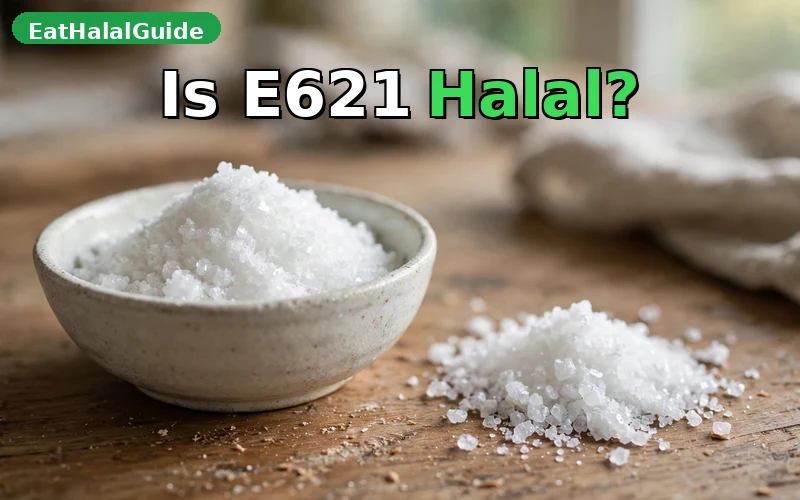
Is E621 halal? The source decides. Standard MSG is made by fermenting plant sugars — sugar cane, beet molasses, corn or tapioca — and that MSG is halal, as is certified MSG. But an uncertified pack listing E621 never names the fermentation growth medium, and in 2001 that medium was made with a pig enzyme.
This guide is about the food additive E621 — monosodium glutamate, or MSG — not the imageboard website that shares the name “e621”. The verdict is source by source: the code, the certified product, the uncertified pack, and the companions on the same label.
Quick Answer
No single verdict — the source decides. E621 is monosodium glutamate (MSG), a flavour enhancer. Standard commercial MSG is Halal by ingredients — made by bacterial fermentation of plant sugars and starches, with no animal ingredient in the finished product. Certified MSG is Halal — AJI-NO-MOTO® made by Ajinomoto (M) Berhad is Halal certified by JAKIM, and Ajinomoto MSG in Indonesia is MUI/BPJPH-certified. An uncertified product listing E621 with no source stated is Mushbooh — the label never names the fermentation growth medium, and the 2001 case proves a pork-derived processing aid has happened. A batch made on a pork-derived medium is Haram — the 2001 Indonesian batch was declared haram by MUI and recalled. Check the companions too — E621 usually appears with E627 and E631.
E621 at a glance
| Code / area | Verdict | Why |
|---|---|---|
| E621 as a molecule, standard production | Halal by ingredients | Bacterial fermentation of plant sugars/starches; no animal ingredient in the finished product |
| Certified MSG (Ajinomoto Malaysia, JAKIM) | Halal | Manufacturer states JAKIM certification; tapioca/sugar-cane fermentation, no animal-based ingredients |
| Certified MSG (Ajinomoto Indonesia, MUI/BPJPH) | Halal | Reformulated with soy-based mameno after the 2001 case; certified since February 2001 |
| Uncertified E621, source unstated | Mushbooh | The label never names the growth medium or processing aids; only a halal mark or the maker settles it |
| Batch made on a pork-derived medium | Haram | The 2001 Indonesian batch (bactosoytone, pig enzyme) was declared haram by MUI and recalled |
| E627 + E631 alongside E621 | Check separately | Guanylate and inosinate can come from fermentation, fish or meat; they are the real risk on the pack |
| E635 (E627 + E631 blend) | Mushbooh | Our E635 page rates the blend Mushbooh — the source is never on the label |
| E621 in the USA | Halal by ingredients | Labels must spell out “monosodium glutamate”; no halal-certified MSG product found by name |
| E621 in the UK | Halal by ingredients | Authorised additive; labelled “flavour enhancer (monosodium glutamate)” or “(E621)”; no halal-certified MSG product found by name |
| E621 in Canada | Halal by ingredients | Not regulated as a food additive but must still be declared; “no MSG” claims are misleading |
| E621 in Malaysia and Indonesia | Halal when certified | JAKIM-certified Ajinomoto in Malaysia; MUI/BPJPH-certified Ajinomoto in Indonesia |
What is E621?
E621 is the European code for monosodium glutamate — MSG — the sodium salt of glutamic acid, an amino acid that occurs naturally in tomatoes, Parmesan, mushrooms and seaweed. As an additive it is a flavour enhancer: it adds umami, the savoury fifth taste. Its Codex number is INS 621, in the glutamate family E620–E625.
Ikeda isolated glutamate from kombu seaweed broth in 1908 and named the taste umami; production began in 1909 as AJI-NO-MOTO® — “essence of taste” — still the world’s best-known MSG. Ask whether MSG is halal and you are asking about this substance: a white crystalline powder, sold pure as a seasoning and added to processed savoury foods. Two distinctions matter: natural glutamate is not added E621, and E621 is not the codes beside it — E627 and E631 are ribonucleotides, not glutamates, and E635 is their blend.
How is E621 made?
Today’s MSG is made by bacterial fermentation — microbes, typically Corynebacterium glutamicum, fermenting a plant carbohydrate such as sugar cane, beet molasses, corn starch or tapioca, then neutralised with sodium and crystallised. Ajinomoto’s own page: its MSG “is produced through fermentation of plant-based ingredients such as sugar cane, sugar beets, cassava or corn”. The FDA says the same: MSG “is produced by the fermentation of starch, sugar beets, sugar cane or molasses”.
On that route there is nothing animal in the finished product — which is why most guides call E621 halal outright. But the route has a part the label never shows: the growth medium. The bacteria need a nitrogen source, and the processing aids that feed them can in principle come from plants or from animals, pigs among them. LPPOM MUI treats MSG as a “critical product” for exactly this reason: the peptone nitrogen source “can come from plants or from animals, pigs among them”, so the enzymes and any shared production line must be free from pork. The ruling follows the pathway, not the code alone.
Why do some sites say E621 is Mushbooh?
Because of one real case, in Indonesia, in 2000–2001 — the case behind nearly every “mushbooh” listing and “pork” rumour. In September 2000, an audit by MUI, the Indonesian Ulema Council, found that PT Ajinomoto Indonesia was using bactosoytone — a bacterial nutrient made using an enzyme from pigs — as a growth-medium ingredient in its MSG fermentation. MUI declared the affected MSG haram, and Indonesia’s health minister ordered a recall of about 3,000 tonnes. Ajinomoto apologised.
The point that matters is what the pork ingredient was: a processing aid for the bacteria, not an ingredient in the finished MSG. That did not save the batch. MUI’s position was that a pork-derived processing aid anywhere in the process made the product haram — and on 19–20 February 2001, after Ajinomoto replaced bactosoytone with mameno, a soy-based nutrient, MUI approved the reformulated product. KH Ma’ruf Amin, then chair of MUI’s fatwa commission, announced the new MSG “declared being halal”; the old batches remained haram.
The doubt has a real origin, and it outlived the case. That is why MUIS’s own listing marks E621 doubtful, why HalalCodeCheck’s E-codes guide rates it Mushbooh, and why the “MSG is made from pork” claim still circulates. The claim as usually stated is wrong — no pork goes into the finished MSG — but the 2001 case is why an uncertified pack listing E621 stays Mushbooh rather than Halal.
What the certifiers and scholars actually say
The certifiers split, and the split is the story.
JAKIM (Malaysia) — Halal, product-level. Ajinomoto Malaysia’s own page states AJI-NO-MOTO® made by Ajinomoto (M) Berhad “is Halal certified by the Islamic Development Department of Malaysia (JAKIM)”, made “through the fermentation of carbohydrates from naturally cultivated tapioca or sugar cane”. No certificate number is published — check the JAKIM logo on the pack.
MUI / LPPOM MUI (Indonesia) — Halal for the reformulated product, since February 2001. See the case above. LPPOM MUI treats MSG as a “critical product”.
SANHA (South Africa) — Halaal. SANHA’s E621 entry (updated 24 July 2023) lists “Status: Halaal” with “Source: fermentation using molasses from cane or beet sugar or wheat protein”.
MUIS (Singapore) — doubtful. MUIS’s own Food Additive Listing (last updated 13 September 2016) lists “621 Monosodium Glutamate/MSG*” — the asterisk means “Syubhah / Doubtful (either by way of its source or manufacturing process)”. Not haram.
IFANCA (USA) — genuinely contested. HalalSpy claims IFANCA “specifically lists E621 as halal in its additive database” and that Ajinomoto holds IFANCA certification in the US. HelalScan claims the opposite: “IFANCA lists E621 as questionable (Q2)”. IFANCA’s own live Halal Shopper’s Guide (21 September 2011) lists neither MSG nor E621 in its Haram/Avoid or Investigate Further lists — so the primary guide settles neither claim. The conflict is the finding.
Darul Ifta Birmingham (UK, 2020) — Ajinomoto halal. Maulana Mustafa Umar (checked by Mufti Mohammed Tosir Miah) ruled Ajinomoto halal, noting it is made from “molasses and tapioca starch derived from sugarcane” (Fatwa ID 03744, 20 May 2020).
Scholars — the transformation question. SeekersGuidance (Mawlana Ilyas Patel) concludes that “if the culture of MSG is halal or if a proper chemical transformation (Istihala) has taken place, then MSG will be considered halal” — but where no such details are available, “it should be avoided and abstained from due to doubt, although it cannot be classified as haram”. That is the Mushbooh position stated most carefully — our What Is Halal Food? guide explains the label. IslamQA (Askimam, checked by Mufti Ebrahim Desai) likewise makes halal status depend on the process: MSG produced in South Africa is halal as SANHA-approved, US MSG is halal as kosher-certified, and Indian MSG is unknown — “Until further research is carried out, we advise that you abstain from consuming it.”
Where you meet E621

E621 is everywhere savoury food is processed: instant noodles, crisps, soups, stock cubes, gravy granules, seasoning blends, sauces, processed meats, frozen ready meals, and takeaway cooking. It is also sold pure: Ac’cent in the US, Ajinomoto — “Chinese salt” — across Asia. The table below names only products where a source actually shows E621 on the label.
| Product | What the label shows | Note |
|---|---|---|
| Shin Ramyun 120g (EU pack) | “flavour enhancers: E621, E627, E631” in the seasoning powder | Our Shin Ramyun guide says the pack decides — do not contradict it |
| Shin Ramyun Stir Fry 131g | “flavour enhancers: E621, E627, E631” | Same trio as the soup pack |
| Shin Ramyun Black 130g | “Geschmacksverstärker E621” in one seasoning powder | German label wording |
| Maggi Vegetable Stock Cubes Less Salt 72g (NL) | “smaakversterkers (E621, E627, E631)” | Dutch pack |
| Maggi Chicken flavor bouillon cubes (US) | “Monosodium Glutamate… Disodium Inosinate…” | US wording — the name, not the code |
| Doritos Nacho Cheese (US) | “monosodium glutamate (MSG), disodium inosinate, and disodium guanylate” | Label comparison, not a Doritos press release |
| Pringles, flavoured UK varieties | E621 together with E627/E631 or E635 | Flavour decides — Original has none |
| Takis Fuego (US) | E621 plus E627/E631 | The companions, not E621 alone, are the problem |
| Takis Fuego Pix (US) | “monosodium glutamate”, neither E631 nor E627 | A cleaner label than Fuego |
| Ac’cent (US) | One ingredient: monosodium glutamate | Pure MSG; no halal certification found |
Three warnings from the label work. First, flavour decides: HalalCodeCheck, checking UK Pringles against Ocado and Waitrose in August 2026, found every flavoured variety contains E621 with E627/E631 or E635 — while Original has none, and one Pringles Hot Honey label lists no MSG at all. Do not say “Pringles contain MSG” flatly. Second, packs differ by market: one New Zealand/Australia Shin Ramyun entry lists E621, E627 and E631 yet carries a “No MSG Added” flag. Third, some claims have no label behind them: no Cheetos flavour E621 label, no Walkers or Lay’s transcription, and the Campbell’s claim is secondary only. Our Shin Ramyun, Hot Cheetos and Nissin guides cover the noodle, snack and seasoning questions pack by pack.
E621’s companions: E627, E631 and E635

E621 rarely travels alone. On most labels it sits with E627 (disodium guanylate) and E631 (disodium inosinate), or as E635 — the blend of the two. Those two are the genuinely source-dependent codes, and usually the real problem on the pack. E627 and E631 are ribonucleotides, not glutamates. They can be made by fermentation, or from fish, or from meat — pork among them. The label never says which. That is why the guides that rate E621 “halal” still tell you to verify E631 and E635 on the same pack. Our own Is E635 Halal or Haram? page rates the blend Mushbooh for exactly this reason. The rule: read the whole flavour-enhancer line, not just the first code. E621 alone, certified or plant-fermented, is the easy half; E621 plus E631 or E635 is a pack to check. Our Is E422 Halal or Haram? guide is the parallel case.
E621 in the USA, UK, Canada and Malaysia–Indonesia
USA. The FDA considers MSG “generally recognized as safe” (GRAS) and requires added MSG to be listed by its name: “FDA requires that foods containing added MSG list it in the ingredient panel on the packaging as ‘monosodium glutamate.'” The E-number is not used on US labels — look for the words, not “E621”. Ask is e621 halal in usa: halal by ingredients — but no US halal-certified MSG product was found by name, and none was found for Ac’cent.
UK. E621 is on the GOV.UK “Approved additives and E numbers” list. UK labels declare it as “Flavour enhancer (MSG)”, “(621)”, “flavour enhancer: monosodium glutamate”, or by the name alone. Ask is e621 halal in uk: halal by ingredients, with the same gap — no UK halal-certified MSG product was found by name. UK-sold halal seasonings instead advertise “No Added MSG”. Ajinomoto MSG is sold in UK supermarkets, but no halal mark was found on the UK pack. McDonald’s UK states: “There is no MSG (Mono Sodium Glutamate) in any food sold in McDonald’s UK restaurants.”
Canada. Health Canada: MSG “is not regulated as a food additive” in Canada — but it “must also be declared in the list of ingredients”. “Contains no MSG” and “no MSG added” claims are misleading, because other added glutamate sources exist — soya sauce, autolysed yeast extracts, hydrolysed plant or vegetable protein. No Canada-specific halal certification for MSG was found.
Malaysia and Indonesia. Here certified MSG is the norm. In Malaysia, AJI-NO-MOTO® is JAKIM-certified — check the logo on the pack. In Indonesia, Ajinomoto MSG is MUI/BPJPH-certified after the 2001 reformulation, and LPPOM MUI points shoppers to certified products. The 2001 case is history, not a live warning about today’s certified packs.
The safety note
Safety and permissibility are separate questions. The FDA considers MSG GRAS; in studies with self-identified sensitive people, “scientists have not been able to consistently trigger reactions”. A FASEB review for the FDA concluded MSG is safe, while noting mild symptoms in some sensitive people who consume 3 grams or more without food. JECFA gave glutamic acid and its salts an ADI of “not specified” in 1987.
EFSA is more cautious: its 2017 re-evaluation set a group ADI of 30 mg/kg body weight per day for glutamic acid and glutamates E620–E625, and concluded exposure “may exceed not only the safe level but also doses associated with adverse effects in humans for some population groups”. That ADI is disputed — a 2018 review argues it sits below normal dietary intake. One minority view deserves a line, not a verdict: a 2025 paper in Al-Fikru argues MSG “can be categorized as haram li-ghayrihi (haram due to external effects), specifically its negative impact on health” — a journal article, not a fatwa, and never “MSG is haram”.
How to check any E621 product in 30 seconds
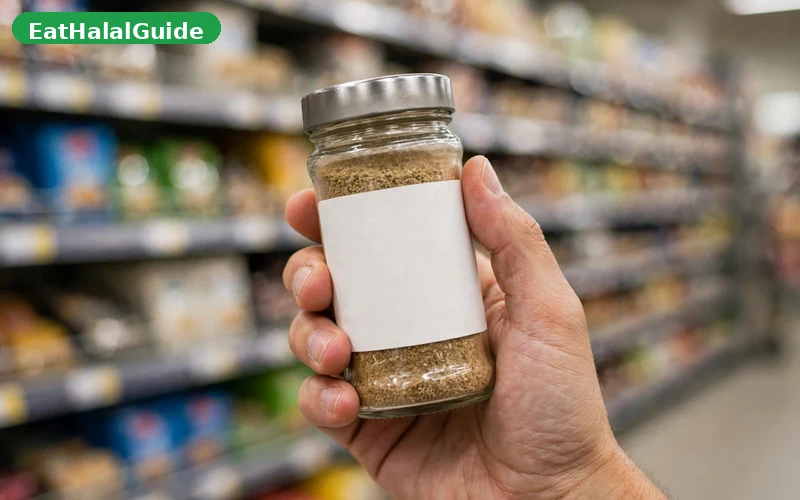
Five checks. First, the halal mark — a recognised logo settles the whole product. Second, the words — “monosodium glutamate” in the USA and Canada; “flavour enhancer (E621)” in the UK and EU. Third, the companions — if the same line lists E631 or E635, ask the maker about the inosinate. Fourth, the rest of the label — one halal code does not make the whole product halal; Gelatin, alcohol and meat extracts are separate questions. Fifth, the maker — if nothing on the packet settles it, the manufacturer can tell you the source. Our E-Code Database hub lists the codes checked so far — E621 is still in “Codes we have not checked yet”.
Frequently Asked Questions
Is E621 halal? No single verdict — the source decides. Plant-fermented MSG is halal by ingredients; certified MSG (JAKIM, MUI/BPJPH) is halal. An uncertified pack listing E621 with no source stated is Mushbooh; a pork-medium batch is haram (MUI, 2001).
Is MSG halal? Yes, in ordinary production: fermented glutamic acid as a salt, made from plant sugars or starches, with no animal material in the finished product. Ask is msg halal about a specific pack — check the halal mark and E631/E635.
Is monosodium glutamate halal? Yes, when plant-fermented or certified. Ask is monosodium glutamate halal about an uncertified pack with no source stated and the answer is Mushbooh — the 2001 case shows why.
Is Ajinomoto halal? Ajinomoto made in Malaysia is Halal certified by JAKIM, and Ajinomoto in Indonesia is MUI/BPJPH-certified after the 2001 reformulation. Ask is ajinomoto halal about a pack sold elsewhere — check that pack.
Is E621 halal in the UK? Yes, halal by ingredients — E621 is an authorised additive. Ask is e621 halal in uk about an uncertified pack: Mushbooh — no UK halal-certified MSG product was found by name.
Is E621 halal in the USA? Yes, halal by ingredients — US labels spell out “monosodium glutamate”. Ask is e621 halal in usa about an uncertified pack: Mushbooh — no US halal-certified MSG product was found by name, and none for Ac’cent.
Final Thoughts
The “Halal” pages are right about the standard route — plant fermentation, no animal ingredient in the finished product — and wrong to ignore the medium. The “Mushbooh” pages are right about the label — it never names the medium — and wrong to ignore certified MSG. The 2001 case is the hinge: a pork-derived processing aid, a haram ruling, a recall, a reformulation, and a halal ruling three months later. It proves the doubt is real, and answerable — by a certificate, or by the maker. So read the pack the way this guide does: mark first, words second, companions third, maker fourth. On E621, the label is not the whole answer — but the mark on the label is.
What we could not verify
- The MUI 2000–01 fatwa text: the fatwa itself was not opened. The dates, the bactosoytone-to-mameno change and the recall are corroborated by contemporary news and a 2024 journal article.
- JAKIM certificate number/expiry for AJI-NO-MOTO®: none was found on Ajinomoto’s own pages. Verify live on the JAKIM portal before citing any number.
- MUI/BPJPH certificate for Ajinomoto Indonesia MSG: a certificate PDF found in search covers seasonings, not a standalone MSG line; the Ajinomoto Indonesia certificate link was not opened.
- HFA / HMC and islamqa.info: no E621-specific position from either UK body was found, and no islamqa.info fatwa on MSG/E621 was found.
- No UK or US halal-certified MSG product, no Canada-specific halal certification, and no Saudi/Gulf MSG certificate were found. UK halal seasonings advertising “No Added MSG” (Prymat; Cape Herb & Spice) were found instead.
- Product labels: no Cheetos flavour E621 label, no Walkers/Lay’s transcription, and no current UK Knorr/Oxo transcription were found; the Campbell’s claim is secondary only.
- Chick-fil-A / KFC MSG claims: secondary reporting only — Chick-fil-A MSG in seasoned (not grilled) chicken; a KFC spokesperson reported to confirm MSG in the original recipe.
- Pakistan: the Supreme Court MSG ban (3 March 2018) was lifted in December 2024 — the federal cabinet decided the ban on manufacturing and import of MSG must be lifted (Express Tribune, 14 December 2024).
- PAA: the live People Also Ask block for “is e621 halal” (captured 2026-11-20) asks: Does E621 contain pork? Is E621 halal or haram? Can Muslims eat Ajinomoto? Is MSG the same as E621? Does E621 halal? Is E621 vegetarian? Is E621 bad? Can Muslims eat red 40? What is E621 in food? — nothing in the answers contradicts this guide.
- HalalCodeCheck, halalharams.com and halalinfohub.com have no E621 page. The competition is HalalSpy, halaloharam.com and isithalal.food.
Sources & Verification
| # | Source | What it says | Status |
|---|---|---|---|
| 1 | Ajinomoto global — “What is MSG and How is it Made?” (ajinomoto.com) | “Today, the MSG (monosodium glutamate) produced by the Ajinomoto Group is produced through fermentation of plant-based ingredients such as sugar cane, sugar beets, cassava or corn.” History: gluten hydrolysis, then 1930s soy extraction, then 1960s bacterial fermentation. | Verified — opened directly 2026-11-20 |
| 2 | Ajinomoto Malaysia — AJI-NO-MOTO® product page (ajinomoto.com.my) | “AJI-NO-MOTO® is produced through the fermentation of carbohydrates from naturally cultivated tapioca or sugar cane, hence it contains no animal-based ingredients.” “Yes, AJI-NO-MOTO® manufactured by Ajinomoto (M) Berhad is Halal certified by the Islamic Development Department of Malaysia (JAKIM).” No certificate number or expiry on the page. Ajinomoto Malaysia says it has held JAKIM approval since 1965 and was named JAKIM’s “Best Malaysian Halal Certificate Holder” in 2021. | Verified — opened directly 2026-11-20 |
| 3 | FDA — “Questions and Answers on Monosodium glutamate (MSG)” (fda.gov, 19 Nov 2012; page updated 17 Jul 2026) | “FDA considers the addition of MSG to foods to be ‘generally recognized as safe’ (GRAS).” “Today… MSG is produced by the fermentation of starch, sugar beets, sugar cane or molasses.” “FDA requires that foods containing added MSG list it in the ingredient panel on the packaging as ‘monosodium glutamate.'” “No MSG”/”No added MSG” claims barred where naturally-glutamate ingredients are present; MSG cannot be listed as “spices and flavoring”. FASEB: safe; mild transient symptoms possible at 3 g or more without food; typical serving under 0.5 g. | Verified — opened directly 2026-11-20 |
| 4 | EFSA — press release “EFSA reviews safety of glutamates added to food” (efsa.europa.eu, 12 Jul 2017) | Group ADI 30 mg/kg body weight per day for glutamic acid and glutamates (E620–E625), from a NOAEL of 3,200 mg MSG/kg bw/day. “Estimated dietary exposure… may exceed not only the safe level but also doses associated with adverse effects in humans for some population groups.” EU max generally 10 g/kg food; no numerical max in salt substitutes, seasonings and condiments. Full opinion: EFSA Journal 2017;15(7):4910. A 2018 review argues the ADI sits below normal dietary intake and the old “not specified” ADI needed no change. | Verified — opened directly 2026-11-20 (press release; full opinion via PMC, search text) |
| 5 | WHO JECFA database — Monosodium glutamate (apps.who.int) | Evaluation year 1987 (Meeting 31); ADI: NOT SPECIFIED; group ADI for L-glutamic acid and its ammonium, calcium, monosodium, magnesium and potassium salts; INS 621; CAS 142-47-2. Human studies failed to confirm MSG involvement in “Chinese Restaurant Syndrome” (term from a 1968 NEJM letter). | Verified — opened directly 2026-11-20 |
| 6 | SANHA — E621 Monosodium Glutamate (sanha.org.za, published 14 Dec 2009, updated 24 Jul 2023) | “Status: Halaal. Source: fermentation using molasses from cane or beet sugar or wheat protein.” Same page carries a “Health Code: Red” warning — a health flag, not a halal ruling. An older, widely circulated E-number table attributed to SANHA lists E621 as Mushbooh — it contradicts the current page. | Verified — opened directly 2026-11-20 |
| 7 | MUI / LPPOM MUI — 2000–01 Ajinomoto Indonesia case (Just-Food, 20 Feb 2001; Jakarta Post, 1 Feb 2001; Hasanudin et al., Al-Manāhij Vol. 18 No. 2, Jul–Dec 2024) | Sept 2000 audit found bactosoytone (pig-enzyme nutrient); MUI declared the MSG haram (16 Dec 2000 per HelalScan); public 9 Jan 2001; recall ~3,000 tonnes (Jakarta Post: 2,756.1 t MSG + 586.7 t Masako + 68 t Sajiku, 3–24 Jan 2001); reformulated with soy-based mameno; 19–20 Feb 2001 MUI declared the new MSG halal (KH Ma’ruf Amin: “declared being halal”); old batches remained haram. 2024 article: MSG “permissible (halal), provided that it is produced from halal ingredients and is processed, packaged, marketed, distributed, and served in compliance with Islamic law”. LPPOM MUI treats MSG as a “critical product”; peptone can come from plants or animals, pigs among them. Seven executives were named as suspects. KH Ma’ruf Amin was then chair of MUI’s fatwa commission and later became Vice President of Indonesia. LPPOM MUI’s clarification also records that all Ajinomoto products distributed in Indonesia are BPJPH-certified, and that a viral “Pork Savor” Ajinomoto product “is not produced or distributed by PT Ajinomoto Indonesia”. | Partially verified — contemporary news + 2024 journal article, 2026-11-20 (fatwa text itself not opened) |
| 8 | Darul Ifta Birmingham, 2020 (daruliftabirmingham.co.uk/is-ajinomoto-halal/, Fatwa ID 03744, 20 May 2020) + IslamQA Askimam 75818 (Ebrahim Desai) | Answer by Maulana Mustafa Umar, checked by Mufti Mohammed Tosir Miah: Ajinomoto halal; made from “molasses and tapioca starch derived from sugarcane”. IslamQA (checked by Mufti Ebrahim Desai): MSG produced in South Africa is halal as SANHA-approved; US MSG is halal as kosher-certified; Indian MSG is unknown — “Until further research is carried out, we advise that you abstain from consuming it.” | Verified — both originals opened directly 2026-11-20 |
| 9 | SeekersGuidance — Mawlana Ilyas Patel, checked by Shaykh Faraz Rabbani (seekersguidance.org) | “If the culture of MSG is halal or if a proper chemical transformation (Istihala) has taken place, then MSG will be considered halal. However, where no such details are available… it should be avoided and abstained from due to doubt, although it cannot be classified as haram.” | Partially verified — search text, 2026-11-20 |
| 10 | MUIS Food Additive Listing (muis.gov.sg, PDF last updated 13 September 2016) | Lists “621 Monosodium Glutamate/MSG*” — the asterisk means “Syubhah / Doubtful (either by way of its source or manufacturing process)”. Not haram. The same listing marks E162 with no asterisk. | Verified — opened directly 2026-11-20 |
| 11 | IFANCA — conflicting secondary claims (HalalSpy vs HelalScan) | HalalSpy: “IFANCA specifically lists E621 as halal in its additive database” + Ajinomoto holds IFANCA certification (US). HelalScan: “IFANCA lists E621 as questionable (Q2).” Reproduced IFANCA table (doczz.net): “Mono-sodium glutamate (MSG) 621 — Flavour enhancer — Halal”. IFANCA 2010 guide: “MSG (Monosodium Glutamate) — Halal”. IFANCA’s own live Halal Shopper’s Guide (21 Sep 2011) lists neither MSG nor E621 in its Haram/Avoid or Investigate Further lists. | Unresolved conflict — reported as such, 2026-11-20; primary IFANCA guide opened directly |
| 12 | GOV.UK — “Approved additives and E numbers” (gov.uk) | E621 Monosodium glutamate listed; authorised under assimilated Regulation (EC) No 1333/2008; E620–E625 “Glutamic acid — glutamates”. | Verified — opened directly 2026-11-20 (via research) |
| 13 | Health Canada — “Monosodium glutamate (MSG) and other sources of glutamate in foods” (canada.ca) | MSG “is not regulated as a food additive” in Canada but “must also be declared in the list of ingredients”, even inside flavouring/spice mixtures. “Contains no MSG”/”no MSG added” claims are misleading (soya sauce, autolysed yeast extracts, HPP/HVP are other added sources). “All studies found that MSG does not pose a health hazard to people.” Usage guidance: no more than 5 mL (1 tsp) per kg of food. Also look for glutaminase in the ingredient list. | Verified — opened directly 2026-11-20 (via research) |
| 14 | Regulation (EC) No 1333/2008, Annex II (legislation.gov.uk) | E620–E625: “Glutamic acid — glutamates” — E620 glutamic acid, E621 monosodium glutamate, E622 monopotassium glutamate, E623 calcium diglutamate, E624 monoammonium glutamate, E625 magnesium diglutamate. | Verified — opened directly 2026-11-20 (via research) |
| 15 | 21 CFR 101.22(h)(5) + 21 CFR 182.1 (eCFR / Cornell LII) | 101.22(h)(5): MSG “shall be declared by its common or usual name ‘monosodium glutamate'”. 182.1 names MSG among common food ingredients regarded as safe for intended use. | Partially verified — search text, 2026-11-20 |
| 16 | Open Food Facts — Shin Ramyun 120g (EU pack, barcode 8801043069588); Shin Ramyun Stir Fry 131g; Shin Ramyun Black 130g | “flavour enhancers: E621, E627, E631” (120g + Stir Fry); “Geschmacksverstärker E621” (Black). The 120g entry also carries a “Halal” label flag on Open Food Facts (EU pack). | Partially verified — search text / label captures, 2026-11-20 |
| 17 | Open Food Facts — Maggi stock cubes (NL/France/US) | Vegetable Stock Cubes Less Salt 72g (NL): “smaakversterkers (E621, E627, E631)”. Kub Or (France): “exhausteurs de goût (glutamate monosodique, guanylate et inosinate disodiques)”. Chicken flavor bouillon cubes (US): “Monosodium Glutamate… Disodium Inosinate…”. | Partially verified — search text / label captures, 2026-11-20 |
| 18 | HalalCodeCheck — E-Codes Halal Guide (halalcodecheck.com/blog/e-codes-halal-guide/) | E621: “Mushbooh (Verify source). Usually made through bacterial fermentation (halal), but depends on culture media.” No certifier, regulator, fatwa or source named for E621; no brands named; no date shown. | Verified — opened directly 2026-11-20 (competitor) |
| 19 | HalalCodeCheck — JAKIM Halal E-Codes guide (halalcodecheck.com/blog/halal-ecodes-malaysia-jakim-guide/) | E621: “Halal” in three tables — “Accepted under JAKIM — plant fermentation standard”; “Always Halal (No Certificate Required)”. Contradicts the same site’s E-codes guide (Mushbooh) and energy-drinks page (Mushbooh). No specific JAKIM document or certificate number cited. | Verified — opened directly 2026-11-20 (competitor) |
| 20 | HalalCodeCheck — Pringles (halalcodecheck.com/blog/pringles-halal-status-every-flavour/) | Flavoured UK varieties verified Aug 2026 (Ocado/Waitrose) contain E621 with E627/E631 or E635; Original has none. Mainstream position accepts them when vegetarian-labelled; HMC-strict = Mushbooh. | Partially verified — search text, 2026-11-20 (competitor) |
| 21 | HalalCodeCheck — Nissin (halalcodecheck.com/brand/nissin/) | E621 in the seasoning sachet listed as Halal; E627/E631 flagged as the key line. | Partially verified — search text, 2026-11-20 (competitor) |
| 22 | HalalCodeCheck — Takis (halalcodecheck.com/brand/takis/) | Takis Fuego: E621 plus E627/E631. Takis Fuego Pix: “monosodium glutamate” but neither E631 nor E627. | Partially verified — search text, 2026-11-20 (competitor) |
| 23 | HalalSpy — “Is E621 (MSG) Halal?” (halalspy.com, updated 2026-03-19) | Verdict Halal; claims Ajinomoto holds JAKIM + MUI + IFANCA certification and “IFANCA specifically lists E621 as halal in its additive database”. Also claims “No credible Islamic authority classifies E621 as haram or even mashbooh” — FALSE on the evidence found (MUIS’s own listing says doubtful; HalalCodeCheck rates Mushbooh). Do not repeat that claim. | Verified — opened directly 2026-11-20 (competitor) |
| 24 | HalalOHaram — “Is E621 Halal or Haram? MSG Rulings Explained” (halaloharam.com, published 2026-02-01, updated 2026-09-30) | Verdict Halal “for most scholars and certifiers”. Fullest 2001 MUI case account of any competitor; Darul Ifta Birmingham 2021; Qur’an 2:29, 5:3, 2:185; Bukhari 52; Tirmidhi 2518; FDA GRAS; Pakistan ban 3 Mar 2018 + Dec 2024 review petition; ban lifted Dec 2024 (Express Tribune, 14 Dec 2024). Country table (UK/US/Canada halal by ingredients). Weaknesses: no certificate numbers; MUI fatwa + Darul Ifta answer summarised, not linked as primary documents; no label photo; “major makers switched to plant-based media after 2001” unnamed/uncited. | Verified — opened directly 2026-11-20 (competitor) |
| 25 | HelalScan — “E621 Monosodium glutamate (MSG): Halal or Haram?” (helalscan.com) | Verdict Doubtful. “IFANCA lists E621 as questionable (Q2).” SANHA Halaal quote; MUI timeline (16 Dec 2000 haram / 19 Feb 2001 halal); LPPOM MUI “critical product”; Darul Ifta Birmingham summary; madhhab split on istihalah (its own characterisation). | Verified — opened directly 2026-11-20 (competitor) |
| 26 | ECodeHalalCheck — E621 (ecodehalalcheck.com/ecode/621, updated 2026-09-12) | Verdict Doubtful, attributed to “MUIS Food Additive Listing · Last reviewed 12 September 2026”. | Verified — opened directly 2026-11-20 (competitor) |
| 27 | IsItHalal.food — “Is MSG (E621) Halal? Yes, Fermented” (isithalal.food, updated 2026-11-15) | Verdict Halal; E620–E625 family; “Still verify E631 and E635 on the same pack”; notes Indonesia’s food/drug agency announced the finished 2001 product contained no pig-derived substances. | Verified — opened directly 2026-11-20 (competitor) |
| 28 | EatHalalGuide — Is E635 Halal or Haram? | E635 (disodium 5′-ribonucleotides, the E627+E631 blend) is Mushbooh — the source is never on the label. | Verified — our own published article |
| 29 | EatHalalGuide — Is E422 Halal or Haram? | Glycerol is Mushbooh — one molecule, three sources, and the label never says which. The parallel “check the source” case. | Verified — our own published article |
| 30 | EatHalalGuide — Is Shin Ramyun Halal or Haram? | The pack decides — EU pack lists E621+E627+E631 in the seasoning powder. | Verified — our own published article |
| 31 | EatHalalGuide — Are Hot Cheetos Halal or Haram? | Flavourings and enzymes decide, not E621 alone. | Verified — our own published article |
| 32 | EatHalalGuide — Is Nissin Halal or Haram? | Seasoning sachet carries E621; the pack and the country decide. | Verified — our own published article |
| 33 | EatHalalGuide — Is Gelatin Halal or Haram? | What E441 is and where it hides in the same processed foods. | Verified — our own published article |
| 34 | EatHalalGuide — What Is Halal Food? | Mushbooh explainer. | Verified — our own published article |
| 35 | EatHalalGuide — E-Code Database (e-codes/) | Hub lists E621 in “Codes we have not checked yet”; deep guides for E471, E621 and E120 listed as coming next; 16 codes checked so far (8 Halal, 5 Mushbooh, 1 Varies, 2 mixed — E110 + E160b dry Halal, liquid Mushbooh). Hub text last verified 2026-11-19. | Verified — our own published hub page (live, last verified 2026-11-20) |
Last verified: 2026-11-20