

Is E904 halal? There is no single agreed answer — it is Mushbooh, because scholars and certifiers disagree about an insect secretion. SANHA lists E904 as Halaal, IFANCA calls it halal, and MUI’s fatwa calls shellac pure. Against that, the Darul Iftaa answer quoted by IslamQA lists E904 among the outright haram codes.
If you came here asking “is shellac halal”, the answer is the same.
Quick Answer
| Form | Verdict |
|---|---|
| Shellac itself, as an ingredient | ⚠️ Mushbooh — scholars differ |
| Product with a recognised halal mark | ✅ Halal |
| You avoid all insect-derived ingredients | ⚠️ Avoid by choice — pick carnauba wax (E903) instead |
| Finished sweet, uncertified, other doubtful ingredients | ⚠️ Check the whole label |
SANHA lists it Halaal. IFANCA, MUI and two published fatwas permit it; the Darul Iftaa answer calls it haram. No single verdict covers everyone — that is what Mushbooh means here.
What is E904?
The e904 food code is the European code for shellac, a glazing agent. Its Codex number is INS 904. Authorised in the EU and Great Britain, permitted in the US and Canada. The EU specification defines it as “the purified and bleached lac, the resinous secretion of the insect Laccifer (Tachardia) lacca Kerr”. Shellac is not pork, not gelatin and not carmine.
Where does shellac come from?
Shellac has one route: the lac insect. Lac insects secrete a resin on host-tree branches in India and Thailand; workers scrape it off, wash and refine it into flakes, then dissolve the flakes in food-grade ethanol to make liquid glaze. There is no plant or synthetic shellac: every E904 is insect resin. That single fact is the whole argument.
| Part | Source | Verdict | Why |
|---|---|---|---|
| Shellac resin | Insect — lac insect secretion | ⚠️ Mushbooh | Scholars differ on insect secretions |
| Liquid glaze | Resin + ethanol solvent | ⚠️ Check | Ethanol source is a process check (MUI) |
| Finished food | Resin + other ingredients | ⚠️ Check | Gelatin, carmine and alcohol fillings are separate questions |
Why scholars differ — the secretion question
The permit side reads shellac as a secretion, not the insect. IFANCA, asked by SANHA itself, calls it “similar to honey or bees wax” and therefore halal. SeekersGuidance (Hanafi, checked by Shaykh Faraz Rabbani) calls it permissible in food and medicine: a secretion is not the insect’s body. Dar Al-Ifta agrees by istihala (transformation). MUI Fatwa No. 27 of 2013 calls shellac pure (suci), halal as an additive while beneficial and not harmful.
The other side reads it as an insect product, full stop. The Darul Iftaa answer quoted by IslamQA (AskImam 19202, approved by Mufti Ebrahim Desai) lists four haram codes, one “E-904 Shellac: Insect secretion”. Note the tension: the same answer cites SANHA — yet SANHA’s own E904 page today says Halaal (the answer is from 2012; the page was updated in 2023).
The ethanol question
Flake shellac is usually dissolved in ethanol, and the dried coating on a sweet is a thin resin film, not a drink. The MUI discussion flags the ethanol as the critical point: it must come from non-khamr industrial alcohol and must not be harmful. If your standard rejects any alcohol-contact processing, choose a carnauba-wax (E903) or beeswax (E901) sweet instead.
Which foods contain E904?
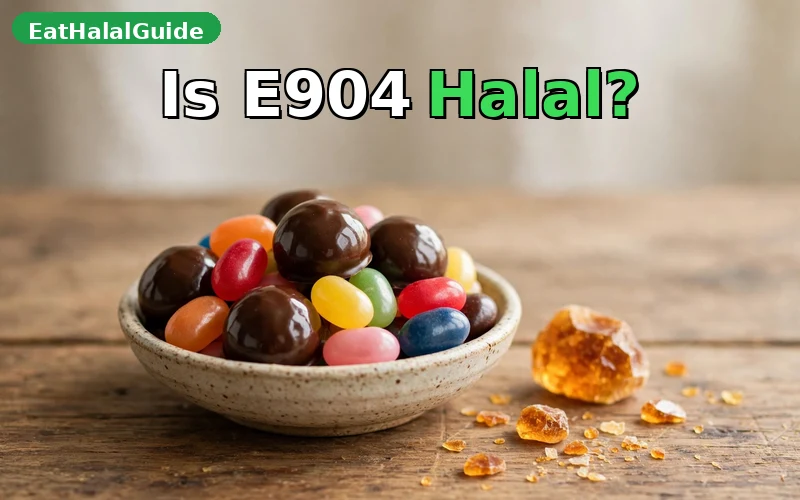
SANHA lists its uses as tablet sealer, varnish or glazing, sweets and waxed fruit — in practice, shiny jelly beans and chocolate-coated sweets, waxed apples and citrus, cake decorations, and tablet and capsule coatings. A jelly bean with a shellac glaze may still have a gelatin centre — see our Gelatin guide — so check the whole label.
The safety note
EFSA’s 2024 re-evaluation set an acceptable daily intake of 4 mg per kg of body weight per day for wax-free shellac made by physical decolouring (temporary for the chemically bleached form; not for wax-containing shellac). EFSA found no reports of food allergy. The FDA lists purified shellac as a permitted diluent (21 CFR 73.1); Health Canada permits it on cake decorations and confectionery (4,000 ppm). None of this is a halal ruling — it is food safety.
How to check your label in 30 seconds
- Find it. “E904”, “shellac”, “confectioner’s glaze” or “pharmaceutical glaze” — the same thing.
- Decide your standard. Do you accept insect secretions? If yes, shellac is fine under SANHA, IFANCA and MUI.
- Check for a halal mark — a recognised logo audits glaze and product.
- Check the rest of the label — gelatin, carmine and alcohol are separate questions.
- If in doubt, ask the maker, or pick a carnauba-glazed alternative.
See Also: E-Code Database
See Also: Is E635 (Disodium 5′-Ribonucleotides) Halal or Haram?
Frequently asked questions
Is E904 halal?
Mushbooh — scholars differ. SANHA lists it Halaal and MUI Fatwa 27/2013 calls it pure; the Darul Iftaa answer lists it haram. A halal mark settles a product.
Is shellac the same as gelatin?
No. Gelatin is animal collagen; shellac is lac resin. A sweet can contain one, both or neither — read the full list.
Is shellac vegan?
No — it comes from an insect. Vegan and halal differ: beeswax is not vegan either, and it is generally accepted as halal.
Is E904 halal in the USA, UK and Canada?
Authorised or permitted in all three; the halal question is the same in all three: scholars differ, so Mushbooh everywhere.
Final Thoughts
E904 is the most divided code so far. Unlike tartrazine — see our E102 guide — the certifiers do not agree here. If you follow SANHA, IFANCA or MUI, shellac is halal; if you follow the Darul Iftaa answer, it is haram. That is why this page says Mushbooh.
Sources & Verification
| # | Source | What it says | Status |
|---|---|---|---|
| 1 | SANHA — E904 (Shellac), sanha.org.za | “E-number: 904, Name: Shellac. Function: Glazing agent. Status: Halaal. Source: resin of lac insect.” Health Code Green. Uses: “Tablet sealer; Varnish or glazing; Sweets, waxed fruit”. | Verified — opened directly 2026-11-17 |
| 2 | IFANCA — Halal Happenings, Summer 2007 (Mail Bag), ifanca.org | SANHA asked IFANCA’s ruling on shellac. IFANCA: “By nature, as a secretion of insects, it is similar to honey or bees wax. Both the honeybee and lac insect are not haram or even najs, as verified by our religious scholars. Any ingredient or product from similar insects is therefore, halal.” | Verified — opened directly 2026-11-17 |
| 3 | LPPOM MUI — Shellac article, halalmui.org (23 Feb 2024, Rina Maulidiyah, Auditor Halal LPPOM MUI) | MUI Fatwa No. 27 of 2013: shellac is pure (suci); its use as an additive or processing aid in food, medicines and cosmetics is halal while beneficial and not harmful. Ethanol used to dissolve it is the critical point — it must come from non-khamr industrial alcohol. | Verified — opened directly 2026-11-17 |
| 4 | SeekersGuidance — Is It Permissible to Consume Shellac-Coated Food? (12 Mar 2023, Mawlana Ilyas Patel; checked and approved by Shaykh Faraz Rabbani) | “Shellac is a resin secreted by the female lac bug on trees in the forests of India and Thailand. It is permissible to use it in medicine and food items” — honey analogy, small amount mixed into a large mass, difficulty of separation, istihala. | Verified — opened directly 2026-11-17 |
| 5 | Egypt’s Dar Al-Ifta — Is shellac prohibited… (Fatwa 6880), dar-alifta.org | “It is permissible to add this substance to medicine and foodstuff provided it has not been proved to be harmful to human health.” Reasoning: istihala (transformation) removes the impurity. | Verified — opened directly 2026-11-17 |
| 6 | IslamQA (Hanafi) — E-numbers answer, AskImam 19202 (Darul Iftaa; Ml. Asif Umar; checked and approved by Mufti Ebrahim Desai) | Haram list: “E-904 Shellac: Insect secretion”. The same answer’s source line cites SANHA — whose own E904 page today says Halaal. | Verified — opened directly 2026-11-17 |
| 7 | Commission Regulation (EU) 2026/189, EUR-Lex | E904 authorised as a glazing agent; recital (7) quotes EFSA’s 2024 re-evaluation (EFSA Journal 2024;22(8):e8897): ADI “of 4 mg/kg bw per day for wax-free shellac (E 904) produced by physical decolouring”. Specification: “Shellac is the purified and bleached lac, the resinous secretion of the insect Laccifer (Tachardia) lacca Kerr (Fam. Coccidae).” | Verified — opened directly 2026-11-17 |
| 8 | Health Canada — List of Permitted Glazing Agents, canada.ca (published 2024-12-18) | “S.1 Shellac — (a) Cake decorations (b) Unstandardized confectionery — Glazing agent — 4,000 ppm”. | Verified — opened directly 2026-11-17 |
Last verified: 2026-11-17
What we could not verify
- HFA (UK), JAKIM and HMC: no E904-specific statement from any of the three was opened directly on 2026-11-17. Secondary apps claim HFA and JAKIM do not accept shellac — NOT repeated here as verified fact.
- IFANCA’s ruling is from its 2007 newsletter, not a current fatwa page; no newer statement was found.
- EFSA 2024 opinion: Wiley full text returned HTTP 403 at prep; the ADI is verified via Regulation (EU) 2026/189 recital (7), which quotes the opinion.
- The ethanol source in any specific product’s glaze: no label states it; no brand-level check was done.
- Whether any specific glazed sweet or tablet is halal: no product-level check was done.
- halalharams.com: no shellac / E904 page surfaced in search on 2026-11-17.


