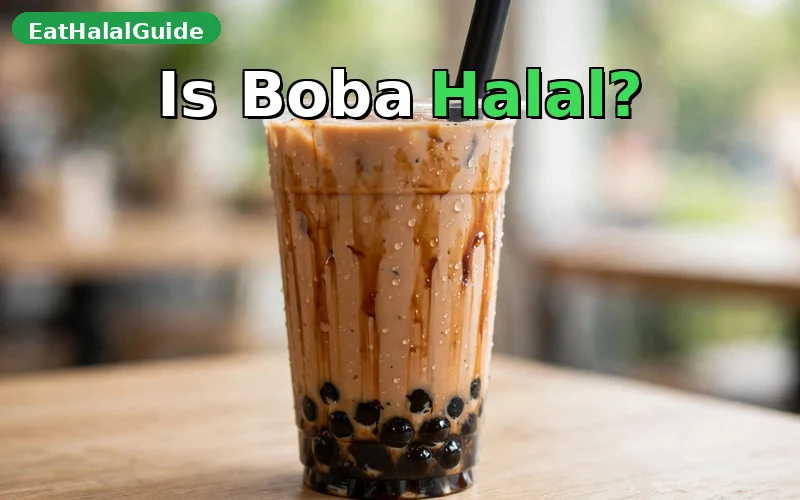

Boba is everywhere now — tall cups with dark pearls at the bottom, extra-wide straws, and a menu that runs from classic milk tea to purple taro. If you are asking is boba halal, you are asking the right question, because the answer is not one word: the pearls are halal, but the drink depends on the cup.
That split is the whole story. The pearls are made from a plant root, and no scholar disputes them. But a single boba drink can hold six to ten ingredients, and each one has its own halal status. So the question is never just “is boba halal?” It is “is this exact drink, from this exact shop, halal?”
Quick Answer
The pearls are halal. The drink depends on the cup.
Tapioca pearls: Halal — tapioca starch from cassava, water and sugar.
Brown sugar boba: Halal with fresh milk.
Popping boba: Usually halal — check the colour for carmine (E120).
Crystal boba: Halal — agar or konjac.
Taro boba: Mushbooh — the root is halal, but the powders can hide whey, animal emulsifiers and alcohol flavourings.
Jellies and pudding: Ask — plant jellies are halal, gelatin ones are not.
Boozy boba: Haram.
Alcohol as a flavour solvent: Disputed.
No chain-wide certification in the USA, UK or Canada.
Boba at a glance
| Component | Usually made from | Verdict |
|---|---|---|
| Tapioca pearls (boba) | Cassava starch, water, sugar | Halal |
| Brown sugar boba | Tapioca pearls in brown sugar syrup | Halal (with fresh milk) |
| Tea base (black, green, oolong, jasmine, matcha) | Tea leaves | Halal |
| Fresh milk | Cow’s milk | Halal |
| Non-dairy creamer | Oils, glucose, emulsifiers (sometimes E471) | Mushbooh — check the source |
| Popping boba | Fruit juice, sodium alginate, calcium salt | Usually halal — check colours |
| Crystal boba | Agar or konjac | Halal |
| Coconut jelly, grass jelly | Fermented coconut water, Mesona plant | Halal |
| Fruit and rainbow jellies | Konjac, agar, carrageenan or gelatin | Ask — gelatin ones are haram |
| Pudding (egg, custard, taro) | Egg, milk, sometimes gelatin | Ask — often set with gelatin |
| Cheese foam | Cream cheese, cream, salt | Ask — check rennet and gelatin |
| Flavour syrups and powders | Sugar, flavourings | Mushbooh — check for alcohol |
| Boozy boba | Alcohol (rum, vodka, soju, liqueurs) | Haram |
What is boba?
Boba is a small, chewy ball made from tapioca starch, usually cooked, soaked in sugar syrup and served at the bottom of a sweet tea drink. The word means two things: strictly, boba means the pearls themselves; in everyday use, especially in the US, “boba” means the whole drink. In this guide, “boba” or “pearls” means the balls, and “boba tea” means the full drink.
The drink comes from Taiwan, where it appeared in the 1980s. “Bubble tea” is older than the pearls: stalls served iced tea shaken with sugar until it foamed, and the “bubbles” were that foam. Bubble tea is the broad name; boba tea has pearls; milk tea is tea with milk. The name does not affect the halal question — only what is in the cup does.
Are tapioca pearls halal?

Yes. Boba pearls halal is the easy part of this question, and every serious guide agrees on it. Classic pearls are made from just three ingredients: tapioca starch, water and sugar. No animal product is needed at any stage of traditional production.
The chew worries people because it feels like gelatin. It is not: the texture comes from the gelatinisation of tapioca starch during cooking, not from animal gelatin. Traditional tapioca boba contains no gelatin, so plain pearls are halal for every school. Brown sugar boba is the same pearl in a thick brown sugar syrup. Boba pearls halal, brown sugar included, is settled when the pearls are the standard kind.
The one honest complication is commercial pearls. Tayib’s 2026 guide claims some cheap industrial brands add pork gelatin to make pearls extra chewy. HalalOharam says it could not find a mainstream supplier using gelatin in standard pearls. Neither names a brand or a label. The honest verdict: standard pearls are halal by ingredients; unknown-brand pearls are Mushbooh — ask the shop which brand it uses and check the bag. Mushbooh — our What Is Halal Food? guide explains the doubtful middle ground.
Is bubble tea halal?
Is bubble tea halal is a harder question than the pearls, because the drink is not one ingredient. Tea is halal, and fresh milk is halal. A plain order — brewed tea, fresh milk, sugar and pearls — is halal almost everywhere.
The problems start with what the shop uses instead of fresh milk. Many shops use non-dairy creamer powder, because it is cheaper and keeps longer. Creamers often contain mono- and diglycerides (E471), an emulsifier that can come from plant oils or animal fat — you cannot tell which from the label unless it says “vegetable origin” or carries a halal or vegetarian mark. Our Is E471 Halal or Haram? guide covers it. Creamers can also contain glycerol (E422) — see our Is E422 Halal or Haram? guide. If a shop uses creamer, ask for fresh milk instead.
Flavour syrups and powders are the second problem. Unless you order plain brewed tea, your drink gets its flavour from industrial syrups or pre-mixed powders, and manufacturers frequently use ethanol (alcohol) as a solvent to carry those flavours. That is why is boba tea halal is a shop-by-shop question: the same flavour can be halal at one shop and Mushbooh at another. Ask to see the bulk packaging.
Is taro boba halal?
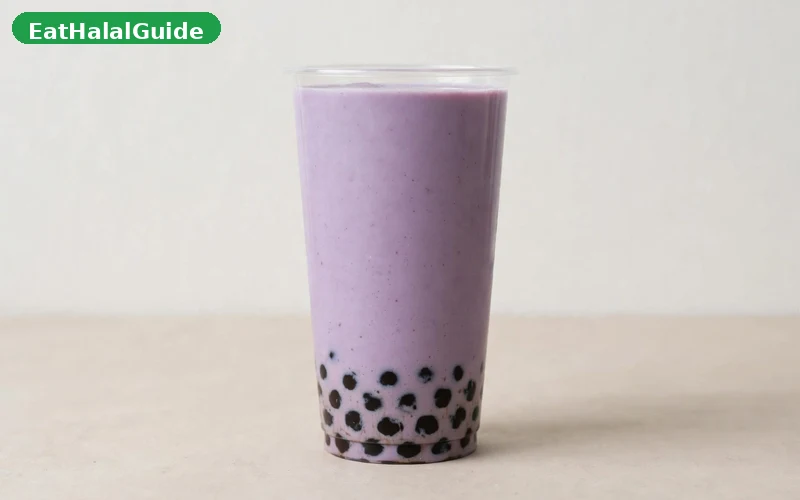
Is taro boba halal is the most-asked flavour question, and the answer is Mushbooh — doubtful, check the powder. Taro itself is a root vegetable and is halal. But taro milk tea is rarely made from fresh taro: it usually comes from a pre-mixed commercial powder, and those powders often contain non-halal whey powder or animal-derived emulsifiers. If the whey comes from cheese made with animal rennet, the powder is Mushbooh. Some taro powders use alcohol as a flavour carrier.
Certified taro products exist. The Tea Planet in India sells a taro boba premix that is HALAL certified, with a published ingredient list. Inotea’s ready-to-drink taro bubble tea carries “Halal” on its label, made in Taiwan. These show the pattern: the taro question is answered by the powder’s label, not by the word “taro” on the menu. If the shop cannot show you the powder, order a plain milk tea.
Popping boba, crystal boba and jellies
Not every “boba” is tapioca. Popping boba is a thin, jelly-like skin filled with fruit juice that bursts when you bite it. It is made by spherification: fruit juice is mixed with sodium alginate from brown seaweed, and drops fall into a calcium solution such as calcium lactate or calcium chloride, forming a thin skin. Some red or pink popping boba may use carmine (E120), a dye made from cochineal insects, and some brands add gelatin to strengthen the membrane.
Carmine is where the schools part ways. Hanafi fatwa bodies hold insect-derived ingredients impermissible — AskImam (Shaykh Ebrahim Desai’s Darul Iftaa) and Darul Iftaa Azaadville, Majelis Ulama Indonesia, by contrast, declared cochineal halal in Fatwa No. 33 of 2011, provided it is beneficial and not harmful. Our Is E120 Halal or Haram? guide covers the debate in full.
Crystal boba (agar boba) is translucent and firmer than tapioca, usually made from agar or konjac. Both are plant-derived and halal.
Konjac, agar, carrageenan and nata de coco (fermented coconut water) are plant-based and halal; coconut jelly and grass jelly are usually plant-based too. But some fruit and rainbow jellies use gelatin, often from pork skin. Pudding is often set with gelatin too. Always ask. Our Is Gelatin Halal or Haram? guide explains where gelatin hides.
Cheese foam, creamers and the hidden additives
Cheese foam (cheese tea or milk cap) is a salty-sweet cream layer on top of the drink, made from cream cheese, cream and milk. Cream cheese is usually set with acid and cultures rather than rennet, so it is normally fine — but some shops use cheese powder or other cheeses, which may be made with animal rennet, and some whipped creams add gelatin as a stabiliser. Ask whether it contains gelatin.
The hidden additives are the ones no menu names. Non-dairy creamer can contain E471 (plant or animal fat — see our Is E471 Halal or Haram? guide) and E422 (plant, animal or synthetic — see our Is E422 Halal or Haram? guide). Red colours can be beet, synthetic dyes, or carmine (E120). Our E-Code Database hub (https://eathalalguide.com/e-codes/) covers 16 codes (E422, E110, E160b, E904, E635 and E162 listed; E471, E621 and E120 deep guides published but NOT yet listed — hub text last verified 2026-11-19).
Vegan does not mean halal: flavourings may still contain alcohol. Kosher does not mean halal either: kosher rules allow alcohol. Our Halal vs Kosher guide explains the overlap.
Alcohol in boba
There are two different alcohol situations in boba. The first is boozy boba: some bars and restaurants serve boba cocktails made with rum, vodka, soju or liqueurs. These are haram. The second is alcohol as a flavour solvent: some flavourings, syrups and vanilla extracts contain a small amount of ethanol used to carry the flavour.
Scholars differ on the solvent, and the two strongest guides take opposite sides. The permissive view holds that a small amount of alcohol disappearing into a liquid is not khamr: Ibn Taymiyyah wrote that when a small amount of alcohol disappears into a liquid, the person drinking it is not drinking khamr. The avoid view cites the Prophet (peace be upon him), “Whatever a lot of it intoxicates, a little of it is unlawful” (Jami’ at-Tirmidhi 1865), and says to avoid them. Our Is Vanilla Extract Halal or Haram? guide covers the same debate in full. One error to avoid: some guides say the alcohol in flavourings “typically evaporates” — it does not evaporate from a cold drink.
No named fatwa on boba itself was found in any of the fifteen searches behind this guide. That is the answer when you ask is boba halal in islam: the pearls are halal, and the drink is checked ingredient by ingredient (Quran 2:29; Sahih al-Bukhari 52).
Boba in the USA, UK and Canada
Certification varies by country, branch and supplier. In Malaysia, JAKIM certifies each outlet, not the whole brand: Chatime has been JAKIM-certified since March 2018, Tealive is JAKIM-confirmed, and about 20 of Gong Cha’s roughly 58 outlets held JAKIM certificates in August 2026. In Singapore, some outlets hold MUIS certificates; in Indonesia, some outlets are certified.
In the USA, UK and Canada, the picture is thinner. Kung Fu Tea, one of the largest chains in the USA, does not carry halal certification as of March 2026. In the UK, two guides contradict each other: HalalSpy claims T4 and several Gong Cha locations carry halal certification, and that some chains carry HMC or HFA certification — but it names no chain, branch or certificate. HalalOharam, updated 30 September 2026, says it did not find a major UK bubble tea chain that is halal certified. Halal Friendly List, a UK directory, lists T4 as “Fully halal” (inspected 13/05/2024) — a directory listing, not an HMC/HFA certificate. In Canada, no chain-wide certification was found. CoCo’s 31 August 2024 halal menu is for its Middle East expansion, not its US, UK or Canada shops.
So in the USA, UK and Canada, order by ingredients, and ask to see the certificate at the outlet you visit.
How boba compares
Kosher does not mean halal. Some packaged pearls carry kosher certification, but kosher rules allow alcohol, and some kosher-certified gelatin may come from sources halal standards do not accept. Our Halal vs Kosher guide explains the overlap and the differences. Vegan does not mean halal either: a vegan drink rules out gelatin and animal additives, but flavourings may still contain alcohol.
For packaged boba, check for a halal logo and read the pearls, syrup and creamer ingredients separately.
Consumer Reports tested boba from Gong Cha and Kung Fu Tea and two packaged products (Trader Joe’s and WuFuYuan) in September 2025 and found lead in every sample. None exceeded CR’s level of concern, but three of the four reached more than half of it in one serving — Trader Joe’s 83%, Gong Cha 70%, Kung Fu Tea 63%, WuFuYuan 29%. CR also measured the liquid separately and found even more lead per serving in the liquid than in the pearls. Lead is a health concern, not a halal one: it does not make boba haram, but moderation is wise.
How to check any boba drink in 30 seconds

Five checks. First, the pearls — ask which brand the shop uses. Second, the milk — ask for fresh milk instead of creamer. Third, the toppings — skip anything with gelatin; ask about pudding and cheese foam. Fourth, the flavour — ask about alcohol carriers; skip boozy boba. Fifth, the certificate — ask to see the current certificate at that outlet. Pass all five and drink it. If the shop cannot answer, stick to the safest order: classic black milk tea with fresh milk, tapioca pearls and 50% sugar.
Frequently Asked Questions
Is boba halal? The pearls are, yes: cassava starch, water and sugar. The full drink depends on the cup.
Is boba halal in Islam? Yes, in principle: food and drink are permitted unless there is evidence against them (Quran 2:29). The check is ingredient by ingredient.
Is bubble tea halal? Usually, yes — tea, fresh milk, sugar and pearls. Gelatin toppings, alcohol flavourings, non-halal creamers or liquor make it Mushbooh or haram.
Is boba tea halal? The same answer as bubble tea. Check the pearls, milk, toppings and flavourings at the shop.
Does boba have pork? Real boba does not. Pork enters only through gelatin: some jellies, puddings and foams use pork gelatin, and one guide claims some cheap pearl brands add it — unconfirmed.
Does boba contain gelatin? Traditional pearls do not. Gelatin can appear in some jellies, puddings and toppings. Ask the shop or check the label.
Is popping boba halal? Usually, yes: fruit juice in a sodium alginate skin, normally no gelatin. Check colours for carmine (E120) and flavourings for alcohol.
Is taro boba halal? It is often Mushbooh: taro milk tea is usually made from powders that can contain non-halal whey or animal emulsifiers. Check the powder.
Is brown sugar boba halal? Yes: pearls in brown sugar syrup. With milk, check whether the shop uses fresh milk or creamer.
Is milk tea halal? Tea and fresh milk are halal. The question is the creamer or powder, which may contain animal emulsifiers. Ask which brand the shop uses.
Final Thoughts
Boba is the rare halal question where the hard part is not the food itself. The pearls are simple: a plant root, water and sugar, chewy because starch sets, not because gelatin was added. Nobody disputes them, and no fatwa was ever needed for them. The drink is where the work is — the jelly, the creamer, the syrup, the certificate.
So the practical rule is simple. Know the pearls are halal. Then forget the pearls and check the cup: the milk, the toppings, the flavour, the certificate. The Prophet (peace be upon him) said, “Leave what makes you doubt for what does not make you doubt” (Jami’ at-Tirmidhi 2518). A plain milk tea with fresh milk and tapioca pearls leaves nothing to doubt.
What we could not verify
- Pork gelatin in commercial pearls — Tayib claims some cheap brands add pork gelatin; HalalOharam found no mainstream supplier using it. Neither names a brand or label.
- UK chain certification — HalalSpy claims T4 and Gong Cha locations are certified, naming no certificate; HalalOharam found no major UK chain certified. The T4 listing is a directory entry, not an HMC/HFA certificate.
- Carmine fatwa texts — the Hanafi cochineal position (AskImam / Darul Iftaa Azaadville) still comes via WhatIsHalal only; MUI Fatwa No. 33 of 2011 and the SANHA E120 position were verified directly 2026-11-23.
- Hadith wordings — quoted via HalalOharam and WhatIsHalal; the hadith texts were NOT opened directly.
- Malaysia PMO December 2019 statement — quoted via HalalOharam only; the original was NOT opened directly.
- JAKIM portal — searched live 2026-11-23: Gong Cha operator TEAFE (M) SDN BHD (19 Syarikat records, certificates to Dec 2028) and Tealive operator LOOB INTEGRATED SDN BHD (188 records, to Mar 2029) found; a “Chatime” brand-name search in Premis Makanan returned 0 records — the operator may be listed under another company name, so the Chatime March 2018 date still rests on HalalOharam’s chain table.
- Kung Fu Tea statement — HalalSpy says the chain has made no public statement as of March 2026; no Kung Fu Tea page was opened directly.
- PAA — live PAA block captured 2026-11-23: “Does boba have pig gelatin?”, “Can Muslims eat tapioca?”, “Is Chick-fil-A halal or Haram?”, “Which bubble tea is halal certified?” — none contradicts this article; all are covered above.
- HalalCodeCheck, HalalHarams and HalalInfoHub boba pages — a HalalHarams boba page surfaced in live Google search 2026-11-23 (not opened, not used as a source); HalalCodeCheck and HalalInfoHub boba pages still did not surface.
Sources & Verification
| # | Source | What it says | Status |
|---|---|---|---|
| 1 | WhatIsHalal.org — “What Is Boba? Is Boba Halal?” (whatishalal.org/food/beverages/is-boba-halal/) | Pearls = tapioca starch, water, sugar; types of boba; ingredient table; gelatin/istihalah position; carmine split (MUI 33/2011 vs Hanafi/SANHA); boozy boba vs flavour solvent; CR Sep 2025 lead test; 7 infographic images; author Mufti Eakub Sheik. | Verified — opened directly 2026-11-23 (competitor) |
| 2 | HalalOharam — “Is Bubble Tea Halal? Boba Pearls and Flavors” (halaloharam.com/is-bubble-tea-halal/, published 2026-02-01, updated 2026-09-30) | Pearls halal; no mainstream supplier found using gelatin in standard pearls; spherification; E471 creamer; cheese foam rennet; alcohol solvents (Tirmidhi 1865 + Ibn Taymiyyah); chain table (Chatime JAKIM Mar 2018; Gong Cha ~20/58 Aug 2026; UK/US/Canada “None found chain wide”). | Verified — opened directly 2026-11-23 (competitor) |
| 3 | HalalSpy — “Is Boba Halal? Bubble Tea Ingredients Muslims Should Check” (halalspy.com/halal-knowledge/ingredients/is-boba-halal/, published 2026-03-18) | Plain pearls halal; IFANCA/JAKIM do not certify US shops; UK T4 + Gong Cha certified (no certificate named); Kung Fu Tea uncertified as of Mar 2026; Yakult <0.1% note (unsourced); WuFuYuan + Bossen pearls named. | Verified — opened directly 2026-11-23 (competitor) |
| 4 | Tayib — “Is Boba Halal? The 2026 Bubble Tea Guide” (tayib.app/blog/is-boba-halal-bubble-tea-dilemma/) | Traditional boba halal; cheap industrial brands add pork gelatin (no brand named); syrups use ethanol as solvent; taro powders contain non-halal whey/emulsifiers — taro “often Mushbooh”. | Partially verified — search text, 2026-11-23 (competitor) |
| 5 | Bubbleteas.moe — “Is Boba Halal? Everything You Need to Know About Halal Bubble Tea” (bubbleteas.moe/is-boba-in-bubble-tea-halal/) | Pearls halal (plant-based); gelatin toppings, alcohol flavourings, non-halal creamers to watch; popping boba usually seaweed-based; ingredient table. | Partially verified — search text, 2026-11-23 (competitor) |
| 6 | HalalIcons — “Is Bubble Tea Halal? The Truth Muslims Need to Know” (halalicons.com/is-bubble-tea-halal/) | Bubble tea can be halal if ingredients are halal; tea naturally halal; non-dairy creamers risky; alcohol in flavourings “typically evaporates” (do not repeat — it does not evaporate from a cold drink). | Partially verified — search text, 2026-11-23 (competitor) |
| 7 | HalalWorthy — “Is Bubble Tea Halal?” (halalworthy.com/is-bubble-tea-halal/) | “Yes, bubble tea is halal” blanket verdict; wrongly says popping boba is made from agar (it is sodium alginate spherification); “earliest adopters were Muslims” claim with no evidence. | Partially verified — search text, 2026-11-23 (competitor) |
| 8 | HaramOrHalal.co.uk — “Is Boba Halal or Haram?” (haramorhalal.co.uk/is-boba-halal-or-haram/) | Cassava root halal; bubble tea halal when all ingredients are halal; Quran 5:3 cited; home recipe given. | Partially verified — search text, 2026-11-23 (competitor) |
| 9 | BobaBuddha — “Is Boba Halal?” (bobabuddha.com/is-boba-halal/) | “Bubble tea is Halal in all countries” blanket verdict (do not repeat); vanilla made from vodka and vanilla beans; popping boba ingredients listed. | Partially verified — search text, 2026-11-23 (competitor) |
| 10 | Tastylicious — “Is Boba Halal? Everything Explained.” (tastylicious.com/is-boba-halal/) | “Yes; boba is halal” quick answer; halal/haram drink lists; milk “typically halal as long as it is from a certified halal source”. | Partially verified — search text, 2026-11-23 (competitor) |
| 11 | Consumer Reports — “We Tested Bubble Tea for Lead. Here’s What We Found.” (consumerreports.org, Sep 2025) | Lead in every sample; none exceeded CR’s level of concern; 3 of 4 samples >50% of the level in one serving; CR also measured the liquid separately and found even more lead per serving in the liquid than in the pearls; “occasional treat, not an everyday staple” (James E. Rogers). | Verified — opened directly 2026-11-23 |
| 12 | Consumer Reports — “Heavy Metals in Products Containing Boba” test methodology + results (PDF, Sep 2025) | Trader Joe’s Instant Boba Kit 83%, Gong Cha Pearl Milk Tea 70%, Kung Fu Tea Milk Tea with Boba 63%, WuFuYuan Tapioca Pearl 29% of CR’s level of concern for lead; results table covers the boba portion only; methodology confirms boba and liquid tested separately. | Verified — opened directly 2026-11-23 (article + PDF) |
| 13 | PR Newswire — “CoCo Bubble Tea Takes First Step Towards Middle East Expansion with Halal Menu” (31 Aug 2024) | Halal menu prepared for Middle East expansion; “All materials for the menu are Halal certified”; 5,000+ stores worldwide. Middle East scope only. | Verified — opened directly 2026-11-23 |
| 14 | Halal Friendly List — T4 (halalfriendlylist.com/t4/) | T4 listed “Fully halal”; first inspection 13/05/2024 (Royal Wharf), last update 16/05/2024; all drink categories halal-friendly. A directory listing, not HMC/HFA certification. | Verified — opened directly 2026-11-23 |
| 15 | Halal Friendly List — Venues (halalfriendlylist.com/venues/) | ChaTime: “Partially halal food / Fully halal drinks”; T4: “Fully halal”; Truedan: “Fully halal”. UK directory listings. | Verified — opened directly 2026-11-23 |
| 16 | BubblePhil — “How to Choose a Popping Boba Supplier” (bubblephil.com) | Popping boba membrane set with sodium alginate, not gelatin; T Foods holds THIDA (Taiwan Halal Integrity Development Association) certification for listed products. | Partially verified — search text, 2026-11-23 |
| 17 | SistaFood — “Does Boba Have Gelatin?” (sistafood.com/does-boba-have-gelatin/) | Traditional pearls contain no gelatin; popping boba uses sodium alginate + calcium lactate; standard tapioca boba “always gelatin-free”. | Partially verified — search text, 2026-11-23 |
| 18 | The Tea Planet — Taro Powder for Taro Milk & Boba (theteaplanet.com) | Taro premix, HALAL certified, FSSC 22000, FSSAI; ingredients: sugar, dairy creamer, permitted flavour, permitted colours (INS 122, 132, 133), anticaking agent (INS 551). | Verified — opened directly 2026-11-23 |
| 19 | Brookshire’s — Inotea Tea Bubble Taro (brookshires.com) | Product description: “Halal. No 1. Tapioca pearls inside. Made in Taiwan.” Ingredients include whole milk powder, non-dairy creamer, taro powder, emulsifiers, Allura Red, Brilliant Blue, Erythrosine Red. | Verified — opened directly 2026-11-23 |
| 20 | Madam Hong — Taro Milk Tea Drink (madamhong.com.tw) | 315ml taro milk tea can, made in Taiwan, “certified FDA & HALAL”; certificate files available on request. | Verified — opened directly 2026-11-23 |
| 21 | Quran 2:29 | “It is He who created for you all of that which is on the earth” — default permissibility, cited via HalalOharam. | Partially verified — quoted via competitor, 2026-11-23 |
| 22 | Quran 5:3 | “The flesh of swine” is forbidden — cited via HalalOharam and HaramOrHalal. | Partially verified — quoted via competitor, 2026-11-23 |
| 23 | Sahih al-Bukhari 52 | Doubtful matters hadith — “whoever saves himself from these doubtful things saves his religion and his honor” — quoted via HalalOharam. | Partially verified — quoted via competitor, 2026-11-23 |
| 24 | Jami’ at-Tirmidhi 1865 | “Whatever a lot of it intoxicates, a little of it is unlawful” — quoted via HalalOharam. | Partially verified — quoted via competitor, 2026-11-23 |
| 25 | Jami’ at-Tirmidhi 2518 | “Leave what makes you doubt for what does not make you doubt” (graded hasan sahih by at-Tirmidhi) — quoted via WhatIsHalal. | Partially verified — quoted via competitor, 2026-11-23 |
| 26 | Ibn Taymiyyah, Majmu’ al-Fatawa | Small amount of alcohol disappearing into a liquid is not drinking khamr — quoted via HalalOharam. | Partially verified — quoted via competitor, 2026-11-23 |
| 27 | MUI Fatwa No. 33 of 2011 | Cochineal food colouring declared halal if beneficial and not harmful — verified directly via LPPOM MUI. | Verified — opened directly 2026-11-23 |
| 28 | SANHA cochineal position (sanha.org.za E120) | E120 (carminic acid) — Status: Haraam; Source: From insect Cochineal. | Verified — opened directly 2026-11-23 |
| 29 | Malaysia Prime Minister’s Office, Dec 2019 | Bubble tea shop without certification “does not mean it is not halal. It only means that it has not been halal-certified”, as long as it uses halal ingredients — quoted via HalalOharam. | Partially verified — quoted via competitor, 2026-11-23 |
| 30 | EatHalalGuide — What Is Halal Food? | Mushbooh explainer. | Verified — our own published article |
| 31 | EatHalalGuide — Is Gelatin Halal or Haram? | Gelatin in jellies, pudding and foam; pork gelatin haram. | Verified — our own published article |
| 32 | EatHalalGuide — Is Vanilla Extract Halal or Haram? | Alcohol as a flavour solvent — the same debate, covered in full. | Verified — our own published article |
| 33 | EatHalalGuide — Halal vs Kosher | Kosher does not mean halal; kosher rules allow alcohol. | Verified — our own published article |
| 34 | EatHalalGuide — Is E471 Halal or Haram? | E471 Mushbooh — emulsifiers in creamers. | Verified — our own published article |
| 35 | EatHalalGuide — Is E120 Halal or Haram? | E120 — carmine in red/pink popping boba. | Verified — our own published article |
| 36 | EatHalalGuide — Is E422 Halal or Haram? | E422 Mushbooh — glycerol in creamers and syrups. | Verified — our own published article |
| 37 | EatHalalGuide — E-Code Database (e-codes/) | Hub covers 16 codes: E422/E110/E160b/E904/E635/E162 published and listed; E471/E621/E120 deep guides published but NOT yet listed among the hub’s checked codes (hub still names them “coming next” and in its not-checked list); E270/E170/E500/E320/E440a/E955 on the not-checked list. | Verified — our own published hub page (live, last verified 2026-11-19) |
Last verified: 2026-11-23