Almost every cheese you buy was made with rennet, and is rennet halal has no single answer. The enzyme that turns milk into cheese can come from a calf’s stomach, a fungus, a fermentation tank or a thistle flower — and the source decides the ruling. Microbial and vegetable rennet are halal; animal rennet from a properly slaughtered calf is halal; animal rennet from a calf not slaughtered Islamically is a genuine scholarly disagreement.
Most supermarket cheese in the USA and UK is already made with fermentation-produced chymosin or microbial rennet. The cheeses that still need checking are traditional European hard cheeses, any pack that says only “enzymes”, and any cheese with no halal mark.

Quick Answer
No single verdict — the source decides. Microbial rennet is Halal — made by fungi. Vegetable rennet is Halal — cardoon thistle, fig sap, nettle. Fermentation-produced chymosin (FPC) is Halal (widely accepted) — the calf chymosin gene expressed in yeast or fungus. Animal rennet from a zabiha-slaughtered calf, lamb or kid is Halal — agreed by all four schools. Animal rennet from a non-zabiha calf is Mushbooh — the majority Maliki, Shafi’i and Hanbali view says it is impure, while Abu Hanifa says it is pure. Porcine rennet is Haram. Rennet with no source named on the label is Mushbooh. Ask is rennet halal in islam and the answer is that scholars agree on four types and disagree on one.
Rennet at a glance
| Rennet type | Source | Verdict | How to spot it |
|---|---|---|---|
| Microbial rennet | Fungi (Rhizomucor miehei) | Halal | “Microbial rennet”, “microbial enzymes”, “suitable for vegetarians” |
| Vegetable rennet | Cardoon thistle, fig sap, nettle | Halal | “Vegetable rennet” stated on the pack |
| Fermentation-produced chymosin (FPC) | Calf chymosin gene in yeast/fungus | Halal (widely accepted) | Usually unlabelled; “suitable for vegetarians” implies it |
| Animal rennet, zabiha | Calf/lamb/kid slaughtered Islamically | Halal | Halal certification mark on the pack |
| Animal rennet, non-zabiha | Calf/lamb/kid, conventional slaughter | Mushbooh | “Animal rennet” or “calf rennet” with no certification |
| Porcine rennet | Pig stomach | Haram | Rarely named; “animal rennet” with no species given |
| Rennet, source unnamed | “Rennet” or “enzymes” on the label | Mushbooh | Ask the manufacturer or choose a certified cheese |
| Parmigiano-Reggiano | Natural calf rennet, PDO-mandated | Mushbooh at best, Haram for strict positions | The PDO name itself — it must be calf rennet |
| Most UK supermarket cheddar | Microbial rennet or FPC | Halal by ingredients | “Suitable for vegetarians” on the pack |
| Cathedral City cheddar | Vegetarian rennet | Halal by ingredients | Maker’s FAQ: “suitable for a Halal diet” (not certified) |
| Tillamook cheese (USA) | FPC since 2016 | Halal (majority certified) | Halal mark on most packs; Maker’s Reserve 10-Year is the animal-rennet exception |
| Cream cheese, cottage cheese | Usually no rennet at all | Halal by ingredients | Check for gelatin or other additives instead |
What is rennet?
Rennet is the enzyme complex that turns liquid milk into solid cheese curd, led by chymosin (rennin), with pepsin alongside it. Add a little to warm milk and the milk proteins clot. Without rennet or an equivalent enzyme, almost no cheese exists.
Traditional animal rennet comes from the abomasum — the fourth stomach — of a young milk-fed calf, lamb or goat kid. The alternatives are microbial rennet from fungi, fermentation-produced chymosin from modified yeast or fungus, and vegetable rennet from plants. All four do the same job; the halal question is entirely about the enzyme’s source.
Rennet is not gelatin: rennet coagulates milk, while gelatin is a protein made from animal collagen. Our Is Gelatin Halal or Haram? guide explains where E441 hides. The doubtful middle ground is called Mushbooh — our What Is Halal Food? guide explains it.
Is animal rennet halal?
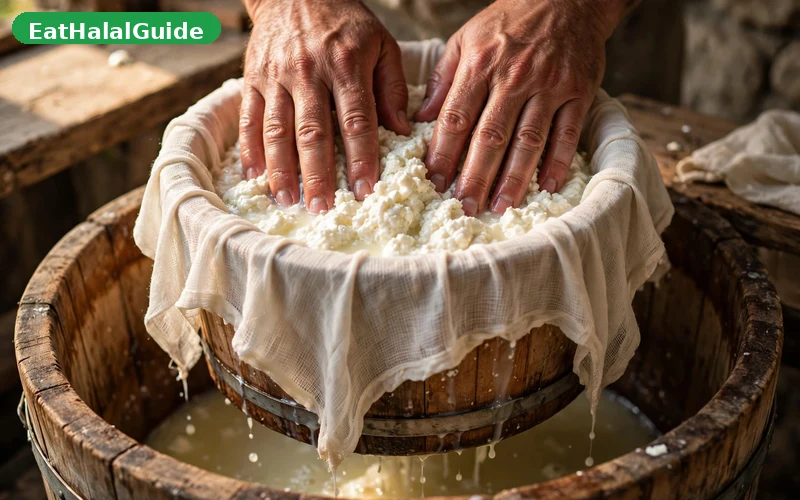
Ask is animal rennet halal and the answer splits in two. If the calf, lamb or kid was slaughtered according to Islamic requirements, its rennet is pure and halal, agreed by all four Sunni schools (IslamQA fatwa 2841).
The disputed case is rennet from a halal animal that died naturally or was not slaughtered Islamically — how most commercial calf rennet is produced. The majority Maliki, Shafi’i and Hanbali view is that the rennet is impure (najis), so its cheese is not permissible. The other view — Abu Hanifa, one narration from Imam Ahmad, favoured by Ibn Taymiyyah — is that the rennet is pure (tahir), because the enzyme contains no flowing blood.
Two finer points matter. The Sahibayn split the question by form: liquid rennet is impure because its container, the stomach, is impure, but solid rennet can be washed and eaten. The Ja’fari position is also permissive: Sayyid Rizvi, citing al-Khu’i and al-Sistani, rules rennet tahir and halal even from an animal not slaughtered Islamically.
If you follow a scholar who permits non-zabiha animal rennet, that is a recognised position; if you follow the stricter view, choose microbial rennet, FPC, vegetable rennet, or a halal-certified cheese.
Is microbial rennet halal?
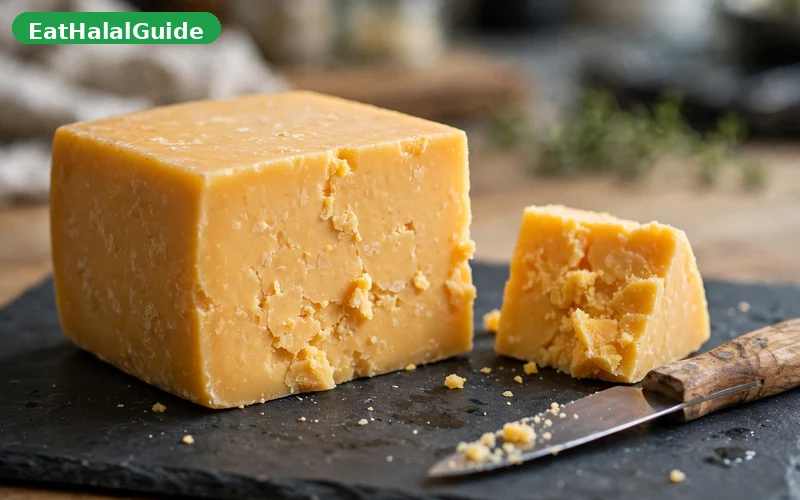
Ask is microbial rennet halal and the answer is the least disputed in this article: yes. Microbial rennet is produced by fungi — most commonly Rhizomucor miehei — whose enzymes work like chymosin. No animal is involved. MUIS puts it plainly: microbial rennet is “generally considered halal, as it does not come from animal sources.” It is the reason most UK supermarket cheddar can be halal by ingredients without any certification. When a label says “microbial rennet” or “microbial enzymes”, the rennet question is answered.
One caveat, from HalalFoodScan and LPPOM MUI: a certifier also checks the culture media and processing aids, which a bare label does not — “microbial” is strong source evidence, not a certificate.
Is vegetarian rennet halal?
Ask is vegetarian rennet halal and the answer is yes — with one clarification that matters. “Vegetarian rennet” is not a separate raw material. It is a label name for microbial or plant rennet.
True vegetable rennet comes from plants — cardoon thistle flowers, fig sap, nettles — traditional in Iberian regional cheeses, and halal with no conditions attached. MUIS agrees. It is rare in industrial cheese, so you will mostly meet it in artisan cheeses.
The value of the word “vegetarian” is on the pack: in the UK, a cheese labelled “suitable for vegetarians” cannot have been made with animal rennet. But it settles the rennet question only — not lipase, gelatin, flavourings or the milk supply chain. Read the whole label.
What is fermentation-produced chymosin (FPC)?
Fermentation-produced chymosin is the dominant coagulant in modern cheesemaking, and the one most shoppers have never heard of. Scientists took the calf chymosin gene and inserted it into a host microorganism — the yeast Kluyveromyces lactis, the fungus Aspergillus niger, or the bacterium Escherichia coli K-12. The microbe is grown in fermentation tanks and produces chymosin. The final enzyme is chemically identical to calf chymosin, but no animal was slaughtered to make it.
The US Food and Drug Administration approved FPC in March 1990 — the first genetically engineered ingredient approved for the US food supply — with GRAS status and no special GMO labelling required. That is why you will almost never see “FPC” on a cheese pack: the manufacturer need not say which rennet it used.
How much cheese uses it? By industry estimates, around 80–90% of cheese made in the United States and United Kingdom uses FPC — enzyme-company and dairy-group estimates put it at 90% of US commercial cheese in 2012, and a peer-reviewed 2021 source agrees. Those are industry estimates, not a verified census. What matters is the ruling: FPC is accepted as halal by the major certification bodies — JAKIM, HMC and IFANCA, according to every competitor that covers it — because the final enzyme is not of animal origin. The gene came from a calf, but the enzyme is made by a microbe, and the certifiers accept it. If genetically modified ingredients concern you beyond the halal question, USDA Organic cheese prohibits FPC entirely.
Which cheeses use which rennet?
Most commercial cheddar in the UK and US is made with FPC or microbial rennet, not animal rennet. Cathedral City, the UK’s best-selling cheddar, uses vegetarian rennet — its FAQ says its cheese is made with “100% cow’s milk to which we add starter culture, vegetarian rennet and salt” and answers “Is Cathedral City cheese suitable for a Halal diet?” with “Yes” — the manufacturer’s own wording, not a halal certification. Tesco, Asda, Sainsbury’s and Morrisons own-brand cheddars are labelled “suitable for vegetarians”.
Mozzarella can go either way, so the label or the manufacturer is the only way to know. Ask rennet in cheese halal about a mozzarella and the answer is the pack, not the cheese name. Cream cheese and cottage cheese usually use no rennet at all — they are acid-set — so check for gelatin. Processed cheese slices are the hardest supermarket case: enzymes plus emulsifying salts, and the rennet source almost never named.
Authentic Parmigiano-Reggiano is protected under EU and UK Geographical Indications law, and its production specification mandates natural calf rennet — a cheese made with microbial rennet or FPC cannot legally be called Parmigiano-Reggiano. The calves are not slaughtered under any Islamic protocol and the Consortium offers no halal-certified production stream, so the verdict is Mushbooh at best, Haram for strict positions. The same rule covers Pecorino Romano, Grana Padano and traditionally Gruyère. But “parmesan” without the PDO name is a different product: US-made parmesan-style cheese is not bound by the rule and often uses FPC or microbial rennet, and a “suitable for vegetarians” label confirms no animal rennet.
Restaurant cheese is harder still: the rennet source is not on the menu, and the chain may not publish it. Our Is Pizza Express Halal or Haram? guide shows the same problem with a chain menu: no halal certification, and the cheese question cannot be answered from the menu alone. When eating out, ask the restaurant — and if it cannot answer, choose a dish without cheese.
Rennet in the USA, UK and Canada
The cheese in the three countries is mostly the same cheese, but the label is not. In the USA, a cheese label may say only “enzymes” — a word the pack cannot resolve, and the FDA does not require the manufacturer to say which. Most US cheese is FPC by industry estimates, but that is not a verification. A halal mark or a direct manufacturer answer is the only way to be sure.
In the UK, most supermarket hard cheese carries “suitable for vegetarians”, which rules out animal rennet, and major brands publish their rennet type in their FAQs. UK supermarket hard cheeses are therefore usually halal by ingredients, though almost none carries a halal certification mark. The exception is the PDO shelf, where calf or lamb rennet is a matter of law.
Canada sits between the two: labels name enzymes more specifically, and halal-certified cheese is available through halal grocers and some mainstream lines. In all three markets the verdict follows the rennet, not the country, and a halal mark is the highest assurance: a certifier has checked the rennet source and every other ingredient — which is exactly what the M&S case shows. Our Is M&S Chicken Halal or Haram? guide records M&S’s Shazans halal chicken, certified by the Halal Food Authority: the mark, not the shelf, verifies the claim. Kosher cheese is not automatically halal cheese — our Halal vs Kosher guide explains where the two systems part.
How rennet compares
Rennet is not the only ingredient where the source, not the name, decides the ruling. Gelatin is the closest parallel: like rennet, it can come from pork, from a zabiha-slaughtered animal, or from a non-zabiha animal, and the label rarely says which. A cheese can be fine on rennet and fail on gelatin, so check both. Our Is Gelatin Halal or Haram? guide covers it in full. The same source question decides E471, the emulsifier in processed cheese slices: our Is E471 Halal or Haram? page rates it Mushbooh, because the plant and synthetic routes are halal, the animal route depends on the source, and the label never says which. Processed cheese is where the two questions meet, so a plain block of cheddar with a vegetarian mark is a simpler buy than a processed slice. If the slice lists E-numbers you do not recognise, our E-Code Database hub covers 16 codes: E422, E110, E160b, E904, E635 and E162 are published pages and listed on the hub; the E471, E621 and E120 deep guides are published pages but are NOT yet listed among the hub’s checked codes — the hub still names them as deep guides ‘coming next’ and in its not-checked list; E270, E170, E500, E320, E440a and E955 are still on the hub’s not-checked list (hub text last verified 2026-11-21).
How to check any cheese in 30 seconds

Five checks. First, the halal mark — a JAKIM, IFANCA, HMC, HFA or MUIS mark means the certifier has verified the rennet source. Second, the vegetarian mark — “suitable for vegetarians” rules out animal rennet entirely, the fastest check in a UK supermarket. Third, the ingredient list — “microbial”, “vegetable” or “vegetarian” rennet is halal; “animal” or “calf” rennet needs halal certification; “rennet” or “enzymes” alone says nothing. Fourth, the cheese name — Parmigiano-Reggiano, Pecorino Romano and Grana Padano must use animal rennet by law, so treat them as Mushbooh at best. Fifth, the rest of the label — lipase, gelatin and flavourings are separate questions. If the pack fails all five checks, ask the manufacturer.
Frequently Asked Questions
Is rennet halal? It depends on the source. Microbial, vegetable and fermentation-produced chymosin are halal; animal rennet from a zabiha-slaughtered calf is halal; animal rennet from a non-zabiha calf is Mushbooh; porcine rennet is Haram.
Is animal rennet halal? From a zabiha-slaughtered calf, lamb or kid, yes — agreed by all four Sunni schools. From a non-zabiha animal, it is a recognised disagreement: the majority Maliki, Shafi’i and Hanbali view says it is impure, while Abu Hanifa says it is pure. For any single cheese, the answer needs the slaughter, not just the species.
Is microbial rennet halal? Yes, with no disagreement worth reporting. It is produced by fungi such as Rhizomucor miehei, with no animal involved. MUIS says it is “generally considered halal, as it does not come from animal sources.” For any cheese that names it, the answer is halal — though a certifier still checks the culture media and processing aids.
Is vegetarian rennet halal? Yes. “Vegetarian rennet” is a label name for microbial or plant rennet, and both are halal. A “suitable for vegetarians” mark rules out animal rennet — but it settles the rennet question only, not lipase, gelatin or flavourings.
Is rennet halal in Islam? Scholars agree on four of the five types: microbial, vegetable and FPC rennet are halal, zabiha animal rennet is halal, and porcine rennet is haram. The one disagreement is non-zabiha animal rennet — and this article presents both positions honestly.
Is the rennet in cheese halal? Usually, in supermarket cheese: most US and UK supermarket cheese is made with FPC or microbial rennet, so the answer is usually yes. The exceptions are PDO hard cheeses, any pack that says only “enzymes”, and any cheese with no halal or vegetarian mark.
Is Parmesan cheese halal? Authentic Parmigiano-Reggiano is Mushbooh at best, Haram for strict positions: PDO rules mandate natural calf rennet with no zabiha verification, and no certified halal version exists. Parmesan-style cheese made with microbial rennet or FPC is halal by ingredients.
Is cheese halal without halal certification? Often, yes — on the rennet question. A cheese made with microbial rennet, vegetable rennet or FPC is halal by ingredients without any certification, and a “suitable for vegetarians” mark is good evidence. But certification is still the highest assurance: it verifies everything a single ingredient line cannot.
Final Thoughts
Rennet is the rare halal question where the science has settled most of the argument. The cheese industry moved away from calf stomachs decades ago: fermentation-produced chymosin and microbial rennet now make the overwhelming majority of supermarket cheese, both halal without controversy. The question survives in three places — the PDO hard cheeses, the packs that say only “enzymes”, and the scholarly disagreement over non-zabiha animal rennet.
So buy the cheese with a halal mark, a vegetarian mark, or one that names its rennet. Everything else is a question to ask the manufacturer, not a guess to make at the shelf.
What we could not verify
- Certifier acceptance of FPC at source — IFANCA’s own FAQ (2 June 2022) opened directly at publish: ‘Chymosin produced using biotechnology is halal’. JAKIM and HMC: no rennet/FPC statement found at source — the MS 1500:2019 claim stays competitor-sourced.
- The 80–90% FPC share — industry estimates only (VRG; 2021 peer-reviewed source; IDFA via HalalSpy). No census or regulator figure was found.
- Parmigiano-Reggiano Consortium specification — opened directly at publish (disciplinare PR_EN_clean_02072025, edition 2 July 2025): calf rennet mandated, no halal provision. The ‘no certified halal version’ claim still rests on competitor reporting.
- Tillamook’s own FAQ — opened directly at publish: FPC since 2016, halal-certified majority, Maker’s Reserve 10-Year exception confirmed; certifier unnamed.
- Cathedral City FAQ — opened directly at publish: ‘vegetarian rennet’ and ‘suitable for a Halal diet’ wording confirmed.
- Fatwa texts — IslamQA 2841 + 115306 and Darul Iftaa Birmingham opened directly at publish. Islamweb 347143 + 436126, SeekersGuidance and the Attari paper were read in search text only. The Islamweb 347143 excerpt ends mid-sentence.
- HalalCodeCheck’s pork-rennet warning — “a small number of cheeses” use pig-derived rennet, naming no cheese, country or source; reported as an un-evidenced competitor claim, not a fact.
- US/Canada labelling rules — the US “enzymes” wording and the Canadian position come from competitor guides, not from labelling text opened directly.
- PAA — Google’s block could not be captured (unusual-traffic page); Bing’s block captured at publish (4 questions, all covered by the FAQs).
Sources & Verification
| # | Source | What it says | Status |
|---|---|---|---|
| 1 | MUIS — “Is rennet used in the making of cheese Halal?” (ask.gov.sg/muis/questions/clks0tqib00qbl90fygbv176e) | Animal rennet only halal if the animal was slaughtered per Islamic rites; microbial rennet generally halal; plant-based rennet (thistles, fig trees) generally halal; look for halal certification, else check with the manufacturer. | Verified — opened directly 2026-11-21 |
| 2 | IslamQA — Fatwa 2841, “Is Animal Rennet Halal?” (islamqa.info/en/downloads/answers/2841) | Zabiha rennet pure, agreed by all four schools; non-zabiha rennet: majority Maliki/Shafi’i/Hanbali say impure, Abu Hanifa + one Ahmad narration say pure (favoured by Ibn Taymiyyah, al-Fatawa 21/102); follower follows an ‘alim on either opinion. | Verified — opened directly 2026-11-21 |
| 3 | IslamQA — Fatwa 115306, “Ruling on eating cheese if the source of the rennet is not known” (islamqa.info/en/downloads/answers/115306) | Same two positions; issue subject to ijtihaad; concludes there is nothing wrong with eating cheese made with it whether the source is known or not. | Verified — opened directly 2026-11-21 |
| 4 | Islamweb — Fatwa 347143, “Ruling on eating rennet and other animal extracts” (islamweb.net/en/fatwa/print/347143, 22-3-2017) | Three opinions: majority Maliki/Shafi’i + predominant Hanbali (impure); Sahibayn (liquid impure, solid washed and eaten); Abu Hanifa + Ahmad (pure, Companions ate Magi cheese). Excerpt ends mid-sentence; only the three opinions are quoted. | Partially verified — search text, 2026-11-21 |
| 5 | Islamweb — Fatwa 436126, “Eating Food Products that Contain Animal Enzymes or Animal Rennet” (islamweb.org/en/fatwa/print/436126, 23-1-2021) | Zabiha enzymes fine; dead-animal extracts to be avoided; Ibn Taymiyyah’s chosen view: animal rennet ritually pure, cheese permissible absolutely; cites Salman al-Farisi’s “whatever He has made no mention of is pardoned” (Abu Dawud). | Partially verified — search text, 2026-11-21 |
| 6 | Darul Iftaa Birmingham — “Is cheese halal or haram?” (islamqa.org/hanafi/daruliftaa-birmingham/136236/is-cheese-halal-or-haram/) | Zabiha rennet: no harm. Non-zabiha: Abu Hanifa + Malik consider it clean; Abu Yusuf, Muhammad and others call it impure; precautionary advice to refrain. Written by Moulana Muqtaur Rahman, checked by Mufti Mohammed Tosir Miah. | Verified — opened directly 2026-11-21 |
| 7 | SeekersGuidance — Shaykh Ilyas Patel, “Is Rennet in Cheese Halal or Haram to Consume?” (hawramani.com, 5 Feb 2011) | Hanafi school: rennet permissible in all cases as long as the animal is not a pig; lawfulness depends on whether life (blood) is in it; better to avoid when the source is unknown. | Partially verified — search text, 2026-11-21 |
| 8 | Mufti Sajid Attari, Dar ul Ifta Ahle Sunnat — “Muslims and Cheese” (archive.org) | Zabiha rennet halal by all scholars; non-zabiha rennet halal per Abu Hanifa (chosen opinion); pig rennet impure and haram; unknown source from non-Muslims permissible unless haram source is established. | Partially verified — search text, 2026-11-21 |
| 9 | Sayyid M. Rizvi, A’alim Network — “Rennet” (al-islam.org/organizations/AalimNetwork/msg00003.html) | Rennet (anfaha) tahir and halal even from an animal not slaughtered Islamically, per al-Khu’i and al-Sistani; Imam al-Baqir to Qatadah (Wasa’il al-Shi’ah vol. 16, p. 364). | Partially verified — search text, 2026-11-21 |
| 10 | HalalCodeCheck — “Is Rennet Halal? Cheese, Calf Rennet, and Microbial Alternatives” (halalcodecheck.com/blog/is-rennet-halal/) | Verdict: depends entirely on the type. Four-type table; “over 90% of UK cheese uses FPC” (no source cited); vegetarian mark is the practical shortcut; PDO list (Parmigiano-Reggiano, Pecorino Romano, Grana Padano, Gruyère); pork-rennet warning names no cheese. | Verified — opened directly 2026-11-21 (competitor) |
| 11 | HalalHarams — “Is Rennet Halal? What Muslims Need to Know About Cheese” (halalharams.com/?p=908) | Rennet halal in some cases; type table; Hanafi permissive vs stricter schools; cheese table names no brand; label advice; 6 FAQs; 2 text-heavy header images. | Verified — opened directly 2026-11-21 (competitor) |
| 12 | HalalSpy — “Is Rennet Halal? Animal, Microbial, and Vegetable Rennet Explained” (halalspy.com/halal-knowledge/ingredients/is-rennet-halal/) | Microbial/vegetable halal; zabiha animal halal; non-zabiha disputed (mashbooh); porcine haram; FPC accepted by JAKIM, HMC, IFANCA; FPC “80–90% of US and UK cheese, per IDFA”; MS 1500:2019 includes FPC. None verified at source in prep. | Partially verified — search text, 2026-11-21 (competitor) |
| 13 | HalalSpy — “Is Cheese Halal? Rennet Types and What to Check on Labels” (halalspy.com/halal-knowledge/ingredients/is-cheese-halal/) | Cheese halal with microbial/vegetable/FPC rennet; non-zabiha animal rennet not halal per majority position (Islamic Fiqh Council Jeddah, European Council for Fatwa and Research); vegetarian label is the fastest indicator. | Partially verified — search text, 2026-11-21 (competitor) |
| 14 | HalalSpy — “Is Parmesan Halal? The Rennet Problem in Parmigiano-Reggiano” (halalspy.com/halal-knowledge/ingredients/is-parmesan-halal/) | Authentic Parmigiano-Reggiano not halal: PDO mandates calf rennet since 1996; no certified halal version exists; US parmesan-style cheese may use FPC/microbial. | Partially verified — search text, 2026-11-21 (competitor) |
| 15 | HalalCodeCheck — “Is Parmesan Halal? PDO Rules and Rennet Explained (2026)” (halalcodecheck.com/blog/is-parmesan-halal/) | Authentic Parmigiano-Reggiano Mushbooh at best, Haram for strict positions; PDO since 1996; calf rennet mandated; Hanafi school internally split; generic vegetarian-labelled parmesan-style cheese halal. | Partially verified — search text, 2026-11-21 (competitor) |
| 16 | Fiqh IslamOnline — “Islamic Ruling on Parmesan Cheese” (fiqh.islamonline.net/en/islamic-ruling-on-parmesan-cheese/) | Generic vs authentic Parmesan; strict view (Shafi’i/Maliki/Hanbali) vs permissive Hanafi view; lipase warning: unspecified lipase source must be avoided. | Partially verified — search text, 2026-11-21 |
| 17 | HalalFoodScan — “Is Rennet Halal? Animal, Microbial and FPC Sources” (halalfoodscan.com/guides/is-rennet-halal/, 4 Sep 2026) | Microbial/FPC generally halal-compatible when culture media and processing aids meet the standard; LPPOM MUI guidance; “microbial” is strong source evidence, not a certificate; explicitly not a fatwa. | Partially verified — search text, 2026-11-21 (competitor) |
| 18 | HalalScanner — “Is Cheese Halal? Animal vs Microbial Rennet” (halalscanner.org/articles/rennet-in-cheese/, updated 15 Nov 2026) | Microbial/FPC: no disagreement worth reporting; uncertified animal rennet Mushbooh; vegetarian mark reliable; FPC the dominant industrial form. | Partially verified — search text, 2026-11-21 (competitor) |
| 19 | HalalExpo — “Halal Cheese: Which Cheeses Are Halal? Buyer’s Guide (2026)” (halalexpo.com, 24 May 2026) | FPC + microbial halal by consensus; certifiers JAKIM (MS 1500:2019), MUI/BPJPH, IFANCA (Crescent-M), HFA, HMC (stricter, less common on cheese). | Partially verified — search text, 2026-11-21 (competitor) |
| 20 | HalalFocus — “Are Enzymes Halal? What Every Muslim Should Know” (halalfocus.com/are-enzymes-halal-what-every-muslim-should-know/) | Source determines ruling; porcine enzymes haram; majority position (IFANCA, ISA, HMC, JAKIM, MUI): enzymes retain the ruling of their source; istihalah minority noted. | Partially verified — search text, 2026-11-21 (competitor) |
| 21 | Cathedral City — FAQs (cathedralcity.co.uk/en/faqs) | “All of our cheese is made with 100% cow’s milk to which we add starter culture, vegetarian rennet and salt.” Q: “Is Cathedral City cheese suitable for a Halal diet?” A: “Yes.” No halal certification claimed. | Verified — opened directly 2026-11-21 |
| 22 | HalalSpy — “Is Cheddar Halal? Brand-by-Brand Rennet Breakdown” (halalspy.com/halal-knowledge/ingredients/is-cheddar-halal/) | Most UK/US supermarket cheddar uses FPC or microbial rennet; Cathedral City, Cabot, Tillamook, store brands confirm non-animal enzymes; Seriously Strong + Pilgrims Choice microbial; own-brand cheddars “suitable for vegetarians”. | Partially verified — search text, 2026-11-21 (competitor) |
| 23 | HalalCodeCheck — “Is Tillamook Halal?” (halalcodecheck.com/brand/tillamook/) | Tillamook FAQ: FPC since 2016, “Kosher and Halal certification”, vegetarian; majority of cheeses halal certified (certifier unnamed); Maker’s Reserve 10-Year Extra Sharp Cheddar is the animal-rennet exception. | Partially verified — search text, 2026-11-21 (competitor) |
| 24 | Vegetarian Resource Group — “Microbial Rennets and FPC” (vrg.org, 2012) | FPC from calf gene via E. coli K-12; FDA approved 1990, first bioengineered food ingredient, GRAS, no special labelling; ~70% of US cheese FPC in 2007, ~90% in 2012 (enzyme-company/dairy-group estimates). | Partially verified — search text, 2026-11-21 |
| 25 | Bioecon — “Fermentation-produced chymosin instead of calf rennet in cheesemaking” (en.bioecon.ru/substitutions/fi05/) | FPC covers 80–90% of the coagulant market in the US and UK (peer-reviewed 2021 source); animal rennet now mostly limited to PDO cheeses in Europe. | Partially verified — search text, 2026-11-21 |
| 26 | Which? — “Best extra mature cheddar” (which.co.uk, Sep 2026) | All extra mature cheddars tested suitable for vegetarians; most cheese now made with non-animal rennet; Parmesan and parmesan-style hard cheeses the exception. | Partially verified — search text, 2026-11-21 |
| 27 | EatHalalGuide — What Is Halal Food? | Mushbooh explainer. | Verified — our own published article |
| 28 | EatHalalGuide — Is Gelatin Halal or Haram? | What E441 is and where it hides; rennet is not gelatin. | Verified — our own published article |
| 29 | EatHalalGuide — Halal vs Kosher | Where halal and kosher rules overlap and part; kosher cheese also turns on rennet. | Verified — our own published article |
| 30 | EatHalalGuide — Is M&S Chicken Halal or Haram? | HFA-certified Shazans lines at M&S; what a halal certification mark verifies. | Verified — our own published article |
| 31 | EatHalalGuide — Is Pizza Express Halal or Haram? | No halal certification; chain-menu answers and their limits. | Verified — our own published article |
| 32 | EatHalalGuide — Is E471 Halal or Haram? | E471 Mushbooh — same source question in processed cheese. | Verified — our own published article |
| 33 | EatHalalGuide — E-Code Database (e-codes/) | Hub covers 16 codes: E422/E110/E160b/E904/E635/E162 published and listed; E471/E621/E120 deep guides published but NOT yet listed among the hub’s checked codes (the hub still names them as ‘coming next’ and in its not-checked list); E270/E170/E500/E320/E440a/E955 on the not-checked list. | Verified — our own published hub page (live, last verified 2026-11-21) |
| 34 | Tillamook — FAQ (tillamook.com/faq/cheese) | ‘Since 2016, we have utilized fermentation-produced rennet that has Kosher and Halal certification and is vegetarian’; Maker’s Reserve 10-Year Extra Sharp Cheddar is the animal-rennet exception; certifier unnamed. | Verified — opened directly 2026-11-21 |
| 35 | IFANCA — FAQ ‘What is the source of rennet?’ (2 June 2022) | ‘Chymosin produced using biotechnology is halal’; a bare ‘rennet’ label means an animal source, questionable until the source is known. | Verified — opened directly 2026-11-21 |
| 36 | Parmigiano-Reggiano Consortium — Production specification (disciplinare PR_EN_clean_02072025, edition 2 July 2025) | ‘Milk coagulation, obtained exclusively by the use of calf rennet.’ No halal provision in the specification. | Verified — opened directly 2026-11-21 |
Last verified: 2026-11-21