
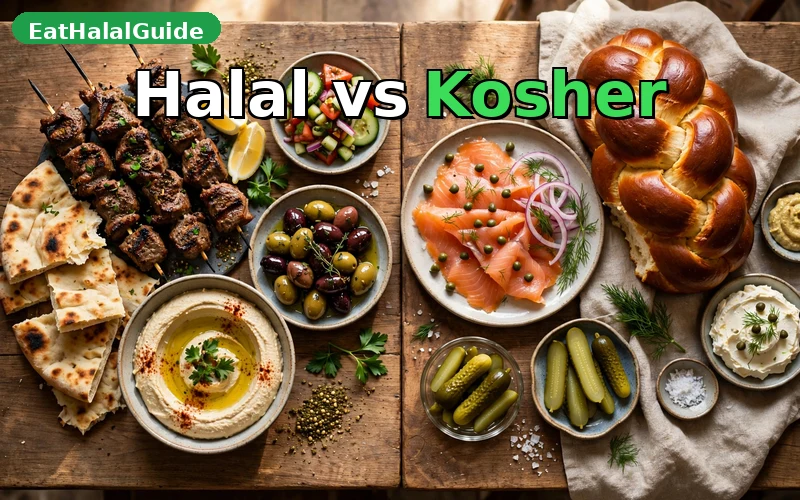
Halal vs kosher is one of the most asked questions in food — and one of the most answered wrong. Both forbid pork and blood, and both require a specific way of slaughtering an animal, so shoppers assume one mark covers the other.
Neither assumption is true. Halal and kosher are two separate religious laws, from two separate scriptures, enforced by two separate sets of certifiers — and they disagree on alcohol, on seafood, on mixing meat with dairy, on who may slaughter, and on what counts as a blessing.
Quick Answer
Halal and kosher are not the same, and neither counts as the other. Both forbid pork and blood and require ritual slaughter — but kosher slaughter does not include Allah’s name over each animal, kosher food may contain alcohol, and kosher gelatin may come from non-zabiha cattle. Halal food is not automatically kosher either: it is not slaughtered by a shochet, it is not inspected and salted the kosher way, and it may mix meat with dairy or contain shellfish.
Halal vs kosher at a glance
| Question | Halal | Kosher |
|---|---|---|
| What does the word mean? | Arabic for “permissible” or “lawful” | Hebrew for “fit” or “proper” |
| Source of the rules | Quran and Hadith | Torah, chiefly Leviticus 11 and Deuteronomy 14, and rabbinic law |
| Pork | Forbidden, always | Forbidden, always |
| Blood | Forbidden; drained at slaughter | Forbidden; drained, then salted or broiled out |
| Alcohol | Forbidden in every form | Permitted; wine must itself be kosher |
| Meat with dairy | Allowed | Forbidden — never mixed, cooked or eaten together |
| Seafood | Most schools permit shellfish; Hanafi school permits only fish | Only fish with fins and scales; no shellfish at all |
| Who slaughters | A Muslim; many scholars also accept Jews and Christians | A trained Jewish slaughterer (shochet) only |
| Words at slaughter | God’s name said over each animal | A blessing before the session, not per animal |
| Pre-slaughter stunning | Certifiers split — some accept it, some reject it | Not permitted |
| Gelatin | Halal only from a halal source | Must be from a kosher source; some authorities accept processed cattle-bone gelatin |
| Who certifies | Halal bodies (IFANCA, HMC, HFA, JAKIM and others) | Rabbinic agencies (OU, OK, Star-K, KLBD and others) |
| Is the other system’s food acceptable? | Kosher is not automatically halal — scholars differ | Halal is not kosher — observant Jews do not accept it |
What do halal and kosher mean?

Halal is an Arabic word meaning “permissible” or “lawful”. Its food rules come from the Quran and the teachings of the Prophet Muhammad (peace be upon him): pork, alcohol, blood and carrion are forbidden, meat must be slaughtered the Islamic way, and doubtful ingredients are judged as mushbooh until verified. See our guide to What Is Halal Food?
Kosher comes from the Hebrew “kasher”, meaning “fit” or “proper”. Its rules, known as kashrut, come from the Torah — chiefly Leviticus 11 and Deuteronomy 14 — and from rabbinic law. Kashrut governs which animals may be eaten, how they must be slaughtered, and how meat and dairy must be kept apart.
The difference between halal and kosher is not one rule but a whole system: two different scriptures, two different ideas of who may slaughter, two different answers on alcohol and seafood, and two different certification worlds.
How is the slaughter different?
The cut looks the same from the outside, and that is what misleads people. In both systems the animal must be alive and healthy, and it is killed with a swift cut across the throat using a very sharp knife, so that the blood drains.
In halal slaughter, called zabiha, the slaughterer must be a Muslim — many scholars also accept Jews and Christians — and Allah’s name must be said over each animal: “Bismillah, Allahu Akbar”. The cut must sever the windpipe, the food pipe and the major blood vessels.
In kosher slaughter, called shechita, only a shochet — a trained Jewish slaughterer — may perform the cut, using a chalaf, a knife that must be perfectly smooth; a single nick makes the meat non-kosher. The blessing is recited before the session begins, not over each animal.
Kosher then adds steps halal does not require: the lungs and organs are inspected (bedikah), the meat is soaked and salted (kashering) to draw out remaining blood, and certain fats and the sciatic nerve are forbidden, so the hindquarters must undergo a process called nikkur.
Stunning is where the two systems diverge most in practice, and it matters most in the UK. Jewish law does not permit stunning before shechita: Orthodox authorities view stunning as a wound (treifah) that renders the animal non-kosher before the cut. Halal certifiers are split: the UK’s Halal Monitoring Committee (HMC) accepts no stunning, while the UK’s Halal Food Authority (HFA) accepts reversible stunning under strict conditions. Our guide to Is M&S Chicken Halal or Haram? works that split through a real UK case — M&S requires every animal to be pre-slaughter stunned, which is exactly why HFA could certify its ready meals while HMC could not. Europe’s highest courts have backed stunning requirements, and a UK Bill introduced in November 2026 proposes compulsory labelling of halal and kosher meat — a labelling proposal, not a ban.
Alcohol: the sharpest difference
If slaughter is the subtlest difference, alcohol is the sharpest. Islam prohibits all alcohol: the Quran states in Surah Al-Ma’idah 5:90 that intoxicants are “the work of Satan”, and the ban extends to cooking wine, alcohol-based vanilla extract and rum-flavoured desserts. A halal-certified product cannot contain alcohol as an ingredient. Jewish dietary law permits alcohol: wine, beer and spirits can all be kosher, and wine is part of religious observance, used for Shabbat kiddush and Passover. Kosher wine must be produced and handled exclusively by Sabbath-observing Jews, unless it is mevushal (cooked or pasteurised).
For a Muslim shopper, this is the difference that bites. A product labelled kosher may contain wine, cooking sherry or alcohol-based flavouring, and kosher certification alone does not guarantee the absence of alcohol. Kosher wine is haram, full stop — and so is any food cooked with it. Standard vanilla extract is 35% alcohol; see our guide to Is Vanilla Extract Halal or Haram?
Meat and dairy: the rule only kosher has
Kosher law prohibits mixing meat and dairy. The rule comes from the Torah’s commandment, repeated three times: “You shall not boil a kid in its mother’s milk” (Exodus 23:19, Exodus 34:26, Deuteronomy 14:21). Kosher households keep two complete sets of dishes, utensils and pots — one for meat (fleishig), one for dairy (milchig) — and after eating meat, observant Jews wait between 1 and 6 hours before eating dairy. Kosher restaurants are either meat or dairy, never both.
Halal has no such restriction. A cheeseburger is permissible in halal law as long as the beef is zabiha-slaughtered and the cheese contains no haram-derived rennet.
Seafood: where the schools part company
Kosher law restricts permissible seafood to fish with fins and removable scales (Leviticus 11:9-12). Shrimp, crab, lobster, clams, oysters, octopus and squid are all non-kosher.
Halal seafood rules vary by school. The Shafi’i, Maliki and Hanbali schools permit all seafood, including shellfish. The Hanafi school permits only fish and considers shrimp, crab and lobster makruh (disliked) or haram — and since the Hanafi school predominates in South Asia, Turkey and Central Asia, that distinction affects hundreds of millions of Muslims.
The animal list differs on land. To be kosher, a land animal must both chew the cud and have split hooves — cows, sheep and goats qualify; camels and rabbits do not. Halal permits camel and rabbit.
Gelatin, enzymes and cheese: the hidden ingredients
Gelatin is where the two systems collide on a supermarket packet. Conventional gelatin comes from pig skin or cattle bones, and pig-derived gelatin is forbidden in both systems. For halal consumers, gelatin must come from a halal-slaughtered animal, a plant-based source or fish. For kosher consumers, gelatin must come from a kosher-slaughtered animal or fish — but some kosher authorities, particularly the Orthodox Union, accept certain forms of processed cattle-bone gelatin on the grounds that the extreme processing transforms it. A kosher mark on a marshmallow therefore proves nothing about halal status. For the full ruling by source, see our guide to Is Gelatin Halal or Haram? — and for the product where one ingredient decides everything, see Are Marshmallows Halal or Haram?
Enzymes in cheese raise the same question. Rennet, used to coagulate milk into cheese, traditionally comes from the stomach lining of calves. Halal rennet must come from a halal-slaughtered calf; kosher rennet must come from a kosher-slaughtered calf; microbial rennet is accepted by both as an alternative. But kosher cheese has an extra rule no ranking page mentions: the cheese is only kosher if a Jew adds the starter culture and rennet to the milk — cheese made without that supervision is gevinat akum, forbidden, even if every ingredient is kosher. Rennet is a davar hama’amid, an ingredient that gives the product its form, so even a trace of non-kosher rennet cannot be overlooked (Yoreh Deah 87:11).
The same pattern holds for flavourings: lipase, pepsin and other enzymes require verification under both systems. Our E-Code Database covers the 10 pilot codes — E322, E412, E418, E476, E102, E415, E410, E211, E330 and E101. E471, E621 and E120 deep guides are coming next; E422, E110, E160b, E904, E635, E162, E270, E170, E500, E320, E440a and E955 sit on the hub’s next-codes list; E442, E901, E903, E414 and E160a are not on the hub at all.
Can Muslims eat kosher food?
Is kosher food halal? Not automatically. Kosher certification guarantees three useful things: no pork, blood drained, and a trained slaughterer with a sharp knife. For plant-based kosher products with no alcohol, the food is almost certainly halal as well. But kosher certification does not guarantee the two things halal requires most: Allah’s name said over each animal, and no alcohol in the product.
Can Muslims eat kosher meat? Sometimes — it depends on who you ask. This is the one genuine scholarly disagreement in the whole comparison, and it deserves names rather than a headcount. The Quran says “the food of those who were given the Scripture is lawful for you” (Surah Al-Ma’idah 5:5). Ibn Abbas read “food” in that verse as slaughtered meat, and Ibn Uthaymeen and Ibn Baz held that meat from the People of the Book is lawful.
The other side applies conditions. IslamQA, quoting SANHA (South Africa), answers that “it would not be permissible for a Muslim to rely on a Kosher approval”, because present-day Jewish slaughter does not include the recitation of Allah’s name upon each animal. Darul Ifta Australia rules the same way: kosher meat is not halal “unless one can ascertain that the name of Allah Ta’ala was taken on that specific animal”. The American Halal Foundation agrees: “Muslims should not casually assume that kosher meat and products are halal.”
So is kosher halal? No — not as a blanket rule, and not on the kosher mark alone. Some scholars permit kosher meat under the 5:5 reading; the major halal certification bodies and the fatwa councils quoted above do not recognise kosher certification as equivalent to halal certification. One minority reading argues the verse’s word for “food” does not mean slaughtered meat at all — reported here, not adopted. The alcohol and gelatin checks still apply on either reading: kosher wine is haram, and kosher gelatin is not automatically halal.
Is halal food kosher?
Is halal food kosher? For observant Jews, effectively no — and the reasons are structural. Halal slaughter is performed by a Muslim, not a Jewish shochet. Halal meat has no lung inspection, is not salted to remove blood, and halal certification does not verify the separation of meat and dairy equipment. Halal food may also contain shellfish or camel.
That asymmetry is the point most comparisons fumble. Kosher is stricter on animal types, on meat-and-dairy separation and on post-slaughter processing, while halal is stricter on alcohol and on the invocation at slaughter. Neither is a subset of the other.
Certification: who checks, and what the marks mean
Halal certification is distributed across dozens of national and regional bodies with varying standards on stunning, machine slaughter and alcohol-based processing aids. The main names a shopper will meet are IFANCA and ISNA in the United States, the American Halal Foundation (AHF), the Halal Monitoring Committee (HMC) and the Halal Food Authority (HFA) in the UK, JAKIM in Malaysia, and HMA and ISNA Canada in Canada. There is no single dominant halal body worldwide.
Kosher certification is more centralised. Four major agencies — OU, OK, Star-K and Kof-K — certify the vast majority of kosher products in the United States, with the Chicago Rabbinical Council (CRC) as a regional authority and the London Beth Din (KLBD) as the primary UK kosher authority. Every kosher-certified product carries a hechsher, a small symbol from the certifying agency.
The OU’s own symbols page decodes the marks a shopper actually sees. A plain OU mark means the product is kosher pareve — neither meat nor dairy, nor made on dairy or meat equipment. OU-D means dairy, or made on dairy equipment. OU-DE means it was made on dairy equipment but contains no dairy ingredient. OU-Meat or OU-Glatt means kosher meat. OU-Fish means the product has fish ingredients. OU-P means kosher for Passover and pareve. A shopper asking is kosher halal is really asking whether one mark can stand in for the other — it cannot: an OU-D chocolate can contain alcohol-based flavouring, and an OU-Meat product was never slaughtered with the tasmiyah. And beware the word “kosher” without a mark: “kosher-style”, “kosher salt” and “kosher dill” are marketing words, not certification.
Can a product be both halal and kosher? Yes — and it happens often. Products without meat or alcohol, such as many snacks, oils and grains, can be certified by both a halal and a kosher body, each checking the ingredients and the plant separately. Meat that satisfies both is rare, because each system requires its own slaughterer and supervision.
Halal vs kosher in the USA, UK and Canada

The rules are the same in all three countries. United States: no federal halal standard — private certifiers fill the gap, and IFANCA is the name you will see most; kosher certification is the most centralised here, with OU, OK, Star-K and Kof-K dominating. Labels name additives, not E-numbers. United Kingdom: halal food is far more visible — larger supermarkets have halal meat counters, typically HFA-certified, and this is where the HMC/HFA stunning split matters most. KLBD is the primary kosher authority. Labels say “gelatine” and use E-numbers. Canada: packs are usually bilingual, with HMA, ISNA Canada and IFANCA marks on imports.
How to check any product in 30 seconds
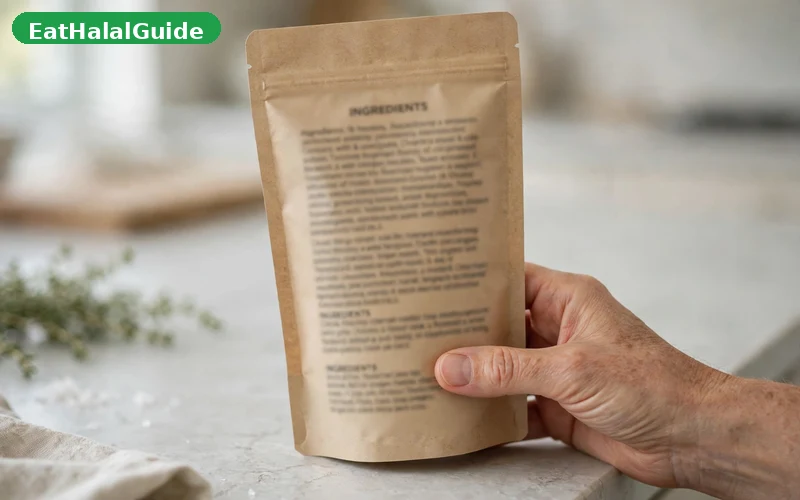
Three questions. First, whose mark is it? Halal mark or kosher mark — and which body issued it? Second, does it contain alcohol, gelatin or unnamed enzymes? If it is kosher and contains any of those, it is not halal until verified. Third, is it meat? Only your own system’s mark counts.
Frequently Asked Questions
Is kosher food halal? No — not automatically. Kosher slaughter does not include Allah’s name over each animal, and kosher products may contain alcohol.
Is halal food kosher? No — not for observant Jews. Halal meat is not slaughtered by a shochet, has no lung inspection, is not salted to remove blood, and may mix meat with dairy.
Can Muslims eat kosher meat if halal is not available? Some scholars permit it under Quran 5:5 — Ibn Abbas, Ibn Uthaymeen and Ibn Baz held it lawful in principle. The American Halal Foundation, IslamQA/SANHA and Darul Ifta Australia take the stricter view.
Is kosher wine halal? No. Kosher wine is wine, and alcohol is haram in Islam in every form.
Can a product be both halal and kosher? Yes. Plant-based products with no alcohol can carry both marks. Meat that satisfies both is rare.
Final Thoughts
Halal vs kosher is not a contest over which system is stricter — two different laws that happen to agree on pork. Kosher is stricter on animal types, on meat-and-dairy separation and on post-slaughter processing. Halal is stricter on alcohol and on the words spoken at slaughter. Neither is a subset of the other. The difference between halal and kosher comes down to this: check the mark of your own system, and read the ingredients.
If you remember one line: kosher is not automatically halal, and halal is not automatically kosher.
What we could not verify
- A dedicated halal-vs-kosher comparison page was found on halalcodecheck.com (“Halal vs Kosher Meat: Can Muslims Eat Kosher Food?”) and on halalharams.com (“Is Kosher Halal? A Complete Guide for Muslims”) at the 2026-11-14 re-check; both agree with this article. No dedicated halal-vs-kosher comparison page was found on halalinfohub.com.
- The Darul Ifta Australia fatwa, the Star-K cheese article and the kashrut.com cheese article were re-opened directly at publish on 2026-11-14 and agree with this article.
- Halalworthy’s claim that Egypt’s Dar al-Ifta ruled kosher meat generally permissible under Quran 5:5 is not verified at source — not repeated here.
- The OU’s “1.2 million products” and OK’s “800,000+ products” figures come via HalalSpy, not from the certifiers — not repeated here.
- The Halal Times’ “$1.53 trillion” food-spend figure for 2024 is not repeated here.
- Live “People also ask” questions for “halal vs kosher” captured 2026-11-14: “Can Jews eat halal?”, “Can Muslims eat kosher food?”, “Is Chick-fil-A halal certified?”, “Is kosher basically halal?” — none contradicts this article.
- No statement was opened directly from KLBD itself in prep.
- The UK labelling Bill was at first reading on 3 November 2026; re-checked 2026-11-14 (bills.parliament.uk) — still at first reading, second reading scheduled 15 January 2027.
- The Al-Salam Institute’s minority reading of Quran 5:5 is reported in the research notes, not adopted.
Sources & Verification
| # | Source | What it says | Status |
|---|---|---|---|
| 1 | halalspy.com — “Halal vs Kosher: Differences in Slaughter, Alcohol, Dairy, Seafood, and Certification” | Side-by-side comparison table; zabiha per-animal invocation vs shechita session blessing; HMC prohibits stunning, HFA/JAKIM permit reversible stunning; KLBD “Primary UK kosher authority”; IIFA and most major halal bodies do not recognise kosher certification as equivalent to halal | Verified — opened directly 2026-11-13 |
| 2 | halaltimes.com — “Halal vs. Kosher: The Key Differences Explained” | Comparison table; CJEU 17 Dec 2020 stunning ruling; ECtHR 13 Feb 2024 Belgium bans upheld; Quran 5:5 quoted; halal meat not kosher (no shochet, no salting); dual certification possible for meat-free, alcohol-free products | Verified — opened directly 2026-11-13 (published 2026-10-14, updated 2026-10-29) |
| 3 | halalfoundation.org — “Is Kosher Halal: Can Muslims Eat Kosher?” (American Halal Foundation) | “No, kosher is not automatically halal”; “Muslims should not casually assume that kosher meat and products are halal”; kosher gelatin not automatically halal; kosher wine not halal | Verified — opened directly 2026-11-13 (published 2022-11-22, updated 2026-10-21) |
| 4 | islamqa.org — “Are Kosher certified products Halaal?” (fatwa-tt/134069) | SANHA excerpt: kosher meat cannot be regarded halal (no tasmiyah per animal); kosher wine and alcohol cannot be made halal by the kosher mark; kosher gelatin not automatically halal; pork enzymes haram | Verified — opened directly 2026-11-13 (published 2020-02-10; Mufti Arshad Ali) |
| 5 | oukosher.org — “OU Kosher Symbols Explained” | OU = pareve (neither meat nor dairy, not made on dairy/meat equipment); OU-D = dairy or dairy equipment; OU-DE = made on dairy equipment; OU-Meat/Glatt = meat; OU-Fish = fish; OU-P = kosher for Passover and pareve | Verified — opened directly 2026-11-13 |
| 6 | fatwa.org.au — “is kosher meat halal” (Darul Ifta Australia) | Kosher meat not halal “unless one can ascertain that the name of Allah Ta’ala was taken on that specific animal”; three Shariah conditions for valid slaughter | Verified — opened directly 2026-11-14 |
| 7 | star-k.org — “Eating Her Curds? No Way” (Rabbi Tzvi Rosen, Spring 2011) | Cheese is kosher only if a Jew puts the starter culture/rennet into the milk; otherwise gevinas akum; microbial rennet widely used | Verified — opened directly 2026-11-14 |
| 8 | kashrut.com — “Say Cheese!” | Rennet as davar hama’amid is never nullified (Yoreh Deah 87:11); gevinat akum ban rests on rennet from non-kosher slaughter | Verified — opened directly 2026-11-14 |
| 9 | alim.org — Tafsir Ibn Kathir on Quran 5:5 | “Their slaughtered animals, as Ibn Abbas, Abu Umamah, Mujahid, Sa’id bin Jubayr, ‘Ikrimah, ‘Ata’, Al-Hasan, Makhul, Ibrahim An-Nakha’i, As-Suddi and Muqatil bin Hayyan stated” | Partially verified — search excerpt 2026-11-13; re-open at publish |
| 10 | theislamicbookcafe.com — “Is the Meat in America Halal?” | Quran 5:5 (Saheeh International); Sahih al-Bukhari 5507; Ibn Uthaymeen 28 Safar 1414 (17 Aug 1993) and Ibn Baz on People of the Book meat | Partially verified — search excerpt 2026-11-13; re-open at publish |
| 11 | alsalam.ac.uk — “The Food of the People of the Book” | Minority reading: the word for “food” (ta’am) in Quran 5:5 does not mean slaughtered meat | Partially verified — search excerpt 2026-11-13; reported, not adopted |
| 12 | halalcodecheck.com — “USDA Halal Certified Foods” and “Halal vs Kosher Meat: Can Muslims Eat Kosher Food?” | TEFAP list marks items (K) kosher and (H) halal; exactly one item carries both marks (low-sodium canned tomato sauce); a dedicated halal-vs-kosher comparison page (“Halal vs Kosher Meat: Can Muslims Eat Kosher Food?”) was found at the 2026-11-14 re-check and agrees with this article | Verified — opened directly 2026-11-14 |
| 13 | majidfoods.com — “Halal vs Kosher: Key Differences Every Consumer Should Know” | Per-animal invocation is “the primary reason many Islamic scholars do not consider kosher meat to be halal”; kosher product “can be completely haram due to alcohol content” | Partially verified — search excerpt 2026-11-13 |
| 14 | blog.zioals.com — “Halal vs Kosher: What’s the Real Difference?” | “Kosher is not automatically halal. Some Muslim scholars allow kosher meat under conditions”; cites WebMD for “Muslims can eat kosher meat” | Partially verified — search excerpt 2026-11-13 (competitor; WebMD citation flagged) |
| 15 | thekosherhub.com — “Kosher vs Halal: Differences & Similarities” | 20-point comparison table; “If you keep kosher, a halal label is never a substitute for kosher certification”; “Generally yes — most Islamic authorities consider kosher meat acceptable” (uncounted headcount, contradicted by Sources 3, 4, 6) | Partially verified — search excerpt 2026-11-13 (competitor; headcount claim flagged) |
| 16 | orthodox-jews.com — “Kosher vs Halal: What’s the Difference?” | “Can Muslims Eat Kosher Food? This is debated among Islamic scholars”; “Can Jews Eat Halal Food? No”; “Generally yes — most Islamic authorities consider kosher meat acceptable” (same uncounted claim as Source 15) | Partially verified — search excerpt 2026-11-13 (competitor; headcount claim flagged) |
| 17 | halalworthy.com — “Halal vs Kosher Meat: Key Differences Muslims Should Know” | Claims Egypt’s Dar al-Ifta ruled kosher meat generally permissible under 5:5 (single secondary claim, not verified at source, not repeated in this article) | Partially verified — search excerpt 2026-11-13 |
| 18 | blog.halalfinderapp.com — “Halal vs. Kosher vs. Vegan” | Comparison table wrongly says shellfish is “allowed” under kosher — false; shellfish is forbidden in kashrut | Partially verified — search excerpt 2026-11-13 (competitor; shellfish error flagged) |
| 19 | chefsresource.com — “Is Halal Meat Kosher?” and “Can a Jew Eat Halal?” | One page says “No, Halal meat is not considered Kosher”; the other says “Yes, in many instances, a Jew can eat Halal” — the site contradicts itself | Partially verified — search excerpts 2026-11-13 (competitor; self-contradiction flagged) |
| 20 | legit.ng — “Kosher vs Halal: what are the similarities and differences?” | “Muslims can eat Kosher meat, therefore making Kosher Halal” — blanket claim, contradicted by Sources 3, 4 and 6 | Partially verified — search excerpt 2026-11-13 (competitor; blanket claim flagged) |
| 21 | en.wikipedia.org — “Orthodox Union Kosher” | OU Kosher founded 1923; symbol first placed on Heinz vegetarian baked beans | Partially verified — search excerpt 2026-11-13 |
| 22 | myjewishlearning.com — “Ask the Expert: Kosher Symbols” | Each hechsher comes from a different organisation or rabbi; kosher products always specify meat, dairy or pareve | Partially verified — search excerpt 2026-11-13 (updated 2024-11-05) |
| 23 | EatHalalGuide — What Is Halal Food? | Short “Is halal the same as kosher?” section with a 6-row table; UK labelling Bill at first reading 3 Nov 2026, second reading 15 Jan 2027; HMC/HFA stunning split | Verified — our own published article |
| 24 | EatHalalGuide — Is Gelatin Halal or Haram? | Gelatin halal only from a halal source; kosher gelatin not automatically halal; E441 explainer | Verified — our own published article |
| 25 | EatHalalGuide — Is Vanilla Extract Halal or Haram? | Standard extract 35% alcohol; no major certifier certifies the bottle; finished-food debate with certifier thresholds | Verified — our own published article |
| 26 | EatHalalGuide — Are Marshmallows Halal or Haram? | Pork gelatin case; most supermarket marshmallows not halal | Verified — our own published article |
| 27 | EatHalalGuide — Is M&S Chicken Halal or Haram? | HMC/HFA stunning split worked through a real UK case; M&S policy requires pre-slaughter stunning for all meat | Verified — our own published article |
| 28 | EatHalalGuide — Halal Sweets: Which UK Sweets Are Halal? | The site’s UK sweets guide — 15 sweets, 10 halal / 5 not | Verified — our own published article |
| 29 | EatHalalGuide — E-Code Database (e-codes/) | Covers E322 (Halal), E412 (Halal), E418 (Halal), E476 (Mushbooh), E102 (Halal), E415 (Halal), E410 (Halal), E211 (Halal), E330 (Halal) and E101 (Mushbooh) — the 10 pilot codes. E471/E621/E120 deep guides coming next; E422/E110/E160b/E904/E635/E162/E270/E170/E500/E320/E440a/E955 on the next-codes list; E442/E901/E903/E414/E160a not on the hub at all. | Verified — our own published hub page |
Last verified: 2026-11-14