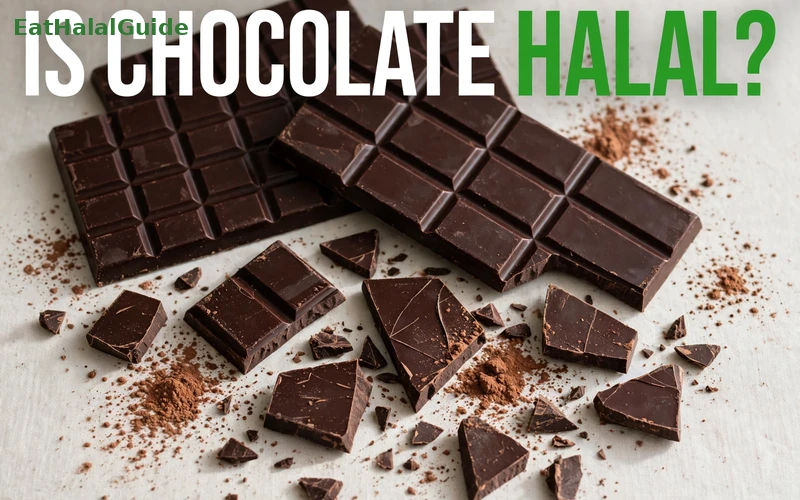

A bar of chocolate looks like the simplest thing in the shop. But is chocolate halal is not a question with one answer — the same bar can be halal in one country and doubtful in another, and the top-ranking pages contradict each other.
One warning: the page that calls a bar doubtful because of E471 may be checking for the wrong ingredient — and the page that calls it halal may be quoting a certificate that does not cover your country.
Quick Answer
Chocolate itself is halal — cocoa, cocoa butter, sugar and milk are all permissible. The bar decides the rest. A plain bar with only soya lecithin (E322) and vanillin is halal by ingredients. A bar becomes Mushbooh on an emulsifier of undisclosed source — E471, E476 or E442 — and Haram on carmine (E120), pork gelatine or an alcohol filling. Most mainstream UK and US bars are Mushbooh: none is certified and none discloses its emulsifier sources. Certified chocolate exists — Whittaker’s (FIANZ), Marou (JAKIM), Firetree (Halal Certification Europe), Nutella (NIHT) and Cadbury Australia (HCAA).
Chocolate at a glance
| Chocolate / market | Verdict | Why |
|---|---|---|
| Plain dark, milk or white (E322 only, vanillin) | Halal by ingredients | Cocoa, cocoa butter, sugar, milk — all halal; no animal or alcohol ingredient |
| Most mainstream UK/US bars (Cadbury, Galaxy, Lindt, Hershey’s, Milka, Kinder) | Mushbooh | No halal certification; emulsifier sources undisclosed |
| Liqueur-filled chocolate (brandy, rum, whisky, kirsch) | Haram | Real alcohol in the filling; cooking does not remove it |
| Carmine / cochineal (E120) in any chocolate | Haram (majority view) | Insect-derived colour; MUI permits, most other authorities do not |
| Gelatine in marshmallow, mousse or jelly centres | Haram unless certified | Gelatine of unnamed source is not shown to be halal |
| Cadbury UK (plain Dairy Milk) | Mushbooh | E442 + E476 undisclosed; no HMC/HFA certification |
| Cadbury Australia (listed products) | Halal — certified | 43 products certified by Halal Certification Authority Australia |
| Cadbury Malaysia | Halal — JAKIM-certified | JAKIM tested the factory in 2014 and cleared it |
| KitKat UK | Mushbooh | Not certified; Nestlé says suitable for a halal diet |
| KitKat Malaysia | Halal — JAKIM-certified | Nestlé Malaysia: all products certified halal |
| Hershey’s US plain bars | Halal by ingredients | PGPR from castor, soybean or sunflower oil; no gelatin; NOT certified |
| Nutella | Halal (mainstream) | 7 ingredients, soya lecithin + vanillin; NIHT-certified plants |
| Whittaker’s | Halal — FIANZ-accredited | Maker’s own FAQ confirms FIANZ accreditation |
| Marou | Halal — JAKIM-certified | Check the specific bar appears in the collection |
| Firetree | Halal — Halal Certification Europe | All bars except a few alcohol gift boxes |
| NOMO | Ingredient-verified only | Vegan, no halal certification |
| Ülker (Turkey) | Halal on the parent group’s claim | TSE claim, no certificate number published |
| Lindt (own guide) | Mushbooh overall; liqueur lines Haram | No product certified anywhere |
| Maltesers (own guide) | Halal by ingredients, NOT certified | Standard UK pack; White/hot chocolate Mushbooh |
| M&M’s (own guide) | Halal by ingredients (US); UK Peanut/Crispy NOT halal | Carmine E120 in UK Peanut/Crispy |
| Smarties (own guide) | Halal by ingredients (UK), NOT certified | Australia certified but the pack lists carmine |
What is chocolate?
Chocolate is cocoa mass (ground cocoa nibs), cocoa butter (the fat pressed from the nibs), sugar and — for milk and white chocolate — milk. Dark chocolate is cocoa mass, cocoa butter and sugar, with no milk solids. Milk chocolate adds milk powder and more sugar. White chocolate has no cocoa solids at all — cocoa butter, sugar and milk solids.
One name traps people: chocolate liquor (or cocoa liquor) on a US label is finely ground cocoa nibs, 0% alcohol — not a drink. Chocolate liqueur is the opposite — a drink, with alcohol.
Is chocolate halal?
The short version of is chocolate halal in islam is that it is two questions: are the ingredients permissible? and is it certified? A bar with only halal ingredients is halal, logo or not — a certificate is a way of checking, not the ruling — but only a certificate settles what a label cannot: where an emulsifier came from, and what shared the line. That is why is chocolate halal in islam gets three answers online — halal, doubtful and haram. See What Is Halal Food? for how doubtful foods are judged.
The base is never the problem — cocoa mass, cocoa butter, sugar and milk are all halal. Everything after that is what the maker added: an emulsifier, a colour, a flavouring, a filling.
The ingredients that decide it
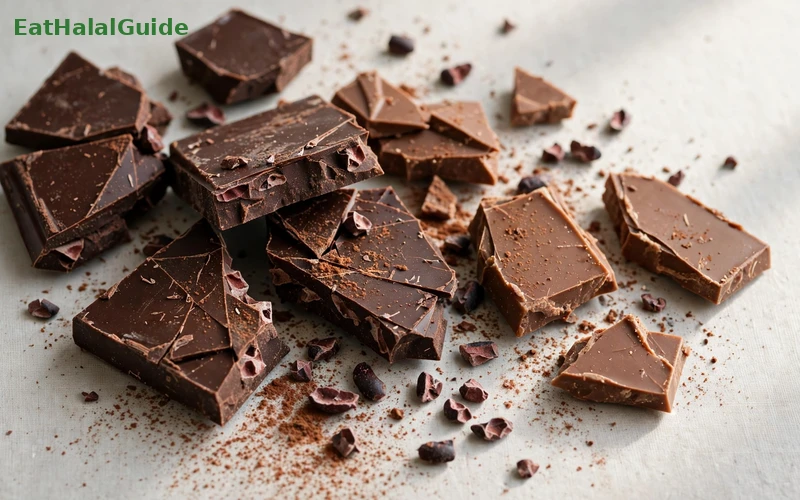
Six ingredients decide almost every chocolate verdict.
E471 — mono- and diglycerides of fatty acids. The most important additive to check. It is made from glycerol and fatty acids, and the E-number does not say whether those fats were plant or animal. SANHA: E471 can be plant or animal and needs a product-level investigation. A bar that lists E471 with no source named is Mushbooh.
E476 — PGPR (polyglycerol polyricinoleate). Fatty-acid half: castor oil, plant. Glycerol half: plant or animal — the label never says which. Our own E-Code Database hub rates E476 Mushbooh — check the source. Hershey’s says its PGPR is “derived from castor bean oil, sunflower oil, or soybean oil” — plant, in Hershey’s case.
E442 — ammonium phosphatides. Another glycerol-based emulsifier, same undisclosed-source question as E476 — Cadbury Dairy Milk UK lists it alongside E476; the hub has not checked E442 yet.
E120 — carmine (cochineal). A red colour made from crushed cochineal insects. Haram in the majority view — JAKIM and the HFA classify it as haram — though Indonesia’s MUI Fatwa 33 of 2011 permits it “as long as it is beneficial and not harmful”. Rare in a plain bar — look for it in red and pink coatings, novelty eggs and coloured sweets. UK Peanut and Crispy M&M’s are NOT halal because they contain carmine (our own M&M’s guide).
E441 — gelatine. Plain chocolate does not normally need it. It appears in marshmallow, mousse and jelly centres, and some caramel fillings. Gelatine of unnamed source is not shown to be halal.
Vanilla extract vs vanillin, and whey. Vanilla extract is vanilla beans extracted in ethanol — about 35% alcohol in the extract. Vanillin is synthetic: no alcohol in production or in the ingredient. “Vanilla extract” is the alcohol carrier, “vanillin” is fine, a bare “flavouring” does not say which. Whey inherits the cheesemaking question: animal rennet is the concern, and a vegetarian stamp rules it out.
E322 (lecithins) is the emulsifier in most bars — soya or sunflower, plant-derived and halal. The hub covers E322 (Varies by source — here lecithins, so halal) and E101 (Mushbooh — not in chocolate). E471, E621 and E120 deep guides are coming next on the hub. E422, E110, E160b, E904, E635, E162, E270, E170, E500, E320, E440a and E955 sit on the hub’s next-codes list. E442, E901, E903, E414 and E160a are not on the hub at all.
See Also: Is Gelatin Halal or Haram? — the site’s E441 explainer.
Is dark chocolate halal?
The short answer to is dark chocolate halal is yes, usually. A simple dark bar is cocoa mass, sugar, cocoa butter and possibly soya lecithin (E322). If only E322 is listed, most scholars accept it as halal. The cocoa percentage proves nothing: two bars at 70% can get different answers.
What to watch for in dark chocolate is the vanilla. Premium dark bars often specify “vanilla extract” — Green & Black’s Organic Dark 70% does. Budget dark bars more often use vanillin. Chocolate chips and baking blocks typically list E471 and sometimes E476 — Mushbooh.
Is milk chocolate halal?
The short answer to is milk chocolate halal is the same as for dark — the type does not settle it, the list does. Milk chocolate adds two questions: the whey and the emulsifiers. Whey powder comes from cheesemaking, and the enzyme used there decides whether it is halal. A vegetarian stamp rules animal rennet out; without one, the whey is open.
Cadbury Dairy Milk UK lists: MILK, sugar, cocoa butter, cocoa mass, vegetable fats (palm, shea), emulsifiers (E442, E476), flavourings. No E471 in the plain bar — the top-ranking complete guide lists Dairy Milk as “E471 (undisclosed)”, which is wrong for the plain bar; Salted Caramel does list E471. The question is E442 and E476, both undisclosed, and Mondelez has not sought HMC or HFA certification for UK manufacturing. Mondelez says most of the range is suitable for a halal diet — but not certified. So is milk chocolate halal in the UK? The plain Dairy Milk bar is Mushbooh — suitable on the maker’s word.
Is white chocolate halal?
The short answer to is white chocolate halal is usually yes on the ingredients — white chocolate is cocoa butter, sugar and milk solids, all halal — but the vanilla question is most acute here: with no cocoa solids to mask flavours, makers often use real vanilla extract. Premium white bars — Green & Black’s White, Lindt White — specify “vanilla extract”. Budget white bars more often use vanillin.
The same emulsifier and whey checks apply as for milk chocolate. White Maltesers are Mushbooh on our own Maltesers guide — they list E476 of undisclosed source. Marou’s 44% white bar is a certified option — check it appears in the JAKIM-certified collection.
Does chocolate contain alcohol?
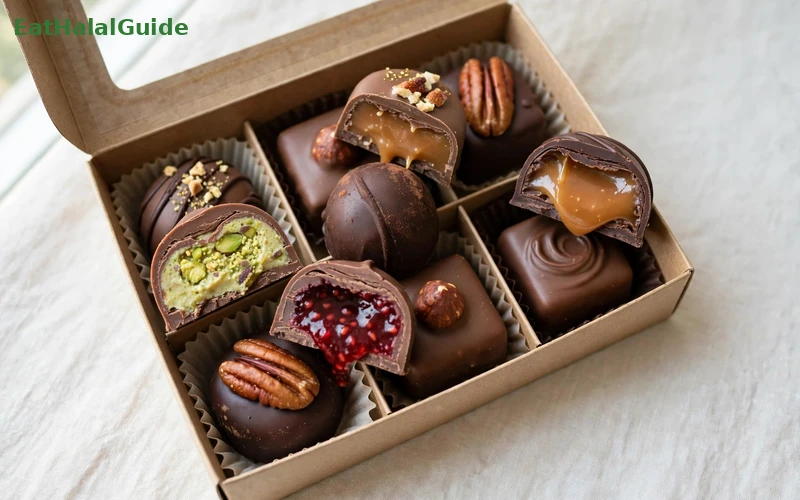
Most chocolate does not. The question does chocolate contain alcohol has three answers.
Liqueur fillings are alcohol — Haram. Brandy, rum, whisky, kirsch and Cointreau centres are alcoholic drinks put into chocolate on purpose — Lindt’s Cognac Bar is about 8% alcohol, its Marc de Champagne pralines about 3%. IFANCA: “When any amount of alcoholic beverages such as beer, wine, liquor, etc. is added to food, the food automatically becomes haram. Cooking, to reduce the ethanol content does not make the contaminated food halal.”
Vanilla extract is alcohol, in a small amount. In the US, vanilla extract is vanilla beans extracted in ethanol — at least 35% alcohol in the extract itself. Scholars differ on the trace: many permit it as a flavour solvent in food that cannot intoxicate; the strict view avoids it. IFANCA’s line is under 0.1% ethanol in total to qualify as halal. A bar that lists “vanilla extract” carries the question; “vanillin” does not.
Chocolate liquor is not alcohol. The name is the trap — ground cocoa nibs, 0% alcohol. IFANCA: it “has no relationship to alcohol, nor is alcohol used in producing it”.
Which chocolate brands are halal?
KitKat is Mushbooh in the UK and the USA: no halal certification, and E476’s glycerol source is unconfirmed by Nestlé for the UK bar. In Malaysia, it is JAKIM-certified. Hershey’s plain US bars are halal by ingredients — no gelatin, no halal claim; marshmallow products list gelatin of unnamed source. Nutella is halal on its seven ingredients, certified in some markets. Cadbury is Mushbooh in the UK, certified in Australia and Malaysia — full story next.
Our own guides: Is Lindt Chocolate Halal or Haram? — Mushbooh overall, no product certified anywhere; liqueur lines Haram. Is Maltesers Halal or Haram? — standard UK Maltesers halal by ingredients, NOT certified; White/hot chocolate Mushbooh. Are M&M’s Halal or Haram? — standard US M&M’s halal by ingredients, NOT certified; UK Peanut and Crispy NOT halal (carmine). Are Smarties Halal or Haram? — UK Smarties halal by ingredients, NOT certified; Australia certified but carmine.
See Also: Is Roshen Halal or Haram?
See Also: Is KitKat Halal or Haram?
See Also: Is Ritter Sport Halal or Haram?
See Also: Is E471 Halal or Haram? — the emulsifier in chocolate whose source the label hides.
Is Cadbury chocolate halal?
Cadbury proves the country decides — three markets, three answers.
United Kingdom — Mushbooh. The plain Dairy Milk bar lists E442 and E476 of undisclosed source, and Mondelez has not sought HMC or HFA certification for UK manufacturing. Mondelez: “Most of the Cadbury range is suitable for those following a Halal diet. However, it is not Halal certified.” Cadbury UK adds that the only animal-related products it uses in the UK are milk and eggs — but some assortments, like Roses, may contain alcohol.
Australia and New Zealand — Halal, for the listed products. Cadbury’s own AU/NZ website publishes a halal page listing the products it states are certified by Halal Certification Authority Australia: Dairy Milk variants, Dream, Caramilk, Old Gold, Flake, Twirl, Boost, Crunchie, Picnic, baking blocks, Freddo and seasonal lines. Cadbury publishes the list, not the certificate.
Malaysia — Halal, JAKIM-certified — and the 2014 story matters. In May 2014, Malaysia’s Ministry of Health reported porcine DNA in two Cadbury batches — Dairy Milk Hazelnut and Dairy Milk Roast Almond — and Cadbury Malaysia recalled them. JAKIM took 11 samples from the Shah Alam factory; the result, announced 2–3 June 2014: no porcine DNA. Certificates reinstated 6 June 2014.
United States — Mushbooh. Cadbury in the USA is made under licence by Hershey’s, with no halal certification.
Halal-certified chocolate you can actually buy
Whittaker’s (New Zealand) — Halal, FIANZ-accredited. Whittaker’s own FAQ: “Whittaker’s have been granted Halal accreditation by FIANZ for many of our Classic and Specialty flavours.” A few limited editions are not covered.
Marou (Vietnam) — Halal, JAKIM-certified. Marou’s halal collection page states its bars are “certified halal by JAKIM Malaysia” — but its FAQ says only “some products” are certified, so check the specific bar.
Firetree (UK craft) — Halal, Halal Certification Europe. Firetree’s FAQ states “we are certified by Halal Certification Europe to produce chocolate” — all bars except a few alcohol gift boxes.
Nutella — Halal, NIHT-certified plants. The Alba plant certificate runs to 28 February 2027; UK jars carry no logo, but the recipe is the same.
Ülker (Turkey) — Halal on the parent group’s claim, not on a certificate you can check. Ülker holds no GİMDES certificate. What exists is a public statement by Murat Ülker, chairman of parent group Yıldız Holding, that all its Turkish factories hold Turkish Standards Institution halal certification — no number, no scope, no dates. Buy it on the pack’s TSE mark, not the brand name alone.
NOMO (UK) — ingredient-verified only. NOMO is vegan, free from dairy, egg and gelatine, and lists no alcohol — but it holds no halal certification, and “vegan” does not rule out an alcohol-carried flavouring.
How to check any chocolate bar in 30 seconds
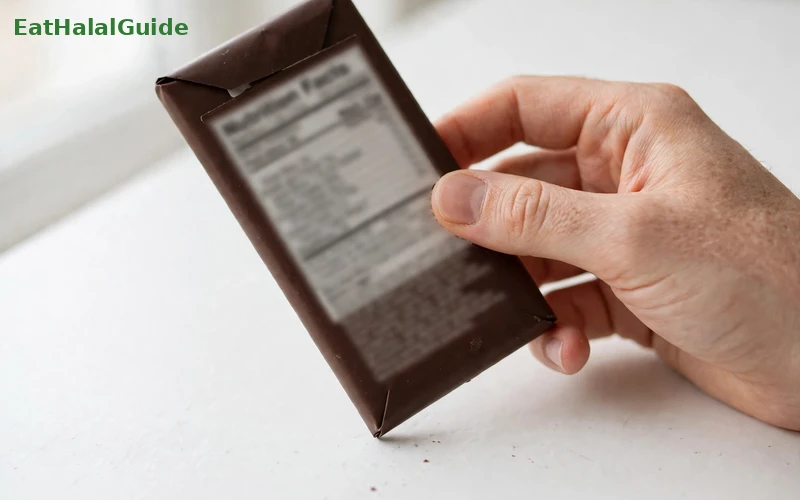
Five checks, in order. First, the halal mark — a logo from a named body settles it. Second, the emulsifier line — E471, E476 or E442 unnamed means Mushbooh; E322 alone closes the question. Third, the red line — carmine, cochineal or E120 means Haram for most schools. Fourth, the filling line — liqueur means Haram; marshmallow or jelly means check the gelatine. Fifth, the vanilla line — “vanilla extract” is the alcohol carrier, “vanillin” is fine.
Chocolate beyond the bar
Hot chocolate. Plain cocoa powder has no emulsifiers, flavourings or E-codes — 100% cocoa solids, halal across the board. Cadbury Drinking Chocolate in the tin lists cocoa powder, sugar and whey powder — no E471, no vanilla extract — widely considered halal in the mainstream position, no certification.
Spreads and baking. Nutella is halal on its seven ingredients; Cadbury Chocolate Spread lists E471 — Mushbooh. Chocolate chips typically list E471 and sometimes E476, sources unspecified — Mushbooh.
Vegan chocolate is not automatically halal. Vegan removes gelatine, carmine, shellac and dairy, but not alcohol — vanilla extract and rum flavourings are common in premium vegan dark. Moo Free uses vanillin; Montezuma’s bars vary. Fairtrade is an ethics label, not a halal one.
See Is Magnum Halal or Haram? for ice cream bars — Mushbooh in the UK, Halal where certified; it does not cover chocolate bars. Is Ice Cream Halal or Haram? covers ice cream only. Halal Sweets: Which UK Sweets Are Halal? covers 15 sweets, no Smarties or chocolate bars.
Frequently Asked Questions
Is chocolate halal? Chocolate itself is halal. A bar becomes Mushbooh on an undisclosed-source emulsifier (E471, E476, E442) and Haram on carmine, pork gelatine or an alcohol filling. Most mainstream UK and US bars are Mushbooh — none certified.
Is dark chocolate halal? Usually, yes. A simple dark bar — cocoa mass, sugar, cocoa butter and soya lecithin only — is halal by ingredients. Check the vanilla and the emulsifier. Certified dark: Ülker Bitter 60%, Whittaker’s Dark Ghana, Firetree, Marou.
Is milk chocolate halal? It depends on the bar. Plain Cadbury Dairy Milk UK is Mushbooh — E442 and E476 undisclosed, no certification — while Cadbury Australia is HCAA-certified and Cadbury Malaysia JAKIM-certified. Check the emulsifier line.
Is white chocolate halal? Usually, yes on the ingredients. The vanilla question is most acute in white chocolate — premium white bars often specify “vanilla extract”. Marou’s 44% white bar is a certified option.
Does chocolate contain alcohol? Most chocolate does not. Liqueur-filled chocolates do — brandy, rum, whisky and kirsch centres are Haram — and vanilla extract is about 35% alcohol. Chocolate liquor contains 0% alcohol.
Final Thoughts
Chocolate is halal at its base; the doubt lives in what is added. A plain bar with soya lecithin and vanillin is halal by ingredients; an undisclosed emulsifier means Mushbooh; carmine, gelatine or a liqueur filling means Haram. The country decides as much as the recipe — the same Cadbury bar is Mushbooh in the UK, certified in Australia and JAKIM-certified in Malaysia; the 2014 scare ended with JAKIM clearing the factory. The top-ranking pages contradict each other on Cadbury, KitKat, Ülker and Maltesers — read the pack in your hand. Check the mark, the emulsifier line, the red line, the filling line and the vanilla line.
What we could not verify
- JAKIM portal searches run 2026-11-13: “Cadbury” returned 74 products (certificates valid to 2026–2028); “KitKat” returned 16 products (certificates valid to 2027–2028); “Nutella” returned 159 products (all third-party bakery items).
- Marou’s JAKIM collection page — not opened directly.
- Firetree’s Halal Certification Europe FAQ — not opened directly.
- Ülker’s TSE certificate — no number, scope or expiry retrieved.
- Galaxy, Milka, Toblerone, Ritter Sport, Ferrero Rocher, Kinder Bueno (UK) — no manufacturer statement opened.
- Cadbury Malaysia’s current JAKIM status — 2014 clearance verified; current status from a 2026 secondary report.
- Nestlé UK’s dietary list (Jan 2023) — not opened directly.
- E471 source in Galaxy hot chocolate, chocolate chips, Bournville Baking Block — undisclosed.
- Cadbury Drinking Chocolate at source — halalcodecheck only.
- MUIS HalalSG register for chocolate brands — not searched directly.
- PAA — Google “People Also Ask” block WAS captured at publish (4 questions) for “is chocolate halal”; the 5 FAQs are competitor-FAQ proxies.
- Image-style check — Google Images failed; Bing not attempted; image-search CLI run instead.
Sources & Verification
| # | Source | What it says | Status |
|---|---|---|---|
| 1 | IFANCA — Chocolate Liquor, Root Beer, Cooking Wine and Non-Alcoholic Beer (ifanca.org) | Added alcohol must be <0.1% ethanol to qualify as halal; vanilla extract ≥35% ethanol (US); chocolate liquor “has no relationship to alcohol, nor is alcohol used in producing it”; any alcoholic beverage added to food makes it haram — cooking does not remove it | Verified — opened directly 2026-11-13 |
| 2 | Cadbury Australia — Halal page (cadbury.com.au/our-range/diet-nutrition/halal/index.html) | “The below listed products have been certified halal by Halal Certification Authority Australia. This list applies to products manufactured for the Australian & New Zealand markets.” — Dairy Milk variants, Dream, Caramilk, Old Gold, Flake, Twirl, Boost, Crunchie, Picnic, baking blocks, Freddo, Caramello Koala, seasonal lines | Verified — opened directly 2026-11-13 |
| 3 | Whittaker’s — FAQ (whittakers.co.nz/en_WW/frequently-asked-questions) | “Whittaker’s have been granted Halal accreditation by FIANZ for many of our Classic and Specialty flavours.” All products made in Porirua, NZ; no palm oil; no GM ingredients | Verified — opened directly 2026-11-13 |
| 4 | The Hershey Company — Common Ingredient Questions PDF (thehersheycompany.com) | “PGPR (polyglycerol polyricinoleate) — An ingredient derived from castor bean oil, sunflower oil, or soybean oil.” Last updated 19 March 2026 | Partially verified — official Hershey’s document via search excerpt 2026-11-13 |
| 5 | Morrisons / Ocado / Asda — Cadbury Dairy Milk UK listings | “MILK, sugar, cocoa butter, cocoa mass, vegetable fats (palm, shea), emulsifiers (E442, E476), flavourings” — NO E471 in the plain bar; Salted Caramel variant lists E471 | Partially verified — retailer listings via search excerpts 2026-11-13 |
| 6 | Full Fact — Mondelez / Cadbury UK statement (2025-04-17) | “Most of the Cadbury range is suitable for those following a Halal diet. However, it is not Halal certified.” | Partially verified — via Full Fact search excerpt 2026-11-13 |
| 7 | The Straits Times / New Straits Times / just-food / PR Week — Cadbury Malaysia 2014 | MOH found porcine DNA in 2 batches (24 May 2014); JAKIM tested 11 factory samples, found none, announced 2–3 June 2014; certification reinstated 6 June 2014 | Partially verified — news reports via search excerpts 2026-11-13 |
| 8 | Ferrero Food Service — FAQ (ferrerofoodservice.com/au/en/faq) | “Nutella® sold by Australian Food Service is sourced from Ferrero® factories in Alba, Italy and from Lithgow, Australia and is Halal certified.” Refers to NIHT (halaal.org.za) | Partially verified — official Ferrero page via search excerpt 2026-11-13 |
| 9 | NIHT directory — Ferrero Alba plant (halaal.org.za, via isithalal) | Ferrero Alba (Italy) plant listed; certificate H786/NR933, issued 01/03/2023, expiry 28/02/2027; names the plant, not individual products | Partially verified — certifier directory via isithalal search excerpt 2026-11-13 |
| 10 | Nutella USA statement (Sept 2020, via isithalal) | “All Nutella sold worldwide is suitable for Halal consumption”; over 90% of industrial plants already Halal certified by a third party | Partially verified — brand statement via isithalal search excerpt 2026-11-13 |
| 11 | halalscannerai.com/blog/is-kit-kat-halal (updated 2026-11-05) | Nestlé UK dietary list (Jan 2023) names standard KitKat bars suitable for a halal diet, not certified; free from alcohol and gelatin; E471/E476 of vegetable origin | Partially verified — secondary page via search excerpt 2026-11-13 |
| 12 | halalcodecheck.com/blog/is-chocolate-halal/ | Chocolate itself halal; E471/E476/E442 Mushbooh; E120 Haram; E441 Haram unless certified; brand table (14 brands) — Maltesers Mushbooh on E471 (wrong per our Maltesers guide) | Verified — opened directly 2026-11-13 (competitor) |
| 13 | halalcodecheck.com/blog/complete-guide-halal-chocolate/ | E471/E476/vanilla extract the three flags; Cadbury Dairy Milk “E471 (undisclosed)” (wrong — plain bar is E442+E476); KitKat “Halal (mainstream)” (contradicts its own KitKat page); Lindt Excellence 70% “vanilla extract” (wrong — vanilla beans); Nutella Halal (mainstream) via NIHT Alba | Verified — opened directly 2026-11-13 (competitor) |
| 14 | halalcodecheck.com/blog/best-halal-chocolate-bars-online-2026/ | Certified list (Ülker, Damak, Whittaker’s FIANZ, Firetree HCE, Marou JAKIM, NOMO ingredient-verified); brand verdicts table; “Does chocolate contain alcohol?” H2; FAQs; Ülker “certified” (contradicts its own Turkey guide); re-checked 19 Aug 2026 | Verified — opened directly 2026-11-13 (competitor) |
| 15 | halalcodecheck.com/blog/halal-chocolate-turkey-guide/ | Ülker holds NO GİMDES certificate; parent chairman’s TSE statement, no number/scope/dates; HAK accreditation mandatory since 4 June 2023; Ülker’s own site blocks automated access | Partially verified — competitor via search excerpts 2026-11-13 |
| 16 | halalcodecheck.com/brand/kitkat/ | UK KitKat Mushbooh — E476 glycerol unverified; Nestlé has not publicly confirmed the glycerol source for UK KitKat; Malaysia KitKat JAKIM-certified | Partially verified — competitor via search excerpts 2026-11-13 |
| 17 | halalfoodscan.com/blog/is-chocolate-halal/ (published 22 Aug 2026, updated 30 Aug 2026) | Plain chocolate usually halal; type table; E471/whey/alcohol/gelatin/carmine/shellac; 5-step check; sources: 21 CFR §163.123/§163.124, FDA, SANHA | Verified — opened directly 2026-11-13 (competitor) |
| 18 | mrpoppleschocolate.co.uk/what-makes-chocolate-halal/ (first published 12 Jul 2024, last updated 10 Nov 2026) | Chocolate liquor 0% alcohol; halal-friendly vs certified; vegan ≠ halal; Darul Ifta Birmingham alcohol view; six label checks | Verified — opened directly 2026-11-13 (competitor — maker page) |
| 19 | halalawareness.com/is-chocolate-halal/ (published 2025-03-19, updated 2025-03-22) | Quick answer; no sources cited; brand list unsourced (“Toblerone — most varieties are halal-certified”); FAQ answers without questions | Verified — opened directly 2026-11-13 (competitor) |
| 20 | isithalal.food/food/hersheys/ (updated 2026-11-07) | Plain bars Halal by ingredients; PGPR from castor/soybean/sunflower per Hershey’s FAQ; Marshmallow Eggs gelatin unnamed; classic syrup E471; OU kosher not halal | Verified — opened directly 2026-11-13 (competitor) |
| 21 | isithalal.food/food/nutella/ (updated 2026-11-06) | 7 ingredients worldwide; NIHT Alba/Arlon/Villers-Écalles plants, certificates to 28/02/2027; AU Food Service Halal certified; Malaysia NIHT-certified (JAKIM-acknowledged) | Partially verified — competitor via search excerpts 2026-11-13 |
| 22 | SANHA — Halaal E-numbers (sanha.org.za, via halalfoodscan) | E471 can be plant or animal, requires product-level investigation | Partially verified — certifier source via halalfoodscan 2026-11-13 |
| 23 | LPPOM MUI — Fatwa 33/2011 (halalmui.org, via Smarties prep) | Cochineal food and drink colouring is halal “as long as it is beneficial and not harmful” | Partially verified — official MUI body via Smarties prep 2026-11-13 |
| 24 | JAKIM Halal Malaysia Portal — myehalal.halal.gov.my | “Cadbury” returned 74 products (certificates valid to 2026–2028); “KitKat” returned 16 products (certificates valid to 2027–2028); “Nutella” returned 159 products (all third-party bakery items). | Verified — portal searches run 2026-11-13 |
| 25 | EatHalalGuide — What Is Halal Food? | Mushbooh explainer; how doubtful foods are judged | Verified — our own published article |
| 26 | EatHalalGuide — E-Code Database (e-codes/) | Covers E322 (Varies by source), E476 (Mushbooh), E101 (Mushbooh); E471/E621/E120 deep guides coming next; E422/E110/E160b/E904/E635/E162/E270/E170/E500/E320/E440a/E955 on the next-codes list; E442/E901/E903/E414/E160a not on the hub at all | Verified — our own published hub page |
| 27 | EatHalalGuide — Is Gelatin Halal or Haram? | E441 explainer — gelatine source decides; istihalah rejected for gelatine | Verified — our own published article |
| 28 | EatHalalGuide — Is Lindt Chocolate Halal or Haram? | Mushbooh overall, no product certified anywhere; plain Excellence dark bars made without animal products or alcohol; liqueur-filled lines Haram | Verified — our own published article |
| 29 | EatHalalGuide — Are M&M’s Halal or Haram? | US standard Halal by ingredients, NOT certified; UK Peanut/Crispy NOT halal (carmine E120) | Verified — our own published article |
| 30 | EatHalalGuide — Are Smarties Halal or Haram? | UK Smarties Halal by ingredients, NOT certified; Australia certified but the pack lists carmine | Verified — our own published article |
| 31 | EatHalalGuide — Is Maltesers Halal or Haram? | Standard UK Maltesers Halal by ingredients, NOT certified; White Maltesers and hot chocolate Mushbooh; no current UK pack lists E471 | Verified — our own published article |
| 32 | EatHalalGuide — Is Magnum Halal or Haram? | Mushbooh in the UK; Halal where certified (Malaysia, Indonesia, the Gulf) — ice cream bars, not chocolate bars | Verified — our own published article |
| 33 | EatHalalGuide — Halal Sweets: Which UK Sweets Are Halal? | 15 sweets, 10 halal / 5 not; does NOT list Smarties or chocolate bars | Verified — our own published article |
| 34 | EatHalalGuide — Is Ice Cream Halal or Haram? | No single verdict — the tub decides; covers ice cream only | Verified — our own published article |
Last verified: 2026-11-13