
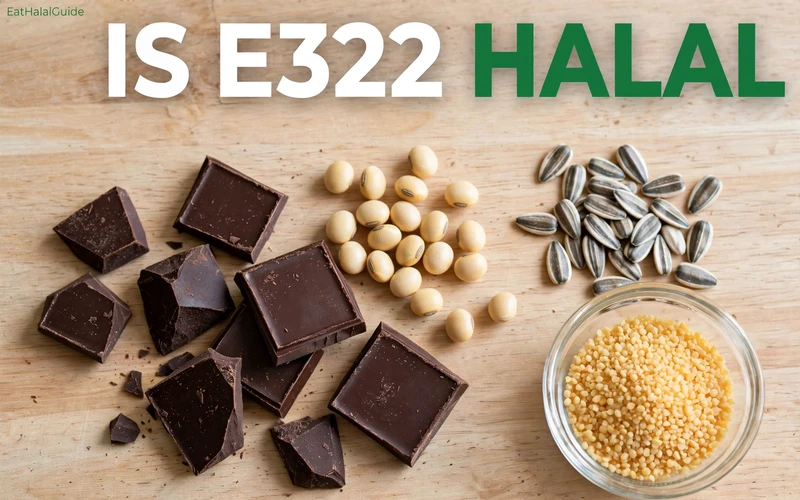

Is E322 halal? Yes — when it is soya, sunflower, rapeseed, or egg lecithin, which covers almost all the lecithin in modern food. The code itself does not settle the question. Lecithin is an emulsifier, and whether it is halal depends entirely on what it was made from. The rest of this page shows you how to check it on any packet in 30 seconds.
Quick Answer
| Source | Verdict |
|---|---|
| Soya lecithin | ✅ Halal |
| Sunflower lecithin | ✅ Halal |
| Rapeseed / corn lecithin | ✅ Halal |
| Egg yolk lecithin | ✅ Halal (not vegan) |
| Source not stated, product uncertified | ⚠️ Mushbooh — ask the manufacturer |
The South African National Halaal Authority (SANHA) lists E322 as Halaal, naming soybean as the main source, with eggs and leguminous seeds. Soya lecithin from major producers is Halal-certified — ADM’s soy lecithin carries IFANCA certification, and Cargill states its US and European lecithins are Halal-certified.
What is E322?
The E322 food code means lecithin, the emulsifier that keeps oil and water mixed in foods like chocolate, margarine, and bread. Its Codex name is INS 322, so the same additive appears as E322 on European labels and INS 322 elsewhere. It covers two forms: E322(i), lecithins, and E322(ii), partially hydrolysed lecithins. Lecithin is a mixture of phosphatides, mainly phosphatidylcholine, and it is also a normal part of every cell in the human body. The European Food Safety Authority (EFSA) re-evaluated it in 2017 and found no safety concern at the levels used in food, with no numerical intake limit set. Lecithin is an emulsifier, not a gelling agent. Gelatin (E441) is a different additive with a different answer — see our Gelatin guide.
Where does lecithin come from?
Commercial lecithin comes from a small set of raw materials, and the source decides the verdict:
| Source | Verdict | Why |
|---|---|---|
| Soybeans | ✅ Halal | Plant. The dominant commercial source since the 1920s, when extraction from soybeans replaced egg yolk at industrial scale. |
| Sunflower seeds | ✅ Halal | Plant. The fastest-growing alternative, because it avoids the soya allergen declaration. |
| Rapeseed / corn | ✅ Halal | Plant. Named by Cargill and by the US Food and Drug Administration’s definition of commercial lecithin. |
| Egg yolk | ✅ Halal | Egg is halal. SANHA lists eggs among E322’s sources and still lists the additive as Halaal. Not vegan. |
| Animal fat (non-egg) | ❌ Haram if from non-halal slaughter | No modern commercial pathway documents this. EFSA notes lecithins can come from animal or vegetable foodstuffs, but the animal raw material manufacturers name is eggs. |
In the United States, the Food and Drug Administration defines commercial lecithin as the mixture isolated from solvent-extracted soy, safflower, or corn oils. In Europe it is authorised as E322 under Regulation (EC) No 1333/2008. Modern crude plant lecithin is produced solely as a by-product of vegetable oils, according to Cargill.
Is egg lecithin halal?
Yes. Egg lecithin is halal, because eggs are halal. It is the original source of lecithin — it was first isolated from egg yolk in 1846 — and it is still used in specialist products and pharmaceuticals. It is not vegan, which is a different question from halal. If a label says “egg lecithin”, the answer is halal, and you do not need to check further on the emulsifier itself.
Which foods contain E322?
Lecithin is one of the most common emulsifiers in the supermarket. SANHA lists chocolate, dried milk, margarine, dessert mixes, and confectionery among its uses. ADM’s technical sheets add infant formula, frostings, bread and bakery products, crackers, cookies, cakes, and pan oils. Cargill lists chocolate and confectionery, margarine and spreads, bakery, powdered beverages, processed meats, and ice cream. In practice, the single emulsifier in a chocolate bar, biscuit, or spread is usually E322.
How to check your label in 30 seconds
- Read the emulsifier line. Look for “lecithin”, “soya lecithin”, “sunflower lecithin”, “egg lecithin”, or “E322”.
- Check the source word. “Soya lecithin”, “sunflower lecithin”, or “rapeseed lecithin” means halal. “Egg lecithin” means halal too.
- Check the allergen note. In the EU and UK, soya and egg must be declared as allergens. A label that says “lecithin” with no soya or egg warning usually means sunflower or rapeseed. This is a strong signal, not a guarantee — a narrow US exemption lets soy lecithin used as a release agent skip the allergen declaration.
- Check for a halal mark. A recognised halal logo (IFANCA, HMC, HFA, JAKIM) on the pack means the sourcing has already been audited — including the lecithin.
- If the source is still not stated and there is no halal mark, treat it as Mushbooh and ask the manufacturer. One email or message is usually enough: “Is the lecithin in this product soya, sunflower, or egg?”
See Also: E-Code Database — every E-number we have checked, with its verdict, in one place.
Frequently asked questions
Is lecithin halal?
Yes, when it is soya, sunflower, rapeseed, corn, or egg lecithin. SANHA lists E322 as Halaal. Only a source that is not stated, on an uncertified product, is Mushbooh.
Is E322 halal in the USA?
Yes, in practice. The FDA defines commercial lecithin as coming from soy, safflower, or corn oil, and the major US producers’ lecithins are Halal-certified. The same 30-second label check applies.
Is soya lecithin halal?
Yes. Soya lecithin is plant-based and halal. ADM’s soy lecithin is Halal-certified by IFANCA, and Cargill states its US and European lecithins are Halal-certified.
Does E322 contain pork?
No evidence was found for pork-derived lecithin in modern food. The animal source manufacturers name is egg yolk, which is halal. Lecithin from non-halal-slaughtered animal fat would be haram, but no manufacturer or regulator documents that as a current commercial pathway.
Final Thoughts
E322 is one of the easiest E-codes to settle. If the label names soya, sunflower, rapeseed, or egg, the answer is halal — and SANHA, IFANCA-certified producers, and the US and European regulators all point the same way. The only doubtful case is a bare “E322” with no source and no halal mark; even then, modern food lecithin is almost always soya or sunflower. Check the source word, check the allergen note, and move on.
Sources & Verification
| # | Source | What it says | Status |
|---|---|---|---|
| 1 | SANHA — E322 (Lecithin), sanha.org.za | Status: Halaal. Source: soybean (mainly); eggs; leguminous seeds. Function: stabiliser, emulsifier. | Verified — opened directly 2026-11-12 |
| 2 | EFSA — Re-evaluation of lecithins (E 322) as a food additive, EFSA Journal 2017;15(4):4742 | E322 authorised in the EU under Regulation (EC) No 1333/2008. Lecithins are phosphatides from animal or vegetable foodstuffs. No numerical ADI needed; no safety concern for the general population over 1 year. | Verified — opened directly 2026-11-12 (full text via PubMed Central) |
| 3 | FDA — 21 CFR 184.1400, Lecithin (eCFR) | Commercial lecithin is isolated from solvent-extracted soy, safflower, or corn oils. Affirmed GRAS, no limitation other than good manufacturing practice. | Verified — opened directly 2026-11-12 |
| 4 | Cargill — Lecithins (manufacturer) | “Cargill lecithins produced in the US and Europe are Kosher and Halal certified.” Crude lecithin from plant and animal raw materials (predominantly eggs); plant sources include rapeseed, sunflower seed, and corn. | Verified — opened directly 2026-11-12 |
| 5 | ADM — Yelkin SS IP Lecithin technical data sheet (Doc. COE.QAL.CQ.DOS.105.800155, approved 2025-02-05) | Soy lecithin, EU food additive E322. “Halal certified (IFANCA)”, Kosher Pareve (OU certified). No animal products, by-products, or animal-derived products used. | Verified — opened directly 2026-11-12 |
Last verified: 2026-11-12.
What we could not verify
- HMC (UK) and HFA (UK): no E322-specific statement was found in search on 2026-11-12. Neither body is cited as ruling on lecithin.
- JAKIM (Malaysia): no E-code-level ruling exists to cite. JAKIM certifies finished products and production facilities, not individual additives.
- A named fatwa on lecithin: no specific fatwa on lecithin surfaced in search on 2026-11-12. The ruling in this page rests on SANHA’s published Halaal listing plus the general Mushbooh principle for an unstated source.


