

KitKat is the chocolate wafer bar on supermarket shelves everywhere, and is kitkat halal is a question with no single answer — the same brand differs by country. The bar sold in Malaysia is JAKIM-certified Halal; the bar sold in the UK and the USA carries no halal certification; and the US bar is not even made by Nestlé — Hershey makes it. Verdicts follow.
The classic bar lists no gelatin and no pork, yet is still not certified in the UK or the USA — and the emulsifier that decides the verdict differs by country.
Quick Answer
No single verdict — the country and the factory decide. Standard KitKat in the UK and the USA is Mushbooh: no halal certification, no gelatin on the label, one open question each — unverified rennet in the UK whey, undisclosed glycerol in the US PGPR. KitKat in Malaysia is Halal — JAKIM-certified, symbol on the pack. KitKat made in Australia is halal certified, per Nestlé New Zealand (no certifier named; April 2019). KitKat in Japan is not halal-certified, with alcoholic sake flavours. Indonesia and the UAE are claimed Halal, not verified — Indonesia’s BPJPH certificate expired 3 March 2026. Canada has no verdict.
KitKat at a glance
| Product / market | Verdict | Why |
|---|---|---|
| Standard 4-Finger (UK) | Mushbooh | No halal certification; no gelatin; whey rennet source unknown |
| Standard 4-Finger (USA, Hershey) | Mushbooh | No halal certification; PGPR (E476) glycerol source undisclosed |
| Standard bar (Canada) | No verdict | Nestlé Canada does not facilitate halal certification; label lists PGPR + whey |
| Standard bar (Malaysia) | Halal | JAKIM-certified; halal symbol on the pack |
| Standard bar (Australia-made) | Halal certified | Nestlé NZ states it; no certifier named; statement from April 2019 |
| Standard bar (Indonesia) | Not verified — certificate expired 3 Mar 2026 | BPJPH certificate ID00410000235940222 covered Chembong-made KitKat, valid 3 Mar 2022–3 Mar 2026; no current certificate found |
| Standard bar (UAE / Gulf) | Claimed Halal, not verified | ESMA claim — secondary only, no certificate found |
| Standard bar (Japan) | Not halal-certified | Nestlé Japan states this; sake flavours contain alcohol |
| KitKat Chunky (UK) | Mushbooh | Same coating as 4-Finger; no certification |
| KitKat Dark (UK) | Mushbooh | No certification; lecithin stated as plant origin |
| KitKat White (UK) | Mushbooh | No certification; “pork gelatin” claim unevidenced |
| KitKat V Vegan (UK) | Mushbooh | Certified vegan, not halal-certified |
| KitKat Bites / Minis | Mushbooh | Same coating; no certification |
| Special editions (marshmallow / jelly / liqueur) | Check the pack | May add gelatin or alcohol; no blanket verdict |
What is KitKat?
KitKat is a chocolate-covered wafer bar — four crisp wafer fingers in milk chocolate — launched in 1935 by Rowntree’s of York, England. Nestlé says York is still “the home of KitKat”. The bar is now sold in 80+ countries, and that is where the halal question starts: outside the United States it is a Nestlé product, but in the USA it is produced under licence by The Hershey Company. The ingredients that matter are the small ones — the emulsifier, the whey, the flavouring — each changing by country. So this guide judges the bar in your hand, not the brand. For how doubtful foods are judged, see What Is Halal Food?.
Is KitKat halal?
Ask is kitkat halal and the answer starts with a test: a halal mark settles it; without one, the label must be clean. KitKat passes the label test in the UK and the USA — no gelatin, no pork, no alcohol — and fails the certification test. That is Mushbooh: not Haram, since nothing haram is named; not Halal, since no certifier checked it.
The label cannot answer everything: “whey powder” does not say which rennet made the cheese, and “PGPR” does not say whether the glycerol is plant or animal. In the UK, the HFA’s certified list does not include standard KitKat lines; in the USA, Hershey’s KitKat carries no halal certification from IFANCA or any US Islamic body. Ask is kitkat chocolate halal about a Malaysian bar and the answer is different: there the audit exists. Our Is Chocolate Halal or Haram? guide uses the same pack-decides rule.
A Nestlé UK list naming standard KitKat bars as “suitable for a halal diet” was located — the January 2023 “Halal” list (Nestlé UK Ltd Nutritional Information, via a Scribd upload, not Nestlé’s own site) — and it states the products on it “are not certified unless stated”. Competitors give three different dates for the list (Jan 2023, Mar 2024, Mar 2025), and the March 2024 and March 2025 versions were not located.
Does KitKat contain pork gelatin?
Ask does kitkat contain pork gelatin and the answer for the classic bars is no — not on any label retrieved: the UK 4-finger, the US Hershey bar, the Canadian bar and the German pack all list no gelatin. Gelatin is E441, and it appears on none of the standard labels in this research. Our Is Gelatin Halal or Haram? guide explains where E441 hides — but not in a classic KitKat.
Two warnings. First, the only page claiming otherwise is HalalHaramWorld (2023), which says “White Chocolate KitKat (contains pork gelatin)” with no source cited — contradicting every 2026 competitor. Second, the “no gelatin” answer covers the classic bars only: marshmallow or jelly editions can add gelatin. Read the pack: if it lists E441 or gelatin, the animal source is not named — treat it as unconfirmed.
The E476 question — the emulsifier that decides the verdict
The emulsifier decides this article, and it differs by country. PGPR — polyglycerol polyricinoleate, E476 — is a chocolate emulsifier whose glycerol half can come from a plant or animal tallow, and the label never says which. Our own E476 page rates PGPR Mushbooh: “the castor oil half is plant, but the glycerol half can be animal.”
On the US bar, PGPR is there in black and white: Hersheyland’s own page lists “Lecithin (Soy), PGPR”, and Hershey does not state the source — as on the Canadian, Australian, South African, Brazilian and Indonesian labels. On those bars the PGPR source is the open question — no halal certifier has audited it.
On the current UK bar, PGPR is not there at all: the Tesco listing lists “Emulsifier (Lecithins)” and nothing else — no E476, no E471 — and the NHS/Brandbank specification agrees. Lecithin is E322, and where its source is named it is plant: the UK Dark label says “Emulsifier Plant origin: Lecithin”; the US and Canadian bars say “soy”.
The leading competitor page gets this wrong: HalalCodeCheck’s KitKat page says the UK 4-finger lists “E476, soya lecithin (E322)” and calls E476 the UK concern, but the current UK pack lists none of those codes. The UK bar is still Mushbooh, but for a different reason: the whey.
One more code: E471, mono- and diglycerides, does not appear on any KitKat label retrieved. HalalCodeCheck’s own pages contradict each other on it — one implies E471 is not a concern, another claims KitKat “contains E471” — and neither cites a label.
KitKat in the UK
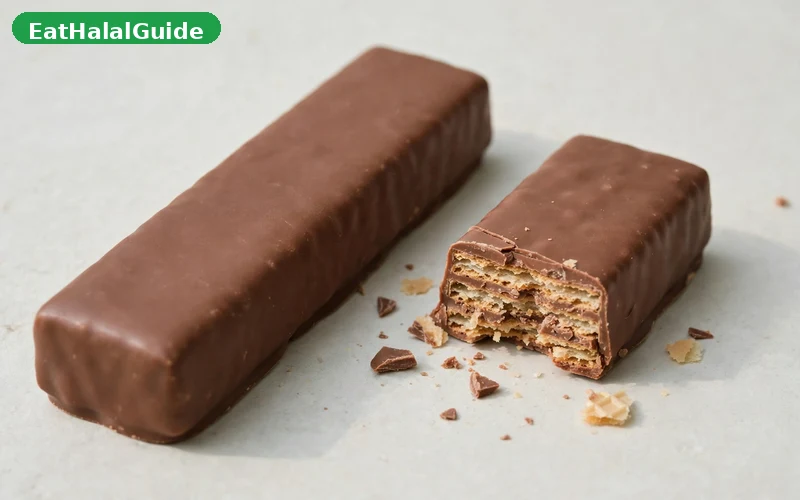
Ask is kitkat halal in uk and the answer is Mushbooh. The current 4-finger label lists sugar, wheat flour, milk powders, cocoa, vegetable fats, whey powder, butterfat, emulsifier (lecithins), yeast, raising agent and natural flavourings. No gelatin, no E476, no E471, no alcohol. Nestlé UK’s vegetarian list includes the 2-finger, 4-finger, Chunky and Bites. That is the short answer to is kitkat halal in uk.
What keeps it Mushbooh is the whey: it appears twice, and whey comes from cheese manufacture, which needs rennet — microbial or animal. No UK statement gives the rennet source for UK-made whey. Nestlé Canada says its whey comes from cheese made with microbial-sourced rennet — but that is Canadian-made, not a York-made bar. The second gap is certification: neither HMC nor HFA has certified UK KitKat, and no halal logo appears on the packaging. Our Is Maltesers Halal or Haram? guide works through the same pattern.
Nestlé Canada says the vanilla flavours in its KitKat use ethyl alcohol as a carrier, “which is removed during the making of the product. There is no alcohol in the finished product” — a carrier, not an ingredient.
KitKat in the USA
Ask is kitkat halal in usa and the answer is also Mushbooh — but for a different reason, and from a different maker: in the United States, KitKat is made by The Hershey Company under licence from Nestlé, and unlike the UK bar, it lists PGPR. Hersheyland’s ingredient list for the classic bar reads: sugar, cocoa butter, wheat flour, chocolate, lactose, skim milk, vegetable oil (palm oil, palm kernel oil), milk fat, and “contains 2% or less of: lecithin (soy), PGPR, vanillin (artificial flavor), salt, yeast, baking soda”. That is the short answer to is kitkat halal in usa.
Three facts decide the US verdict. First, no halal certification: Hershey’s KitKat carries none from IFANCA or any US Islamic body. Second, the PGPR source is undisclosed — Hershey does not state whether its glycerol is plant or animal, the gap our E476 page calls Mushbooh. Third, the pack carries an OU-D kosher mark, and a kosher mark is not a halal certificate.
The US bar contains no gelatin, no whey, no E471 — only soy lecithin and PGPR. The certified KitKats are made in Malaysia and Australia, not Hershey, Pennsylvania.
KitKat in Malaysia, Indonesia, Australia and the Gulf
Malaysia is where the answer changes: ask kitkat halal certified and Malaysia has a real answer — Halal. Nestlé Malaysia states that all confectionery it sells in Malaysia is produced in Malaysia and JAKIM-certified, and its press release names KIT KAT. Its “Our Halal Promise” page says all Nestlé products in Malaysia are certified halal by JAKIM or JAKIM-recognised authorities, and the halal symbol is on the packaging. No certificate number was found, and the certification covers Malaysian-made bars only.
Australia is the second certified market — with a caveat: Nestlé New Zealand’s halal FAQ states: “Our plain milk chocolate KitKat range made in Australia is halal certified” — 2-finger, 4-finger, Chunky, King Size and 170g block; “As of April 2019, KitKat Gold, Chunky Caramel and Dark are also Halal certified.” Two caveats: no certifier is named, and the April 2019 date is more than seven years old — re-confirmation owed.
Indonesia and the Gulf are claimed, not verified. HalalScannerAI says Indonesia’s KitKat comes from Nestlé’s Chembong factory in Malaysia, certified by BPJPH on an MUI ruling — while HalalCodeCheck says KitKat is “produced under MUI certification”, implying Indonesian production. A BPJPH certificate for the Chembong factory was found on Nestlé’s factory site: certificate ID00410000235940222, on an MUI ruling, issued 3 March 2022 and covering KitKat (Finger), Chunky Original, Green Tea, Bites Mix-In, Choco Banana and Gold — but it expired 3 March 2026, and no current certificate was found, so Indonesia remains not verified. The UAE claim is thinner: Nestlé MENA says its Dubai Al-Maha factory holds ESMA halal certification, but no KitKat-specific ESMA certificate was found — do not buy on either claim without seeing the mark on the pack.
KitKat in Japan and Canada
Japan is the market where the flavours decide. Nestlé Japan states in its official FAQ that the KitKat it makes and sells in Japan is not halal-certified, and no Japanese KitKat carries a halal logo. Most flavours list a soy-derived emulsifier and no gelatin, but are uncertified. Two regional flavours are positively unsuitable: Japan Sake (Masuizumi), cream of powdered sake at 0.5% alcohol, and Ume Sake (Tsuruume), cream of powdered plum wine at 0.2% alcohol. As of 2026, no halal-certified KitKat SKU is made or sold in Japan.
Canada has no verdict: the reason is a policy, not a recipe. Nestlé Canada says: “For our Nestlé products sold in Canada, we currently don’t facilitate halal certification; instead, we rely on the home market of our imported products.” The Canadian label lists whey powder and PGPR. Its FAQ says the PGPR in its confectionery “is derived from the castor bean plant and is therefore of vegetable origin”, its whey comes from cheese made with microbial-sourced rennet, and the vanilla flavours in KitKat use ethyl alcohol as a carrier which “is removed during the making of the product”. Those statements cover Nestlé Canada confectionery only, and the bar still carries no halal mark.
The other KitKat bars
The variants change the details, not the verdict. KitKat Chunky uses the same coating as the 4-finger, and its specification lists lecithins only — Mushbooh in the UK, for the same whey reason. KitKat Dark lists plant-origin lecithin and no gelatin — Mushbooh, no certification. KitKat White: HalalHaramWorld claims “pork gelatin” with no source; no other competitor or label agrees — Mushbooh. KitKat V is certified vegan — the strongest plant-only indicator — but still not halal-certified, so Mushbooh. Bites and Minis — Mushbooh.
Special editions differ: one 2023 page lists Chunky Peanut Butter, Cookie Dough and Coconut as containing alcohol, with no label cited — not verified here. Marshmallow and jelly editions can add gelatin. Lindt is the closest parallel — country and variant decide there too: our Is Lindt Chocolate Halal or Haram? guide works through the same split. The rule for every variant: read the pack — halal mark first, then emulsifier, then whey, then any flavouring naming alcohol. Our Halal Sweets listicle checks brands the same way.
The E-number check
On the UK label the additives are named, not coded: E322 lecithin is the UK bar’s emulsifier — soya and sunflower. E476 PGPR is on the US, Canadian, Australian, South African, Brazilian and Indonesian labels — not on the current UK pack. E500 sodium bicarbonate is the raising agent. E471, E330 and E441 gelatin do not appear on any KitKat label retrieved.
Our E-Code Database hub lists only the 10 pilot codes — E322, E412, E418, E476, E102, E415, E410, E211, E330 and E101. E476 PGPR is a hub page, rated Mushbooh; E322 lecithin is a hub page, rated Varies by source. E471, E621 and E120 deep guides are coming next; E422, E110 and E160b are published pages but the hub page still names them in its next-codes list (the hub text was last verified 2026-11-12 and has not been updated yet); E904, E635, E162, E270, E170, E500, E320, E440a and E955 sit on the next-codes list — E500 is on that list, not a live page. E471 is not a hub page at all.
How to check any KitKat bar in 30 seconds
Five checks, in order. First, the halal mark — a JAKIM, MUI, ESMA or other recognised logo settles it at once. Second, the maker: a US bar is made by Hershey, and no Hershey bar is halal-certified. Third, the country — a Malaysian-made bar is JAKIM-certified; a UK, US or Japanese bar is not. Fourth, the emulsifier — “lecithins” is plant lecithin on a UK pack; “PGPR” means the glycerol source is undisclosed. Fifth, the flavour: “sake”, “umeshu”, “liqueur”, “marshmallow” or “gelatin” means a different verdict.
Frequently Asked Questions
Is KitKat halal? No single verdict — it depends on the bar. Malaysia’s is Halal (JAKIM-certified); the UK and USA standard bars are Mushbooh: no certification, no gelatin, one open question each.
Is KitKat halal in the UK? Mushbooh. The current 4-finger label lists no gelatin and no E476 — the emulsifier is lecithins only — but the bar carries no HMC or HFA certification, and the whey rennet is unverified.
Is KitKat halal in the USA? Mushbooh. US KitKat is made by Hershey under licence, not by Nestlé. It lists soy lecithin and PGPR (E476); Hershey does not state the PGPR glycerol source. It carries an OU-D kosher mark — not a halal certificate.
Is KitKat halal certified? Only in some markets. Malaysia’s is JAKIM-certified; Australia-made KitKat is halal certified according to Nestlé New Zealand (no certifier named; April 2019). Indonesia and the UAE are claimed, not verified — Indonesia’s BPJPH certificate expired 3 March 2026; the UK, USA, Japan and Canada bars are not certified.
Is KitKat chocolate halal? The chocolate is the easy part: cocoa butter, cocoa mass, sugar and milk. The halal question is the certification, the whey and, on the US bar, the PGPR — a bar is halal when the pack carries a recognised halal mark.
Does KitKat contain pork gelatin? No — not on the classic bars: no gelatin (E441) appears on any standard UK, US, Canadian, Australian, German or Japanese KitKat label retrieved, and the one page claiming pork gelatin in White Chocolate KitKat cites no source. Marshmallow or jelly editions may differ — check the pack.
Final Thoughts
KitKat is the easiest chocolate bar to buy and one of the hardest to judge: the verdict changes at the border. The Malaysian bar is Halal, JAKIM symbol on the pack. The British bar is Mushbooh: a clean label, lecithin the only emulsifier, no certification, whey of unknown rennet. The American bar is Mushbooh: made by Hershey, PGPR of unknown glycerol source. The Japanese bar is uncertified, its sake flavours alcoholic.
The rule is the pack, not the brand: halal mark first, maker second, country third, emulsifier fourth.
What we could not verify
- JAKIM portal result / certificate number — portal searched 2026-11-17: “KitKat” and “Kit Kat” returned 0 records; “Nestle” returned 10 companies / 186 products. No KitKat certificate number retrieved.
- Nestlé UK “suitable for a Halal diet” list — January 2023 version located via a Scribd upload (not Nestlé’s own site); it states products are not certified unless stated. March 2024 and March 2025 versions not located; competitors quote three different dates (Jan 2023, Mar 2024, Mar 2025).
- MUI / BPJPH (Indonesia) — certificate ID00410000235940222 found on Nestlé’s factory site, valid only to 3 March 2026 (expired); no current certificate found. ESMA (UAE) — Nestlé MENA says its Dubai Al-Maha factory holds ESMA halal certification, but no KitKat-specific ESMA certificate or portal result found.
- HMC / HFA directories — searched directly 2026-11-17: no KitKat entry in HMC site search or HFA results; HalalCodeCheck also records no HMC, HFA or MCB logo on UK KitKat.
- Nestlé Japan FAQ (original, Japanese) — “not halal-certified” and the sake 0.5% / umeshu 0.2% figures via Halal-Navi (last verified 15 Oct 2026); re-checked 2026-11-17, original FAQ still not located directly.
- Australia-made certification — Nestlé NZ’s statement names no certifier and dates from April 2019 (7+ years old); re-confirmation owed.
- E476 / E471 / E503 / E341 on the current UK pack — label sources show none; HalalCodeCheck asserts E476/E503/E341 without a citable label. Re-checked 2026-11-17: still none on the current UK pack.
- Rennet source for UK-made KitKat whey — no UK statement found; only the Nestlé Canada FAQ (microbial rennet, Canada-made). Hersheyland page — opened directly 2026-11-17. KitKat V vegan certification — press-release excerpt only. Chunky alcohol flavours — 2023 claim, no label cited, not verified. PAA — live block captured 2026-11-17: “Is KitKat haram for Muslims?”, “Is KitKat chocolate halal?”, “Do KitKats contain gelatin?”, “Does KitKat have pork fat?”; Google’s AI Overview answers are looser than this article (“generally halal-friendly”; UAE/Pakistan “100% halal”) and cite no primary certificate. Calendar-uk.co.uk — scraped FAQ aggregator, internally contradictory; not cited.
Sources & Verification
| # | Source | What it says | Status |
|---|---|---|---|
| 1 | Nestlé Malaysia — “Our Halal Promise” (nestle.com.my/our-halal-promise-nestl%C3%A9s-commitment-halal-certified-standards) | “All Nestlé products manufactured, imported, and distributed in Malaysia are certified halal by JAKIM (Department of Islamic Development Malaysia) or other JAKIM’s recognised Islamic authorities globally.” “You can verify the halal status of any Nestlé product by visiting the official JAKIM Halal Portal.” | Verified — opened directly 2026-11-17 |
| 2 | Nestlé Malaysia — “Halal Assurance on Nestlé Malaysia’s Products” press release (nestle.com.my/media/pressreleases/allpressreleases/halal_assurance_on_nestle_malaysias_product) | “All Confectionery products sold and marketed in Malaysia by Nestlé Malaysia are produced in Malaysia and have received Halal certification from JAKIM (Department of Islamic Development Malaysia). Some of Nestlé Malaysia’s Confectionery products range is as follows: – Nestlé KIT KAT” | Verified — opened directly 2026-11-17 |
| 3 | Nestlé New Zealand — Halal Products FAQ (nestle.co.nz/ask-nestle/products-brands/answers/products-halal) | “Our plain milk chocolate KitKat range made in Australia is halal certified. This includes the 2 finger (17g), 4 finger (45g), ChunKy (50g), King Size (65g), and 170g block made in Australia, as well as share bags and bulk packs. As of April 2019, KitKat Gold, KitKat Chunky Caramel and KitKat Dark are also Halal certified.” “We don’t use halal certification to promote our products to consumers in Australia, and for this reason we don’t include the halal certification logo on our retail packs.” | Verified — opened directly 2026-11-17 (no certifier named; April 2019 date) |
| 4 | Nestlé Canada — Halal Products & Ingredient Origin FAQ (madewithnestle.ca/help/halal-products-ingredient-origin.html; dated Tuesday, July 29, 2025) | “For our Nestlé products sold in Canada, we currently don’t facilitate halal certification; instead, we rely on the home market of our imported products for that claim.” “The polyglycerol polyricinoleate in our confectionery products is derived from the castor bean plant and is therefore of vegetable origin.” “The vanilla flavours used in our Coffee Crisp ® and Kit Kat ® products use ethyl alcohol as a carrier, which is removed during the making of the product. There is no alcohol in the finished product.” “Our locally produced confectionary products (manufactured in Canada) do not use any rennet.” | Verified — opened directly 2026-11-17 |
| 5 | Nestlé UK — KitKat brand page (nestle.co.uk/en-ie/brands/chocolate-confectionery/kitkat) | “KitKat, the perfect balance of light crisp wafer and smooth chocolate, has been one of the nation’s favourite chocolate bars since its launch in 1935…” “85 years on, York is still the home of KitKat with the world’s biggest KitKat factory making over four million bars every week.” No ingredient list, no halal claim on this page. | Verified — opened directly 2026-11-17 |
| 6 | NHS Supply Chain / Brandbank — KitKat 4 Finger 41.5g spec (media.supplychain.nhs.uk/media/documents/ADT771/Marketing/95182_ADT771_07.04.2025.pdf; Nestlé UK data, target market GB, IE) | Ingredients: “Sugar WHEAT Flour (contains Calcium, Iron, Thiamin and Niacin) Whole MILK Powder Cocoa Mass Cocoa Butter Vegetable Fats (Palm, Shea, Palm Kernel, Sal) Whey Powder Product (MILK) Skimmed MILK Powder Emulsifier (Lecithins) Yeast Raising Agent (Sodium Bicarbonate) Glucose Syrup Butterfat (MILK) Whey Powder (MILK) Natural Flavourings”. “Suitable for vegetarians”. No E476, no E471, no gelatin. | Verified — opened directly 2026-11-17 |
| 7 | Tesco — Kit Kat 4 Finger Milk Chocolate Bar Multipack 41.5g 4 Pack (tesco.com/shop/en-GB/products/292573934) | Ingredients: “Sugar, WHEAT Flour (WHEAT Flour, Calcium, Niacin, Iron, Folic Acid, Thiamin), Skimmed MILK Powder, Cocoa Mass, Cocoa Butter, Vegetable Fats (Palm, Shea, Palm Kernel, Sal), Whey Powder Product (MILK), Butterfat (MILK), Emulsifier (Lecithins), Yeast, Raising Agent (Sodium Bicarbonate), Glucose Syrup, Whey Powder (MILK), Natural Flavourings”. Emulsifier is “Lecithins” only. | Verified — opened directly 2026-11-17 |
| 8 | Hersheyland — KIT KAT® Milk Chocolate XL Candy Bar, 4.3 oz (hersheyland.com/products/kit-kat-milk-chocolate-xl-candy-bar-4-3-oz.html) | “Sugar, Cocoa Butter, Wheat Flour, Chocolate, Lactose (Milk), Skim Milk, Vegetable Oil (Palm Oil, Palm Kernel Oil), Milk Fat, Contains 2% Or Less Of: Lecithin (Soy), PGPR, Vanillin (ARTIFICIAL FLAVOR), Salt, Yeast, Baking Soda”. “Contains: Milk, Soy, Wheat”. No halal mark shown. | Verified — opened directly 2026-11-17 |
| 9 | EWG / LabelINSIGHT — Kit Kat Milk Chocolate label capture (ewg.org/foodscores/products/034000296132-KitKatMilkChocolate/; captured Sep 14, 2026) | “SUGAR, WHEAT FLOUR, COCOA BUTTER, CHOCOLATE, VEGETABLE OIL (PALM OIL, PALM KERNEL OIL), LACTOSE (MILK), SKIM MILK, MILK FAT, CONTAINS 2% OR LESS OF: LECITHIN (SOY), PGPR, VANILLIN (ARTIFICIAL FLAVOR), SALT, YEAST, BAKING SODA.” Corroborates Hersheyland. | Partially verified — search text, 2026-11-17 |
| 10 | Open Food Facts — US KitKat 1.5 oz, UPC 034000247066 (world.openfoodfacts.org/product/0034000247066/milk-chocolate-crisp-wafers-milk-chocolate-kitkat) | “Sugar, Wheat Flour, Cocoa Butter, Chocolate, Vegetable Oil (Palm Oil, Palm Kernel Oil), Lactose (Milk), Skim Milk, Milk Fat, Contains 2% Or Less Of: Lecithin (Soy), Pgpr, Vanillin (Artificial Flavor), Salt, Yeast, Baking Soda”. E476 listed; no E471, no gelatin, no whey. | Partially verified — search text, 2026-11-17 |
| 11 | Open Food Facts — UK KitKat 2 Finger (uk-gd.openfoodfacts.org/product/7613036099400/kit-kat-2-finger-milk-chocolate-biscuit-bars-nestl%C3%A9; via isithalal.food, retrieved 14 Oct 2026) | “sugar, wheat flour…, milk powders (whole and skimmed), cocoa mass, cocoa butter, vegetable fats (palm, shea, mango kernel, sal), lactose and proteins from whey (from milk), whey powder (from milk), butterfat (from milk), emulsifier (lecithins), yeast, raising agent (sodium bicarbonate), natural flavourings” — no E476, no E471, no gelatin. | Partially verified — search excerpt, 2026-11-17 |
| 12 | Open Food Facts — KitKat Chunky (world.openfoodfacts.org/product/3800020412091/kitkat-chunky-imp-nestle) | Four crispy wafer fingers covered with thick milk chocolate (70%). Ingredients list emulsifier (lecithins) and raising agent (sodium bicarbonate); E322 only. No E476, no gelatin. | Partially verified — search text, 2026-11-17 |
| 13 | Open Food Facts — Canada KitKat (world.openfoodfacts.org/product/0059800000031/kitkat-nestle) | Milk chocolate lists “LÉCITHINE DE SOYA, POLYRICINOLÉATE DE POLYGLYCÉROL” (E476) and whey powder. | Partially verified — search text, 2026-11-17 |
| 14 | Orthodox Union — Hershey’s KitKat kosher certificate (via WebstaurantStore PDF; valid through 1/31/2027) | “Brand: Kit Kat • 34000-07695 4-Finger Unwrapped Bulk, 25 lb. OUD3-E80GSKK Dairy -D Symbol required.” Kosher dairy only; not a halal certificate. | Partially verified — search excerpt, 2026-11-17 |
| 15 | JAKIM portal (halal.gov.my) | Verification route cited by Nestlé Malaysia and isithalal.food (“You can verify the halal status of any Nestlé product by visiting the official JAKIM Halal Portal”). Portal searched 2026-11-17: “KitKat” and “Kit Kat” returned 0 records; “Nestle” returned 10 companies / 186 products. No individual “KitKat” portal result was retrieved. | Verified — portal searched 2026-11-17 |
| 16 | halalcodecheck.com — “Is Kit Kat Halal?” (halalcodecheck.com/brand/kitkat/; published 2026-04-24, updated 2026-05-09) | Verdict: “Mushbooh — not verifiably halal without certification”. “E476 is the single point of Mushbooh concern.” UK list given includes “E476, soya lecithin (E322)” and “raising agents (E500, E503, E341)” — contradicted by the current UK pack (rows 6–7). “No gelatin. No E441.” No certificate number or expiry for any certifier named. | Verified — opened directly 2026-11-17 (competitor; UK E476 claim contradicted by label sources) |
| 17 | halalcodecheck.com — “The Complete Guide to Halal Chocolate” (halalcodecheck.com/blog/complete-guide-halal-chocolate/) | “Kit Kat — Nestlé UK confirms no pork-derived ingredients, E471 from plant sources → Halal (mainstream)”. Contradicts its own /brand/kitkat/ page (Mushbooh over E476) and cites E471, which no label retrieved shows. | Verified — search result, 2026-11-17 (competitor; internal contradiction) |
| 18 | halalspy.com — “Is KitKat Halal? UK, Global and Nestlé Certification Explained” (halalspy.com/halal-products/snacks/is-kitkat-halal/; published 2026-06-18, updated 2026-03-19) | “UK KitKat is suitable for a halal diet according to Nestle UK” (intro) vs FAQ “No. KitKat sold in the UK is not halal certified” and UK standard bars listed under “KitKat Products to Avoid”. UK ingredient list given contains no E476. “No pork gelatin, pork fat, or carmine (E120) appears in the standard UK KitKat formulation.” No certificate number or expiry. | Verified — opened directly 2026-11-17 (competitor; self-contradictory on the UK verdict) |
| 19 | halalscannerai.com — “Is Kit Kat Halal? What Muslims Need to Know (2026)” (halalscannerai.com/blog/is-kit-kat-halal; published 2026-07-18, updated 2026-11-05) | “Kit Kat depends on where it was made.” “Nestlé UK’s own dietary list (January 2023) does name the standard KitKat bars as suitable for a halal diet, though not certified.” “Hershey’s makes Kit Kat in the US under licence from Nestlé… The emulsifiers are lecithin and PGPR (E476), and Hershey does not state the source of the PGPR.” “Indonesia’s KitKat is not made locally: it comes from Nestlé’s Chembong factory in Malaysia, with certification from BPJPH on an MUI ruling.” “In the UAE it comes from Nestlé’s Dubai factory and carries ESMA certification.” No certificate number or expiry. | Verified — opened directly 2026-11-17 (competitor). Certificate since found: BPJPH ID00410000235940222, expired 3 Mar 2026 — see “What we could not verify”. |
| 20 | isithalal.food — “Is KitKat Halal?” (isithalal.food/food/kitkat/; published 2026-03-08, updated 2026-11-05) | Verdict “Market-dependent”. “On classic U.S. Hershey milk-chocolate KitKat pages the emulsifiers are soy lecithin and PGPR… not E471.” “A UK two-finger pack lists sunflower and soya lecithin as its emulsifiers… Neither lists gelatin or E471.” “In Malaysia, Nestlé says all Nestlé products manufactured, imported and distributed in the country are certified Halal by JAKIM.” Sources cited with retrieval dates (Hersheyland, JAKIM portal, Nestlé Malaysia). No certificate number or expiry. | Verified — opened directly 2026-11-17 (competitor) |
| 21 | halal-navi.com — “Is KitKat in Japan Halal? A Flavor-by-Flavor Guide” (halal-navi.com/blog/en/is-kitkat-japan-halal-flavor-guide-muslim-travelers-2026/; published 2026-06-22, updated 2026-10-20, last verified 2026-10-15) | “KitKat made and sold in Japan by Nestlé Japan is not halal-certified; Nestlé Japan states this in its official FAQ.” “Japan Sake (Masuizumi) KitKat: the cream uses powdered sake… Nestlé Japan states it contains 0.5% alcohol.” “Ume Sake (Tsuruume) KitKat… contains 0.2% alcohol.” “As of 2026, there is no publicly documented halal-certified KitKat SKU manufactured or sold in Japan by Nestlé Japan.” No certificate number or expiry. | Verified — opened directly 2026-11-17 (competitor; Japan only) |
| 22 | halalharamworld.com — “Is Kitkat Halal? Ingredients, Flavours And Certification” (halalharamworld.com/is-kitkat-halal/; published/updated 2023-02-21) | “the answer is yes – KitKat is generally considered to be Halal-friendly.” “White Chocolate KitKat (contains pork gelatin)” — no source cited. “No, KitKat does not have any alcohol content.” “The brand dates back to 1911 when it was first introduced in the UK.” “Nestle has stated that it can’t guarantee that the products are made with halal ingredients.” No certifier named. | Verified — opened directly 2026-11-17 (competitor; 2023, unevidenced and internally contradictory) |
| 23 | azofficial.org — “Is Nestlé Chocolate Halal? How To Check The Pack” (azofficial.org/is-nestle-chocolate-halal-guide/; no date shown) | “Malaysian KitKat is JAKIM-certified and Indonesian KitKat is MUI-certified; UK and US KitKat carry no halal certification, and US KitKat is made by Hershey, not Nestlé.” “A vegetarian logo is not a halal logo… Similarly, a kosher mark is not a halal certificate.” Sources: “The Holy Qur’an; Sahih al-Bukhari; Sahih Muslim; Nestlé Malaysia; JAKIM”. No certificate number or expiry. | Verified — opened directly 2026-11-17 (competitor; Nestlé-wide guide) |
| 24 | EatHalalGuide — E-Code Database (e-codes/) | Hub table lists only the 10 pilot codes — E322, E412, E418, E476, E102, E415, E410, E211, E330 and E101. E476 PGPR: “Mushbooh — check the source”. E322 Lecithin: “Varies by source”. “Deep guides for E471 (mono- and diglycerides), E621 (MSG) and E120 (carmine) are coming next.” “Codes we have not checked yet” still lists E471, E621, E120, E422, E110, E160b, E904, E635, E162, E270, E170, E500, E320, E440a and E955 (hub text last verified 2026-11-12). | Verified — our own published hub page (live, opened directly 2026-11-17) |
| 25 | EatHalalGuide — Is Chocolate Halal or Haram? | Rates chocolate bars by the same pack-decides rule; KitKat covered as a bar where country and variant decide. | Verified — our own published article |
| 26 | EatHalalGuide — Is Lindt Chocolate Halal or Haram? | Another chocolate brand where the country and the variant decide the verdict. | Verified — our own published article |
| 27 | EatHalalGuide — Is Maltesers Halal or Haram? | A chocolate bar judged halal by ingredients but not certified. | Verified — our own published article |
| 28 | EatHalalGuide — Is Gelatin Halal or Haram? | What E441 is and where it hides. | Verified — our own published article |
| 29 | EatHalalGuide — What Is Halal Food? | Mushbooh explainer. | Verified — our own published article |
| 30 | EatHalalGuide — Halal Sweets | Brand-by-brand sweets checks, KitKat included in the same style. | Verified — our own published article |
Last verified: 2026-11-17