
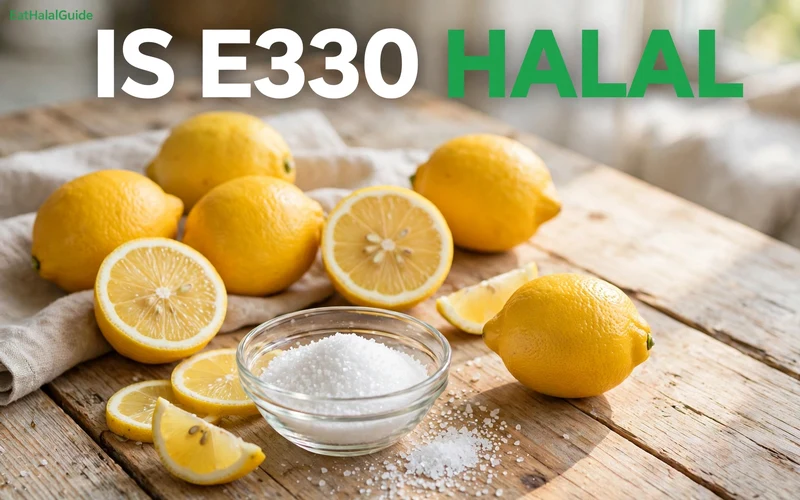

Is E330 halal? Yes — citric acid is halal. The E330 food code is the European code for citric acid, the acid that gives lemons their sour bite, made from fruit juice or by fermentation — never from an animal. The South African National Halaal Authority lists it as Halaal.
If you searched for e330 halal after seeing it on a packet, here is the short answer, the one safety note, and a 30-second label check.
Quick Answer
| Question | Answer |
|---|---|
| Is E330 halal? | Yes — Halal. |
| Is citric acid halal in the UK? | Yes. The UK Food Standards Agency authorises E330, and SANHA lists it as Halaal. |
| Is citric acid halal in the USA? | Yes. The FDA permits it under 21 CFR 184.1033, and its defined routes have no animal source. |
| Is citric acid halal in Canada? | Yes. Health Canada permits it under List 10, item C.16. |
| Does it contain alcohol? | No alcohol as an ingredient. The FDA’s production description names only fruit juice or fermentation — no alcohol anywhere in it. |
| Is it vegan? | Yes, by definition — fruit juice or fermentation of carbohydrate solutions, with no animal source. |
What is E330?
So is citric acid halal? Yes. Citric acid (C6H8O7) is the organic acid that makes lemons and oranges taste sour. As a food additive it does three jobs: it adds sharpness, it keeps acidity steady, and it stops fats and colours going off — JECFA calls these its roles as acidifier, sequestrant and flavouring agent.
Where does citric acid come from?
| Source | Verdict | Why |
|---|---|---|
| Recovery from fruit juice | ✅ Halal | The FDA’s rule names lemon or pineapple juice as a source. |
| Fermentation of carbohydrate solutions | ✅ Halal | The FDA and JECFA both name fermentation using Candida spp. or Aspergillus niger. |
| Animal source | ❌ Does not exist | Neither the FDA nor JECFA names any animal input in the defined routes. |
SANHA lists E330 as “Halaal” — the whole answer in one line: unlike E471 or E476, where the source can be plant or animal, E330 has two defined routes, and both are non-animal. Islamweb’s fatwa 338500 answers the citric acid question directly: “There is no harm in using citric acid in food and beverages.” IslamQA (Hanafi), in its E-numbers answer (AskImam 19202), says most E-number ingredients are halaal — and E330 is in neither its haram list nor its mashbuh list.
One honest limit: the specifications name the organisms and the feedstock type, but not the exact fermentation medium of any single batch. For certainty about one product, choose a halal-marked one or ask the maker — the code itself is halal.
What about the EFSA re-evaluation?
This is a safety question, not a halal one. Europe has not re-evaluated citric acid yet: EFSA put E330 on the priority list of its March 2026 call for data, with a deadline of 30 June 2026. That is a data-gathering step, not an alert. JECFA’s safety limit for it is “Not limited”, set in 1973 and confirmed in its 2014 monograph. A pending safety review is a regulator’s matter, not something that makes the additive haram.
Which foods contain E330?
Health Canada’s list (item C.16) allows it in jams and jellies, canned fruit and vegetables, juices, beer and wine, cheese, and ice cream mix. The FDA allows it in food generally, with no limit other than good manufacturing practice, so it can turn up in almost any processed food.
In practice you will meet it most in soft drinks, sweets and biscuits, jams and sauces, and ice cream.
See Also: Is Sodium Benzoate (E211) Halal or Haram? — the preservative often found with citric acid in soft drinks.
How to check your label in 30 seconds
- Find the code. Look for “E330”, “citric acid” or “INS 330” in the ingredients list.
- Look for a halal mark. A halal mark on the pack settles everything at once.
- No mark? The code is still halal. E330 has no animal version, and its defined routes are fruit juice or fermentation.
- Check the rest of the label. E330 being halal does not make the whole product halal — other additives on the same label are separate questions. See our E102 tartrazine guide.
- The safety note: a pending EFSA re-evaluation is not a halal question — see the section above.
See Also: E-Code Database — every E-number we have checked, with its verdict, in one place.
Frequently asked questions
Is citric acid halal in the UK?
Yes. The UK Food Standards Agency authorises E330, and SANHA lists it as Halaal.
Is E330 the same as lemon juice?
No — but they are closely related. Citric acid is the acid that gives lemons their sour taste, and recovering it from lemon or pineapple juice is one of the two ways of making it; the other is fermentation. Either way, the compound is the same: C6H8O7.
Is E330 vegan?
Yes, by definition. Its defined routes are fruit juice or fermentation of carbohydrate solutions — no animal input anywhere in them.
What is INS 330?
INS 330 is the Codex name for the same additive outside Europe. E330 and INS 330 are the same code for citric acid, and the verdict is the same.
Final Thoughts
The citric acid halal question has a one-word answer: yes. It is made from fruit juice or by fermentation, there is no animal version of this code, and SANHA lists it as Halaal.
Sources & Verification
| # | Source | Status |
|---|---|---|
| 1 | SANHA — Halaal E-Numbers, E330 entry (sanha.org.za) | Verified — opened directly 2026-11-12; “Status: Halaal. Function: Acidity Regulator, Flavouring.” Source: “microbiological fermentation; citrus fruits; pineapple waste”. |
| 2 | FDA — 21 CFR 184.1033, Citric acid (eCFR) | Verified — opened directly 2026-11-12; produced by recovery from lemon or pineapple juice, by mycological fermentation using Candida spp., or by solvent extraction from Aspergillus niger fermentation liquor. GRAS, no limitations other than good manufacturing practice. |
| 3 | JECFA — Citric acid monograph, FAO JECFA Monographs 16 (2014), 79th JECFA | Verified — opened directly 2026-11-12; definition matches the FDA wording; Group ADI “Not limited” (17th JECFA, 1973); functional uses: acidifier, sequestrant, antioxidant synergist, flavouring agent. |
| 4 | Islamweb — Fatwa 338500, “Using citric acid in food and beverages halaal” (islamweb.net) | Verified — opened directly 2026-11-12; “There is no harm in using citric acid in food and beverages.” Named ruling on citric acid itself. |
| 5 | IslamQA (Hanafi) — E-numbers answer, AskImam 19202 (islamqa.org) | Verified — opened directly 2026-11-12; “Most E-number ingredients are halaal”; E330 in neither the haram list (E120, E441, E542, E904) nor the mashbuh list. Scholarly cross-check, not a direct ruling on E330. |
| 6 | Food Standards Agency (UK) — Authorised Regulated Food and Feed Products, E330 (data.food.gov.uk) | Verified — opened directly 2026-11-12; E330 authorised in England, Scotland, Wales; Group I; status change 31 December 2020; last updated 1 April 2025. |
| 7 | Health Canada — List of Permitted Acidity Regulators and Acid-Reacting Materials (List 10), item C.16 | Verified — opened directly 2026-11-12 (archived version, published 2024-12-18); C.16 Citric Acid, acidity regulator, Good Manufacturing Practice, in jams, jellies, marmalades, canned fruit and vegetables, juices, beer, wine, cheese, ice cream mix, and more. |
| 8 | EFSA — Open call for food additives analytical data and use levels (4 March 2026) | Verified — opened directly 2026-11-12 (efsa.europa.eu); E330 on the priority list, data deadline 30 June 2026; the re-evaluation of E330 is still pending. |
Last verified: 2026-11-12
What we could not verify
- IFANCA (USA): the IFANCA FAQ page was opened and searched for “citric” on 2026-11-12 — no citric acid answer or certificate was found.
- HMB (UK): the HMB E-numbers page returned a Cloudflare verification wall on 2026-11-12 and could not be opened directly.
- HMC (UK) and HFA (UK): no E330-specific statement was found on 2026-11-12.
- JAKIM (Malaysia): JAKIM certifies finished products and facilities, not individual additives — there is no E-code-level ruling to cite.
- SANHA source field: the E330 entry’s Source field was read in full at publish on 2026-11-12 and reads “microbiological fermentation; citrus fruits; pineapple waste”.
- Health Canada List 10: the version opened is the archived list published 2024-12-18.
- EFSA re-evaluation: no re-evaluation of E330 exists yet. A secondary site’s claim of a 2017 EFSA re-evaluation conflicts with the EFSA record and was not used.
- The competitor’s foods list was not verified at source — the foods section rests on the Health Canada and FDA lists instead.
- The 2026 NutriNet-Santé association reported by a secondary blog was not verified at source and is not used.


