
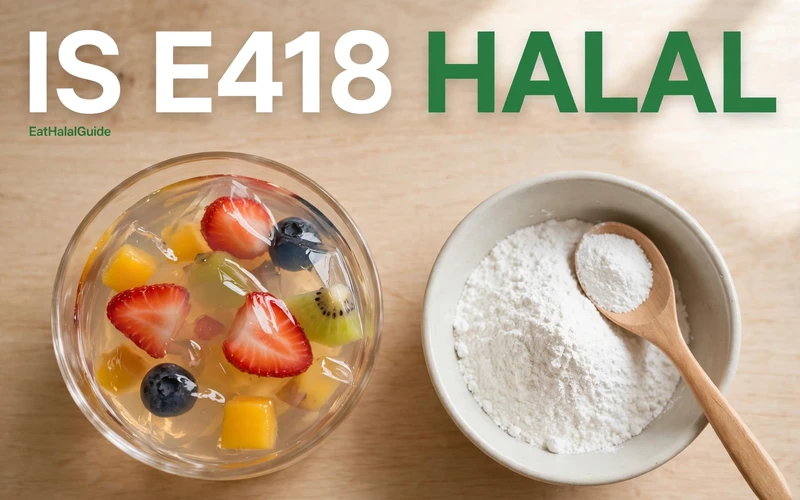

Is E418 halal? Yes — E418 is gellan gum, and gellan gum is halal. It is made by bacterial fermentation of a carbohydrate. SANHA lists E418 as Halaal (“microbiological fermentation”); CP Kelco marks its KELCOGEL gellan gum “Halal approved”. Below: what it is, where it appears, the one thing worth checking, and a 30-second label check. If you came here asking “is gellan gum halal”, the short answer is the same: yes — with one caveat about the fermentation feed, explained below.
Quick Answer
| Source | Verdict |
|---|---|
| Gellan gum (E418) | ✅ Halal |
| Animal-derived E418 | ❌ Does not exist — the code is defined as a bacterial fermentation product |
| Gellan gum from an unknown fermentation feed | ✅ Halal by the code’s definition — but ask the manufacturer if you follow a strict position (see below) |
SANHA rules it Halaal. CP Kelco marks its KELCOGEL gellan gum “Halal approved”, and CINOGEL says its gellan gum is halal-certified on a soya or pea protein feed. No regulator defines an animal-derived E418.
What is E418?
The E418 food code is the European code for gellan gum, a gelling agent, thickener and stabiliser. Its Codex name is INS 418, also sold as Gelrite or Phytagel. It is a long-chain polysaccharide of two glucose units, one glucuronic acid and one rhamnose. EFSA re-evaluated it in 2018 with no safety concern at food levels. It is authorised in the EU and Great Britain, permitted by the US FDA (21 CFR 172.665), and on Health Canada’s permitted list. It is a microbial gelling agent, not one made from animal collagen. Gelatin (E441) is a different additive — see our Gelatin guide.
See Also: Is Guar Gum (E412) Halal or Haram? — another plant thickener.
See Also: Is Xanthan Gum (E415) Halal or Haram? — another fermentation-made gum.
Where does gellan gum come from?
One bacterium, one process: gellan gum is made by Sphingomonas elodea — the bacterium regulators still call Pseudomonas elodea. One production strain, ATCC 31461, is used across the industry. It is grown in a tank on a carbohydrate feed, then the gum is recovered with isopropyl alcohol, dried and milled into an off-white powder. The finished gum contains no living bacterial cells — the FDA requires the process to render it “free of viable cells”.
| Source | Verdict | Why |
|---|---|---|
| Bacterial fermentation of a carbohydrate | ✅ Halal | The only source the regulators define. No animal tissue involved. |
| Animal tissue | ❌ Not a source | No regulator or manufacturer documents an animal-derived gellan gum. |
| Fermentation feed (the medium) | ⚠️ The one variable | Usually sugars plus a nitrogen source. Plant feeds are standard in commercial production; ask the manufacturer if the feed matters to you. |
The fermentation medium — the one thing to check
EFSA describes the fermentation medium only as “a carbon source (usually sugars), nitrogen sources and mineral salts” — the nitrogen source is never named, so the medium is not fixed. Lab media for the production strain sometimes contain peptone. Commercial producers who publish their feed use plant protein: CINOGEL states its feed culture is “Soya protein or Pea protein”. A halal certificate on the gum — or the finished product — settles this: the certifier audits the feed. That is the whole caveat — one input to the process, not the gum itself.
Does gellan gum contain alcohol?
No alcohol in the gum itself. It is recovered with isopropyl alcohol, which is then removed; the FDA and JECFA both cap any residue at 0.075% (750 mg/kg). The alcohol is a processing aid, not an ingredient, and the finished gum is not an alcoholic product.
Which foods contain E418?
Gellan gum sets gels at as little as 0.05%. You will find it in dessert gels and jellies, jams and fruit preparations, dairy drinks and plant milks, yogurt and dairy desserts, frostings and bakery fillings, confectionery and aspics, and suspension drinks with fruit pulp. It is also the gelling agent in many vegan jelly sweets, where it replaces gelatin.
How to check your label in 30 seconds
- “Gellan gum”, “E418”, “INS 418”, “Gelrite” or “Phytagel” — the same additive.
- E418 itself needs no further check. Unlike E471 or gelatin, there is no animal version.
- Look for a halal mark: a recognised logo (SANHA, IFANCA, HMC, HFA, JAKIM) means the whole product, feed included, has been audited.
- Check the rest of the label: gelatin (E441), E471, carmine (E120), flavours and meat are where the real questions live.
- If still doubtful, ask the manufacturer what feeds their fermentation.
See Also: E-Code Database — every E-number we have checked, with its verdict, in one place.
Frequently asked questions
Is E418 halal?
Yes. Gellan gum is made by bacterial fermentation of a carbohydrate. SANHA lists E418 as Halaal.
Is gellan gum the same as E418?
Yes. E418 is the European code (INS 418 is the Codex number used outside Europe), also sold as Gelrite or Phytagel.
Does gellan gum contain alcohol?
No. It is purified with isopropyl alcohol, which is then removed; regulators cap any residue at 0.075%.
Is E418 halal in the USA, UK and Canada?
Yes, in all three. The US FDA lists it as a permitted food additive (21 CFR 172.665), the UK Food Standards Agency lists it as authorised, and Health Canada includes it on its permitted list. The same definition applies in each country.
Final Thoughts
E418 is one of the simpler E-codes: the gellan gum halal question has a one-word answer — yes. One source — a bacterium fermenting a carbohydrate — and that source is not an animal. SANHA says it directly, regulators in the US, UK, EU and Canada agree, and certified products exist. The only second look is the fermentation feed — and a halal mark answers that. On a label, watch everything else.
Sources & Verification
| # | Source | What it says | Status |
|---|---|---|---|
| 1 | SANHA — Halaal E-Numbers, E418 (Gellan gum), sanha.org.za | “E-number: 418 Name: Gellan gum … Function: Thickener, Stabiliser Status: Halaal Source: microbiological fermentation.” | Verified — opened directly 2026-11-12 |
| 2 | FDA — 21 CFR 172.665, Gellan gum (eCFR) | “The additive is a high molecular weight polysaccharide gum produced from Pseudomonas elodea by a pure culture fermentation process and purified by recovery with isopropyl alcohol.” Strain nonpathogenic and nontoxic; process renders it free of viable cells; residual isopropyl alcohol not to exceed 0.075%. | Verified — opened directly 2026-11-12 |
| 3 | EFSA — Re-evaluation of gellan gum (E 418) as a food additive, EFSA Journal 2018;16(6):5296 | “Gellan gum (E 418) is a high molecular weight polysaccharide gum produced by a pure culture fermentation of a carbohydrate by strains of P. elodea … produced by only one bacterial strain ATCC 31461.” No numerical ADI needed; no safety concern. Authorised in the EU under Regulation (EC) No 1333/2008. | Verified — opened directly 2026-11-12 (full text via PubMed Central) |
| 4 | JECFA — Gellan gum monograph, 49th JECFA (1997), FAO | “Gellan gum is a high molecular weight polysaccharide gum produced by a pure culture fermentation of a carbohydrate by Pseudomonas elodea, purified by recovery with isopropyl alcohol, dried, and milled.” SYNONYM INS No. 418; isopropyl alcohol not more than 750 mg/kg. | Verified — opened directly 2026-11-12 |
| 5 | CP Kelco — KELCOGEL HA-B Gellan Gum, Product Data Sheet (Doc. 607-X, 21 October 2022) | “Food grade gellan gum, CAS: 71010-52-1; E418 … Kosher approved; Halal approved.” Regulatory list includes 21 CFR § 172.665 (USA), Canadian Food and Drug Law (Item G.2, Table IV), JECFA. | Verified — opened directly 2026-11-12 |
| 6 | CINOGEL Biotech — Low Acyl Gellan Gum product page, cinogel.com | “Feed Culture: Soya protein or Pea protein.” “ISO, KOSHER, HALAL certified, 100% pure and NON-GMO.” Complies with 21 CFR § 172.665 (USA), Canadian Food and Drug Law (Item G.2, Table IV), EU purity criteria, JECFA. | Verified — opened directly 2026-11-12 |
| 7 | Food Standards Agency (UK) — Approved additives and E numbers, food.gov.uk | Section 6, “Emulsifiers, stabilisers, thickeners and gelling agents”: “E418 — Gellan gum”. Additives permitted under assimilated Regulation (EU) 1333/2008. | Verified — opened directly 2026-11-12 |
| 8 | Health Canada — List of Permitted Emulsifying, Gelling, Stabilizing or Thickening Agents (List 4) | Gellan Gum listed as a permitted emulsifying, stabilizing or thickening agent (subitem G.2), including use in aspics, unstandardized fruit spreads and processed fruit products (3,000 ppm), beverage whiteners and unstandardized confectionery. | Verified — opened directly 2026-11-12 |
Last verified: 2026-11-12.
What we could not verify
- IFANCA (USA): no IFANCA live certificate for gellan gum was found on 2026-11-12. A secondary copy of a 2019 IFANCA certificate for CP Kelco gellan gum expired on 31 January 2020.
- HMC (UK) and HFA (UK): no E418-specific statement was found on 2026-11-12.
- JAKIM (Malaysia): JAKIM certifies finished products and facilities, not individual additives — no E-code-level ruling exists.
- A named fatwa on gellan gum: no specific fatwa (for example from IslamQA / Darul Ifta) surfaced on 2026-11-12.
- Fermentation-medium composition for a given product: EFSA names the medium only as “a carbon source (usually sugars), nitrogen sources and mineral salts” — a label never says what fed the fermentation.
- CP Kelco certificate details: the CP Kelco data sheets say “Halal approved” but name no certifying body, certificate number or expiry — manufacturer evidence only.


