
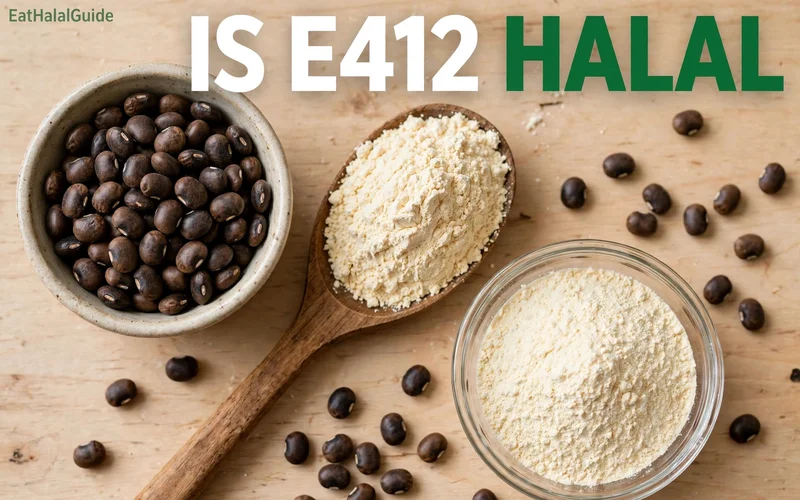

Is E412 halal? Yes — E412 is guar gum, and guar gum is halal. It is the ground endosperm of the guar bean, a legume grown mainly in India and Pakistan, with no animal-derived version. IFANCA answers the ‘is guar gum halal’ question directly in its FAQ: guar gum “is considered to be Halal since the source is from plant origin.” The rest of this page shows you what E412 is, where it appears, and how to check any packet in 30 seconds.
Quick Answer
| Source | Verdict |
|---|---|
| Guar gum (E412) | ✅ Halal |
| Animal-derived E412 | ❌ Does not exist — the code is defined as guar bean endosperm |
| Clarified guar gum | ✅ Halal — purified with an alcohol wash that is evaporated off (see below) |
IFANCA’s FAQ answers it directly. Ingredion’s guar gum is IFANCA Halal-certified until 30 September 2027, and Penta lists its guar gum as Halal-compliant, with no animal-derived ingredients known.
What is E412?
The E412 food code is the European code for guar gum, a thickener, stabiliser and emulsifier. Its Codex name is INS 412, and it is also sold as guaran or guar flour. Food-grade guar gum is about 80% guaran, a galactomannan. EFSA re-evaluated it in 2017 and found no safety concern at food levels, with no intake limit set. It is authorised in the EU and Great Britain, listed as GRAS by the US FDA (21 CFR 184.1339), and on Health Canada’s permitted list. Guar gum is a plant thickener, not a gelling agent made from animal collagen. Gelatin (E441) is a different additive with a different answer — see our Gelatin guide.
See Also: Is Xanthan Gum (E415) Halal or Haram? — another plant thickener.
See Also: Is Locust Bean Gum (E410) Halal or Haram? — another plant thickener from a seed.
Where does guar gum come from?
The guar plant, Cyamopsis tetragonoloba, is a legume, like peas and beans. Its seeds are screened, split in a mill into endosperm halves, the germ sifted off, and hot air loosens the hull, leaving pure endosperm (85–95% galactomannan) milled into the pale powder sold as guar gum. The whole route is mechanical, with no animal input at any stage.
| Source | Verdict | Why |
|---|---|---|
| Guar bean endosperm | ✅ Halal | Plant. The only source the regulators define. |
| Animal tissue | ❌ Not a source | No regulator or manufacturer documents an animal-derived guar gum. |
| Clarified guar gum | ✅ Halal | Same plant source. Purified by dissolving in hot water and recovering with an ethanol or isopropanol wash, then evaporation and drying. |
Its small protein fraction (about 5–6%) is plant protein from the seed itself.
Does guar gum contain alcohol?
No alcohol in the gum itself — the standard route above is mechanical, with no alcohol involved. A purified grade, “clarified” guar gum, is dissolved in hot water and recovered with an ethanol or isopropanol wash, then evaporation and drying; JECFA caps any residual alcohol at 1% in the finished powder. The alcohol is a processing aid, not an ingredient, and the finished gum is not an alcoholic product. If you follow a strict position on any alcohol contact in processing, ask the manufacturer whether their guar gum is the clarified grade.
Which foods contain E412?
Guar gum is a widely used thickener: ice cream, yogurt, processed cheese, salad dressings and sauces, soups and gravies, baked goods and cereals, gluten-free bread and pasta, jams and jellies, chewing gum and confectionery, dairy desserts, and plant-based meat and dairy analogues.
How to check your label in 30 seconds
- Read the thickener line. “Guar gum”, “E412”, “INS 412”, “guaran” and “guar flour” are the same additive.
- E412 itself needs no further check. Unlike E471 or gelatin, there is no animal version — the code is defined as guar bean endosperm.
- Check the rest of the label. Gelatin (E441), E471, carmine (E120), flavours and meat are where the real questions live.
- Check for a halal mark. A recognised halal logo (IFANCA, HMC, HFA, JAKIM) means the whole product has been audited.
- If the product is otherwise doubtful, ask the manufacturer — E412 alone is not a reason to avoid it.
See Also: E-Code Database — every E-number we have checked, with its verdict, in one place.
Frequently asked questions
Is E412 halal?
Yes. Guar gum is the ground endosperm of the guar bean, a plant, and IFANCA says it “is considered to be Halal since the source is from plant origin.”
Is guar gum the same as E412?
Yes. E412 is the European code (INS 412 is the Codex number used outside Europe), also sold as guaran or guar flour.
Does guar gum contain alcohol?
No. A purified “clarified” grade may be washed with ethanol or isopropanol, but the wash is followed by evaporation and drying, and JECFA caps any residue at 1% — the finished powder is not an alcoholic product.
Is E412 halal in the USA, UK and Canada?
Yes, in all three. The US FDA lists it as GRAS (21 CFR 184.1339), the UK Food Standards Agency lists it as authorised, and Health Canada includes it on its permitted list. The same plant definition applies in each country.
Final Thoughts
E412 is one of the simplest E-codes to settle, and the guar gum halal question has a one-word answer: yes. It has one source — the guar bean — and that source is a plant. IFANCA says it directly, regulators in the US, UK, EU and Canada define it the same way, and certified products exist. On a label, watch everything else in the product.
Sources & Verification
| # | Source | What it says | Status |
|---|---|---|---|
| 1 | IFANCA — Frequently Asked Questions (Q10), ifanca.org | “I want to know the source of guar gum. Is it Halal or Haram? … Guar gum is considered to be Halal since the source is from plant origin.” | Verified — opened directly 2026-11-12 |
| 2 | EFSA — Re-evaluation of guar gum (E 412) as a food additive, EFSA Journal 2017;15(2):4669 | Guar gum is the ground endosperm of the seeds of the guar plant (Cyamopsis tetragonoloba). No numerical ADI needed; no safety concern for the general population. Authorised in the EU under Regulation (EC) No 1333/2008. | Verified — opened directly 2026-11-12 (full text via PubMed Central) |
| 3 | JECFA — Guar Gum monograph, 53rd JECFA (1999), FAO | “Primarily the ground endosperm of the seeds from Cyamopsis tetragonolobus (L.) Taub., (Fam. Leguminosae)… galactomannans; mannose:galactose ratio is about 2:1.” ADI “not specified” (19th JECFA, 1975). Purification may use ethanol/isopropanol washing followed by evaporation and drying; residue capped at 1%. | Verified — opened directly 2026-11-12 |
| 4 | FDA — 21 CFR 184.1339, Guar gum (eCFR) + Substances Added to Food | “Guar gum is the natural substance obtained from the maceration of the seed of the guar plant, Cyamopsis tetragonoloba…” GRAS; CAS 9000-30-0; listed uses include baked goods, cheese, milk products, soups and sauces. | Verified — opened directly 2026-11-12 |
| 5 | Ingredion — IFANCA Halal Certificate, Belcamp, Maryland (Doc. 1341.12864.II260079, dated 15 October 2026) | Guar gum products listed as Halal-certified, including GuarNT® Guar gum (HC-25INDO18), GuarNT® USA 8/22 (HC-25INO501) and Pre-Hydrated® Guar Gum (HC-25INB597). Certificate valid until 30 September 2027. | Verified — opened directly 2026-11-12 (scanned PDF; certificate number, validity date and guar product lines confirmed in the document) |
| 6 | Penta Fine Ingredients — Halal Statement, Guar Gum NF Grade (Doc. 07-62005-HAL, issued 17 July 2026) | “GUAR GUM NF GRADE … is recognized by Penta Fine Ingredients, Inc. as Halal-compliant.” Halal status: Approved. Animal-derived ingredients: None known. Certifying authority not named in the document. | Verified — opened directly 2026-11-12 |
| 7 | Food Standards Agency (UK) — Guar Gum, NOVEL-69 | “Native guar gum is the ground endosperm of seeds from natural strains of guar Cyamopsis tetragonolobus L. Taub.” Status: Authorised in England, Scotland and Wales. Labelling must say “Guar Gum”. | Verified — opened directly 2026-11-12 |
| 8 | Health Canada — List of Permitted Emulsifying, Gelling, Stabilizing or Thickening Agents (List 4) | Guar Gum listed as a permitted emulsifying, gelling, stabilising or thickening agent (subitem G.3), including use in bread, canned vegetables, ice cream mix and other foods. | Verified — opened directly 2026-11-12 |
Last verified: 2026-11-12.
What we could not verify
- SANHA (South Africa): SANHA’s E412 entry could not be opened directly on 2026-11-12 — no SANHA page for E412 surfaced in search. A secondary page quotes it as “Status: Halaal. Source: pea extract.” That wording was not confirmed at source, and the verdict in this page does not rely on it.
- HMC (UK) and HFA (UK): no E412-specific statement was found in search on 2026-11-12.
- JAKIM (Malaysia): no E-code-level ruling exists to cite. JAKIM certifies finished products and facilities, not individual additives.
- A named fatwa on guar gum: no specific fatwa (for example from IslamQA / Darul Ifta) surfaced in search on 2026-11-12. The ruling in this page rests on IFANCA’s published FAQ answer.
- Bone char in processing: one vegan site suggests guar gum processing “may involve animal-based products, such as bone char.” No primary source supports this — the EFSA/JECFA manufacturing descriptions list only mechanical separation and water/alcohol washing. The claim was not relied on.


